Parsley Caterpillars
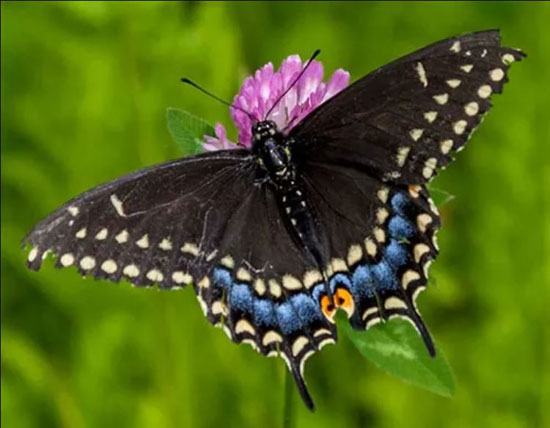
Female Black Swallowtail
What are the black and yellow caterpillars eating my parsley?
These are the larvae of the swallowtail butterfly (Papilio polyxenes). The larvae feed on several plants in the carrot family, Apiaceae. These include caraway, carrot, celery, parsley, parsnip, sweet fennel, caraway and dill, along with common roadside wildflowers like Queen Anne's lace. The butterfly eats nectar from a variety of plants including clover, milkweed, thistles, and phlox. This is one of the easiest butterflies to lure to your own backyard, just by planting a bed of these herbs in a sunny spot.
Master Gardener John Peterson says they will quickly defoliate the parsley and then move on to another plant. His advice is “Don’t kill the caterpillar, the parsley will survive and regrow.”
Tiny swallowtail caterpillars cause almost no noticeable damage, but as they get older, each stage eats more than the last so that whole stands of parsley may be decimated. Because the only job of an adult butterfly is to mate and lay eggs, most butterflies do not live that long. This is why it’s so essential for caterpillars to store up as much food as possible so that they can live as healthy adults.
The older larvae are easily identifiable as green caterpillars with a brilliant, yellow dotted black band across each body segment. When the caterpillar is disturbed, it protrudes a pair of fleshy “horns,” the better to scare predators away. This larval stage of the gorgeous black swallowtail can grow up to 2 inches (5 cm.) long.
Although many may regard these “worms” as a nuisance, they should be treated with care as these “worms” are actually the larvae of the Black Swallowtail (Papilio polyxenes) butterflies. These butterflies not only grace your garden with their beauty, but they are also important pollinators. Although “parsley worms“ are voracious eaters, the benefit of attracting a future pollinator (and a stunning one at that) may outweigh worm control practices on parsley. Just plant a few more parsley, dill, or whatever the insects are feeding on. Healthy plants will usually recover from the foliage loss and parsley worms will not sting or bite humans.
Swallowtail Butterfly Life Cycle
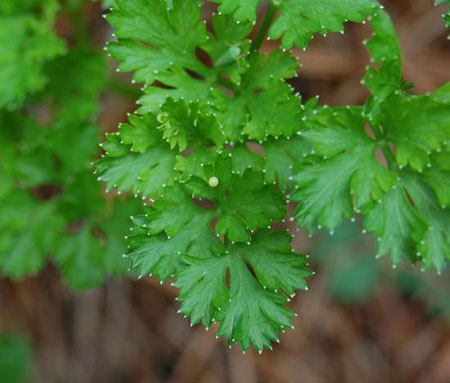
Black Swallowtail Butterfly Egg
Female black swallowtail butterflies are slightly larger than males and, as is usual in nature, a bit duller in color than their male counterparts. The wingspan may be up to 76 mm (3 in.). Both are velvety black in color with tailed hind wings marked with peacock-like eyes.
The females lay spherical, 1 mm (0.05 in.) across eggs that change in color from pale yellow to reddish-brown. Each egg will be laid individually on a host plant, often near the ends of the leaves. Each individual female may lay 200-400 eggs, although they tend to spread those eggs out over a relatively large area. The eggs are tiny yellow spheres on leaves and stems and turn brown before hatching (actually, it’s turning translucent and the brown is the caterpillar seen through.)
Four to nine days later, the eggs hatch and young larvae (instars) emerge and begin feeding. The caterpillar that emerges is black with a white band around its middle. As it grows, it develops reddish orange spikes on its body. Later, the white band disappears and the caterpillar develops green and black bands with yellow spots.
The caterpillar will feed on dill, parsley, carrot, and fennel for about 3-4 weeks. They will then find a branch, or twig and form a chrysalis, which will be pale green in color. The pupa or chrysalis is around 32 mm (1.25 in.). long. During most of the summer, black swallowtail chrysalises are green to blend in with all of the green leaves and other vegetation. However, as the day length gets shorter and the last generation gets ready to overwinter, the chrysalises that the black swallowtails make will be brown instead of green in order to more easily blend in with the dead leaves and vegetation throughout the winter. These pupae can overwinter attached to stems or fallen leaves and emerge as butterflies in April-May.
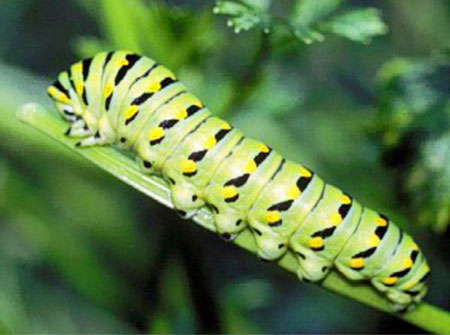
Black Swallowtail Butterfly Caterpillardc
When forming the chrysalis, the transformation is quite amazing. The caterpillar will find its spot, and hang in a ‘j’ formation for several days before it pupates. The pupating process only takes a few minutes. While inside the chrysalis, changes in the caterpillar cells unlock complex chemical processes responsible for the radical transformation of its body into a butterfly. Scientists (entomologists) can now peer into the chrysalis and watch the transformation as the different parts start to form and grow. The new organs, wings, antennae, and legs form while in the chrysalis stage. The wings are usually visible about 24 hours before it hatches. When they hatch, they are soft, and pump blood into their wing veins, which then harden for flight.
The butterfly will eclose (emerge from its chrysalis) after 10-20 days.
The black swallowtail has two generations a year. The first group of butterflies emerges between late April and early June after having overwintered in the chrysalis. The life cycle of the butterflies that hatch in the spring/summer is approximately 6-14 days. This is the first adult butterfly generation. It pupates for 9-11 days. The second group of butterflies emerges in the late summer. The second generation mates, and their eggs become the first generation the next spring and the life cycle begins all over again, with the chrysalis of the last generation overwintering to emerge the following spring.
