How to Unclog a Toilet (using a plunger or auger)
A poor flush means that your toilet drain is partially or completely plugged. Most clogged toilets are what are known as “slow drainers.” That is, flush water partially fills the bowl but doesn’t rush out and clean away the waste. The water level remains high, then usually drains down to normal height within a minute or two. You might not even know the toilet is clogged until you flush it. So if you suspect a problem, test the drainage first, then reach for the toilet plunger.
Warning: A plunger should never be used to unclog a toilet that has been blocked with a washcloth or diaper or any object that can easily get pushed deeper into a drainpipe. Doing so might worsen the problem. You can use a closet type of auger to remove such objects.
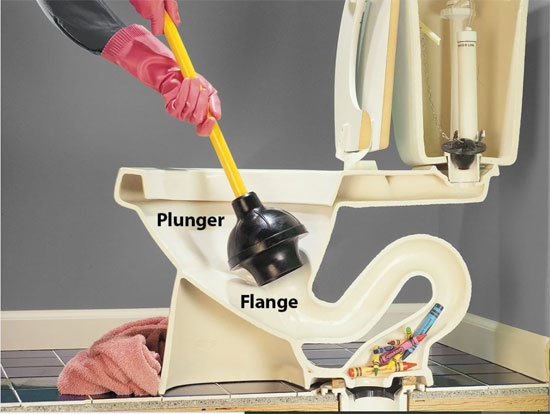
Plunger
Tip: Run the plunger under hot water before using it. This will soften it up, which will help with create a seal.
In most cases, toilet clogs can be cleared with the proper use of a plunger—but not just any plunger. There are two common types of household plunger. A cup plunger is the most common type, featuring a rubber cup with a flat rim attached to a handle. It is designed for clearing sink, bathtub, and shower clogs.
The other type of plunger is a toilet plunger, also called a flanged plunger or closet plunger. This type has a uniquely different shape, with a narrowed bottom that is designed to fit into the hole in the toilet bowl and a larger cup that seals around the outside of the hole to create a good seal. Some styles allow the rim of the cup to be tucked up inside the cup so the tool can also be used as a standard plunger.
- Prepare the Plunger
Make sure the plunger completely covers the hole. Add water to the toilet bowl, as needed, until it is about half full. The plunger should be submerged in water to ensure a seal around the drain opening and be effective.
Make sure the flange (the narrow portion) at the bottom of the plunger cup is extended. The flange on many toilet plungers can be folded up into the cup so that you can use the plunger for sinks and tubs. It should always be extended for toilets.
- Position the Plunger
Lower the plunger into the bowl at an angle so the plunger cup fills with water as you lower it; this increases the plunging force. Fit the cup over the drain opening in the bottom of the bowl so the flange is inside and the cup seals around the outside of the hole. - Pump the Plunger
Push down on the plunger repeatedly with swift, powerful thrusts, sending enough pressure down the drain to loosen the obstruction. Maintain a good seal throughout the motions. When the plunger comes up, it creates a suction effect that helps loosen the clog; when it goes down, it pushes the clog down the drain.
Pull the plunger out of the hole after five or six thrusts. If most of the water is gone from the bowl, you've probably cleared the clog. - Test the Toilet
Remove the lid from the toilet tank. Flush the toilet to see if the clog has cleared, but be ready: If the bowl looks like it will overflow, quickly reach into the tank and push down the flapper (the rubber flap that covers the hole in the bottom of the tank). This stops the flow of water to the bowl to prevent an overflow.
Repeat the plunging and flushing process until the clog is gone.
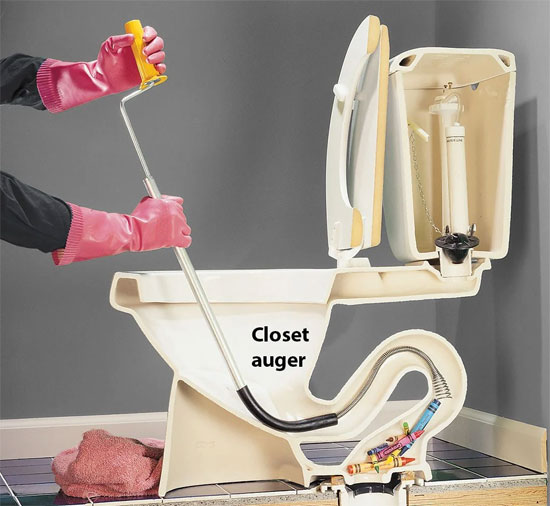
Auger/Plumbing Snake
A plumbing snake (also sometimes called a "flexible cleaning tool" or "auger") is a flexible coil of wire that can "snake" through the curves of a drain and get deeper than a wire can. The best snake is a "closet auger" which is designed specifically to clear toilet clogs without damaging or staining the bowl. A plumber would likely use a closet auger.
- Prepare the Auger
Retract the auger cable so that the tip of the cable is at the end of the guide tube. Insert the guide tube into the toilet, so that the sweep elbow rests at the bottom of the bowl and the cable end reaches into the drain opening. - Crank the Auger
Crank the handle of the auger clockwise while gradually pushing the cable into the toilet trap until the cable goes no further. Crank slowly to ensure that the cable does not kink and double-back on itself inside the toilet.
If necessary, you may need to reverse the cranking direction to coax the cable through the bends of the toilet drain. After the auger cable has been fully extended, you likely will have broken through the clog. - Extract the Cable
Slowly pull the cable back out of the toilet while rotating the handle. Be gentle with this action to avoid scratching the fixture.
Flush the toilet to make sure the clog has cleared.
You may need to twist and push the snake through the obstruction. The goal is to break up the obstruction into smaller pieces that can move through the pipes. It may take a few minutes of maneuvering to clear the obstruction. Once the water drains, flush the toilet to see whether it drains as quickly as normal.
When to Call a Plumber
If both a plunger and an auger fail to remove the clog from your toilet, you will probably need to call a plumber, as it is likely the clog lies beyond the reach of the auger. If you see water backing up into other drains in your home (the bathtub, for example) when the toilet flushes, this can be the sign of a serious problem.
