Homemade Cream Cheese
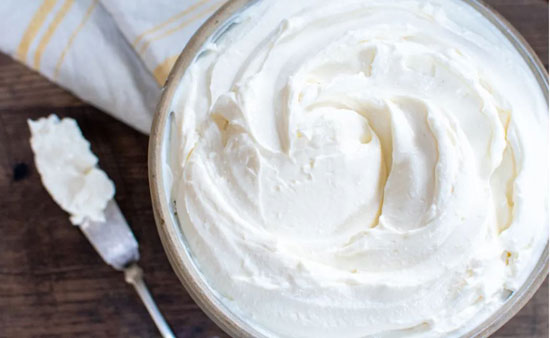
By the mid-1800s, many American dairy farms were producing a fresher, un-aged version of what in Europe was known as Neufchatel. The dairy product we call cream cheese was invented around 1875 by dairy farmer William Lawrence of Chester, New York. He purchased an operating Neufchâtel factory in the area and began experimenting as one of his major clients, a prestigious New York City grocery store, was asking for a richer cheese spread. Lawrence boosted the cream content in the recipe used at his factory and created something new.
Note: French Neufchâtel is a soft, slightly crumbly, mold-ripened, bloomy-rind cheese similar to Camembert and Brie. American Neufchâtel is a lighter version of American cream cheese.
It was not marketed as "Philadelphia Cream Cheese" until 1880. That year, Lawrence partnered with A.L. Reynolds, a cheese distributor in New York to sell larger quantities of cream cheese. At the time, Philadelphia, PA, and the surrounding area had a reputation for its high-quality dairy farms and creamier cheese products, so they decided to use the name "Philadelphia" on the foil-wrapped blocks of their cream cheese. He was one of the earliest individuals to brand a food of any kind.
Cream Cheese can be made with or without rennet but it is best to use rennet. The cheese loses its whey more easily, the flavor is often slightly better, and you will have greater volume of finished product.
Because vinegar is used to develop the curds in the no-rennet homemade cream cheese (rather than a microbial starter or rennet, as is often the case with store-bought), this homemade cream cheese has a pleasantly sour, tangy finish. The texture is thick and rich, but does not have the bouncy texture that commercial cream cheese may have from the added gums and stabilizers.
Note: Ingredients in Philadelphia Cream Cheese do NOT include rennet: Pasteurized Milk and Cream, Salt, Carob Bean Gum (thickener, stabilizer and emulsifier), Cheese Culture
Troubleshooting
Why is my cream cheese grainy?
The milk was overheated due to inaccurate timing, which tends to separate fat from the cheese. This can be avoided in commercial production by adding stabilizers such as carob bean gum, guar, or carrageenan to make it creamier and smoother.
How To Make Cream Cheese (without rennet)
from https://www.thekitchn.com/
2 cups whole milk (not ultra-pasteurized)
1/2 cup heavy cream
3 tablespoons distilled white vinegar
1/4 teaspoon kosher salt, plus more as needed
Heat the dairy. Place 2 cups whole milk and 1/2 cup heavy cream in a small stainless steel saucepan over medium heat until tiny bubbles form around the edge of the pan, a translucent film develops over the surface of the milk, and an instant-read thermometer registers 190°F, about 8 minutes.
Add the vinegar. Remove the saucepan from the heat. Add 3 tablespoons distilled white vinegar and stir to combine. Let sit at room temperature for 1 hour to let the small curds separate from the thinner whey.
Prepare for straining. Meanwhile, run an 18x18-inch piece of finely-woven cheesecloth or butter muslin under water, then squeeze out the excess moisture. Lay the cheesecloth in a single layer in a fine-mesh strainer and fit over a large bowl.
Strain the curds. Gently pour the curds and whey into the cheesecloth. Let drain at room temperature until no more whey drips into the bowl (the bottom of the strainer should not touch the liquid in the bowl), about 20 minutes. Discard the whey or reserve it for another use.
Drain in the refrigerator. Gather up the sides of the cheesecloth into a bundle, twist the bundle a few times, and tie closed with kitchen twine. Suspend over the now-empty bowl so that the bundle does not touch the bottom of the bowl (one way is to tie the bundle onto a chopstick and lay the chopstick across the top of the bowl). Refrigerate until no more whey drips and the cheese is your desired consistency, 1 1/2 to 2 hours.
Season the cream cheese. Transfer the cream cheese to a small bowl. Add 1/4 teaspoon kosher salt and stir to combine. Taste and season with more kosher as needed.
Storage: Transfer to an airtight container and refrigerate for up to 7 days.
Makes about 1 cup
Homemade Cream Cheese
from https://cheesemaking.com/
If you’ve made Greek yogurt, you can make homemade cream cheese. How’s that for a confidence boost? This is a fun and easy cheese to make at home. Cream cheese is similar to Neufchatel from France except that cream cheese has more butterfat, starting with a high fat milk of about 7-10%.
Just like in yogurt making, you heat the milk, add an appropriate culture, set it aside and allow it to coagulate. Once that’s done, simply strain out the whey until it’s thick.
You do not need rennet to make homemade cream cheese! But you should bear in mind that, like yogurt, the longer you let cream cheese sit during incubation, the tangier it gets. For this reason, I’ll also be giving you optional instructions for adding a few drops of rennet to speed the coagulation process along for a less tangy product. This it totally optional!
About the Milk & Cream
Most cream available is ultra-pasteurized. This is not a problem, though, because the cream portion is just for the butterfat.
The milk portion will provide the proteins for curd formation and should NOT be ultra-pasteurized.
1 gallon whole milk
1 pint heavy cream
1/8th teaspoon Aroma B culture (or Flora Danica)
4-8 drops liquid rennet, optional
1 teaspoon sea salt
Warm your milk and cream to 86F.
Sprinkle the culture over the surface of the milk and allow a minute for it to rehydrate.
Thoroughly stir the culture in for two minutes.
Add the rennet, if you’ll be using it, and gently stir with an up and down motion for 30 seconds to thoroughly mix it in.
Cover the pot and set it aside where it can sit completely undisturbed for the next 12-24 hours if using rennet, 24-48 hours if no rennet was used.
The curds are ready when you see droplets of whey begin to form on the surface and the curd mass starts to pull away from the side of the pot. Check for a clean break by slipping a knife just into the top of the curd mass and lifting it up.
Using a slotted spoon, carefully transfer large slices of the curd to a cheesecloth-lined colander that is sitting in a large bowl.
Allow the whey to drain out for 1-2 hours.
Tie up the corners of the cheesecloth and hang it in a warm area for 12-24 hours. Scrape the sides of the cheesecloth every 4 hours to move the cheese from the outside to the center and vice versa until you get the desired texture.
How long you allow the cheese to drain entirely depends on what consistency you prefer. Just remember that the longer you allow the cheese to drain, the more sugars the culture will “eat” and the tangier your final cheese will become.
At the last scraping of the sides, mix in 1 teaspoon of salt for flavor and to release any extra whey.
If the cheese has drier chunks in it simply mix them back in. You can hand beat it, use a stand mixer, or immersion blender. If it comes out too dry, add a splash of cream. Next time, plan on simply draining for less time, just until it’s the desired thickness.
Store cream cheese in the refrigerator for up to a week.
Yield: 40 ounces
