Candied Fruit
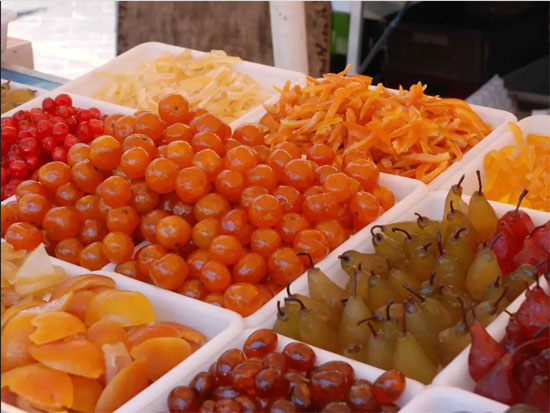
Candied fruit is made from whole fruit, smaller pieces of fruit, or pieces of peel, placed in heated sugar syrup, which absorbs the moisture from within the fruit and eventually preserves it. Depending on the size and type of fruit, this process of preservation can take from several days to several months. The continual process of drenching the fruit in syrup causes the fruit to become saturated with sugar, preventing the growth of spoilage microorganisms due to the unfavourable osmotic pressure this creates. This process allows the fruit to retain its quality for up to a year. It has existed since the 14th century.
Fruits that are commonly candied include dates, cherries, pineapple, peaches, as well as a root ginger. The principal candied peels are orange and citron; these with candied lemon peel are the usual ingredients of mixed chopped peel (which may also include glacé cherries). Recipes vary from region to region, but the general principle is to boil the fruit, steep it in increasingly stronger sugar solutions for a number of weeks, and then dry off any remaining water. Citron is one of the four ancient citrus fruits, being grown for over 3000 years.
In making candied fruit, it is better to use fruit that is just ripe. Dried fruit can also be used. Starting from dried fruit takes two-thirds less time, but it does need to be rehydrated first. The candying process can take 6 to 14 days, or even several months. You put whole small fruits, or chopped larger fruits, into a sugar syrup, and gradually day by day increase the strength of the sugar syrup. The sugar syrup pulls the water out of the cells in the fruit, because sugar attracts water, and the water that leaves the cells gets replaced by the sugar. The process must be gradual or the fruit will shrivel and toughen.
Limes cannot be candied successfully at home; an enzyme in their rind will darken them and break them down. Commercially, though, it can be done, and both candied lime slices and candied lime peel (or zest) are available.
The term “candied fruit” is often used casually as a catch-all phrase for candied fruit, crystallized fruit (aka frosted fruit), and glazed fruit (aka glacé fruit). Candied fruit is fruit that has been candied as described above. The two latter are actually different products. Crystallized fruit is fruit that has been frosted with caster sugar. Glazed fruit is fruit that has been coated or shipped in a sugar syrup.
How to make candied fruit (short method)
Traditionally, candied fruit could take up to an entire month to make, but thanks to candy enthusiasts, a shortened method was created. The method described in Field Guide to Candy (Quirk Books, 2009) is an easy process.
Cut your chosen fruit into 1/4-inch (5 mm) slices.
For every 1/2 cup of sugar, combine with 1-1/2 cups of water in a saucepan. Bring to a boil.
Add your sliced fruit into the boiling sugar syrup, keeping the fruit covered by syrup. Cook at medium-low heat, turning the slices of fruit occasionally, for 40 to 50 minutes or until the fruit becomes translucent, but still intact.
Use a slotted spoon to transfer the sliced fruit onto a wire rack. Let cool and dry overnight.
Roll sliced fruit in a layer of sugar to complete your candied treat. Store in an airtight container, between sheets of waxed paper, in the fridge or a cool, dry place for up to six months.
Tips for making candied fruit
Because much of the candying process involves simmering the fruit in a delicate syrup, Barnier shares a few of the Test Kitchen's tips on cooking with sugar.
"Simmer the sugar and peel mixture over low heat, and keep your eyes on it," Barnier says. "Sugar can easily boil over and cause serious burns. Use a pot that can hold three times the amount of liquid to help prevent the syrup from boiling over."
If you have any leftover sugar syrup, "it can then be used to moisten cakes and sweeten drinks such as iced tea, cocktails and sparkling water,” Barnier adds. “(Sugar syrup) should keep well in the refrigerator for a few weeks."
When drying candied fruit, "set a tray lined (with parchment or wax paper) beneath your wire rack to catch any drippings," says Barnier. "And leave it in an open space where there is good air circulation."
How To Make Candied Fruit And Peels (long method)
Put the washed and stoned cherries into a saucepan (I am using cherries for illustration sake, but you would do the same with each fruit type or peel), cover them with water, bring to the boil and cook them for 4 minutes. Strain the cherries, keeping the liquid in a saucepan. Spread the cherries into a deep dish (just enough space for syrup between each cherry, and syrup covers the fruit when you pour it back on).
Stir together: 1 1/2 c water and 3/4 c sugar. Heat slowly until the sugar dissolves, then add the food coloring, if using, bring the syrup to the boil and pour it over the cherries. Leave them in the syrup for 24 hours at room temperature. If the syrup does not cover, make more; the fruit MUST be covered.
Days 2-6
The next day strain the cherries again, put the syrup in a saucepan. Stir 1/4 c sugar into the syrup and bring to the boil. Pour the syrup over the cherries again and leave them in the syrup for 24 hours. Repeat this process for another 4 days. {yes, you add sugar to the syrup each day}
No task on day 7.
On the 8th day, drain the cherries, add 1/4 c sugarto the syrup and bring to the boil. Add the cherries to the syrup and cook them over low heat for 3-4 minutes, then pour them into the deep dish and leave them undisturbed for 48 hours.
No task on day 9.
On the 10th day, repeat the process of the 8th day and leave the cherries to soak in the syrup for another 4 days.
On the 14th day, drain the cherries and place them on a rack to dry.
The cherries can be stored for at least six months covered in the refrigerator.
