Taxonomy of Legumes
First, What’s the Difference Between a Legume, Bean, and Pulse?
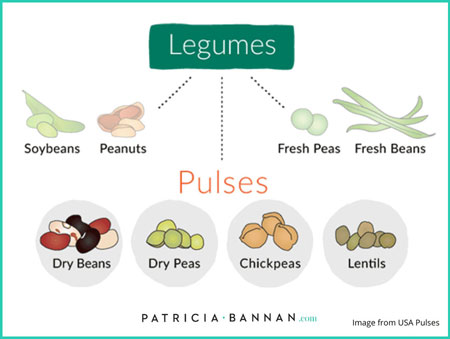
The word bean, is a term loosely used to describe to any legume whose seeds or pods are eaten. Legumes, pulses, and beans are words that are often used interchangeably, but there are small differences.
First and foremost, think of legumes, pulses, and beans in a hierarchy: legumes are the umbrella term, with pulses directly underneath. Beans fall under both of these – in other words, beans are legumes and also pulses.
1. Legumes include all types and forms of beans and peas that come from the Fabaceae (or Leguminosae) botanical family, which includes any plant that bears its fruit inside a pod. In other words, legumes are the umbrella family that all beans, peas, and pulses fall under, and include thousands of varieties grown around the world. The main types of edible legumes include:
- Fresh legumes (fresh beans, fresh peas/pods)
- Pulses (dry beans, dry peas, lentils, chickpeas, etc.)
- Oilseed legumes (peanuts, soybeans)
2. What’s the difference between pulses and legumes? Pulses are the dried edible seeds of the legume plants. Not all legumes are pulses. For instance, fresh peas, fresh beans and peanuts are technically legumes, but not pulses. Hundreds of different varieties of pulses are grown around the globe. The word stems from the latin word puls, meaning seeds that can be made into a thick soup.
In common usage, pulses may be referred to as both peas or beans (as in the case of a bag of split peas or a pile of dried navy beans), which certainly adds some confusion to the matter. Rest assured though that if it is a dried and edible legume seed you have on your hands, it is a pulse! The other exception to this pulse rule is made for certain legumes known as oilseed crops, which feature a naturally high oil content and as such, are mostly grown for oil production. While legumes such as peanuts and soybeans may be dried in a manner similar to that of other pulses, as oilseed legumes, they do not fall into the pulse category.
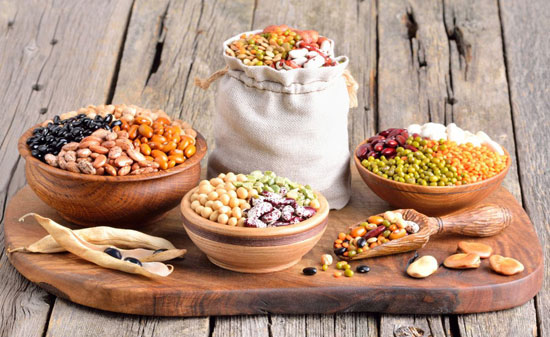
There are 5 main types of pulses, each group of which may contain other individual varieties:
- Dry Beans (black eyed peas, black beans, cannellini beans, etc.)
- Garbanzo beans (also known as chickpeas!)
- Lentils
- Dry Peas (does not include fresh shelling peas or edible-podded types of peas such as snow peas or sugar snap peas)
- Cowpeas, such as black-eyed peas
3. As mentioned before, beans and legumes are often used interchangeably. As we learned above, beans are included in the overarching category of legume, but this does not mean that all legumes are considered beans. Some varieties of legumes which we commonly refer to as beans are: black beans, lima beans, fresh green beans, kidney beans, pinto beans, fava beans, and navy beans. Some beans are consumed fresh--pod and all--while others are shelled and eaten fresh or dried.
The point at which things get most confusing is determining what the term “bean” actually refers to. In some cases, we refer to the entire pod (with seeds inside) as a bean--think fresh green beans, string beans and wax beans. In other cases, we use the word bean to refer to each individual seed itself, as in the case of black beans and kidney beans. At any rate, beans are distinct from both pulses and legumes in the sense that the word bean refers to either the seed pod or individual seeds (unlike legume, which refers to the entire plant category), while pulses are a very specific type of legume seed - dried.
Genuses in the Fabaceae Plant Family
Pulses
Archaeological finds show the first human consumption of legumes dates back to before 10,000 years BCE and were first cultivated in the Middle East. From the Neolithic age of agriculture, cereal cultivation was first, then came legumes. The Mesopotamian and Egyptian civilizations grew and ate many types and varieties of legumes. In the Syrian-Palestinian and Phoenician traditions, cereals were combined with legumes, and used in the form of flour or the various parts of the plant (pods, seeds, leaves).
Numerous ancient cultures depended on beans, including the Egyptians and classical Greeks, with a history of legume consumption going back more than 20,000 years in some Eastern cultures. A couple of older favorites in Europe were smallish, flat lentils (Lens culinaris), which were eaten in Greece as long as 13,000 years ago. Bumpy, round chickpeas (Cicer arietinum) were used in soup in Western Europe in the seventh century B.C., and the fava bean, or broad bean (Vicia faba), has been cultivated in the Mediterranean region for so many years that the wild ancestor of our present culinary varieties is now extinct. Also cultivated were the pea (Pisum sativum) and the bitter vetch (Vicia ervilia). The ancient Greeks used cereals as a nutritious base for their diet, adding legumes, such as the fava bean, lentils and peas.
The soybean (Glycine max) was also cultivated very early in China. Some of the other Old World beans are the adzuki (or azuki) bean (Phaseolus angularis), the hyacinth bean (Dolichos lablab), the winged bean (Psophocarpus tetragonolobus), the guar bean (Cyamopsis tetragonoloba), and the pigeon pea (Cajanus cajan).
As foodways became more local, forming cuisines, they became a distinctive element of the identity of a people. Apicius in the Roman collection of recipes, De re culinaria, dedicated one section entirely to legumes, prepared sumptuously, often with rare and expensive condiments. Historical sources report the custom among the Romans of eating puls, a semi-liquid polenta made with spelt, barley or fava beans; the Egyptians prepared another stew, based on fava beans, known as ful or ful medammes.
Literature and scholarly writing indicated that the legumes cultivated in Greco-Roman areas were chickpeas (Cicer arietinumI L.), fava beans (Vicia faba L.), lentils (Lens culinaris Medikus), peas (Pisum sativum L.), lupins (Lupin spp.), as well as the cowpea (Vigna unguicolata) (see for instance L. Iunius Moderatus Columella, De Re Rustica 2.7.1.2). The cowpea was certainly present in Italy since the Greco-Roman times as also evidenced in the De re coquinaria.
In the last centuries of the Roman Empire, as Christianity spread, it promoted a diet of great frugality: symbolically and explicitly opposed to extravagance and greed. Legumes became a symbol of sobriety and balance, consolidated in the following centuries, as Christian society formalised the dichotomy between food for the rich and food for the poor.
With the end of the feudal system and the growth of cities, this model was adopted by the new ruling classes: refined, rich foods for the nobles; simple foods for the peasants. Beans and cereals were eaten by both, though the peasants subsisted on them.
Beans were also cultivated early in the New World, both in South and North America. The most important bean species from the New World is the common bean (Phaseolus vulgaris). Other New World beans include Lima beans (Phaseolus limensis), runner beans (Phaseolus coccineus), tepary beans (Phaseolus acutifolius, var. latifolius), and butter beans (Phaseolus lunatus).
In the modern era, a vast wave of new foods was imported from the Americas, including a new species of bean (Phaseolus) was introduced, in addition to the already cultivated black-eyed pea which had come from Africa. The New World bean soon became prevalent in the European diet and took on the popular name (faculia for the Greeks, fagiolo for the Italians, flayot and flageolet for the French).
Until the beginning of the 20th century, legumes continued to be eaten by the humblest social classes. Industrial development changed the way people ate. Wheat came to predominate to the detriment of minor cereals and legumes. On average, in Europe, legume consumption per person fell from about 10-20 kg (24 lbs to about 45lbs) per year in the second decade of the 20th century to 2-4 kg (5 lbs to about 10 lbs) per year by the mid-1900s.
Post WWII social advances, economic well-being, industrialisation and massive country to city migration, once again changed the way people ate, especially since refined foods were so available and accessible. Today, however, legumes have once again become a vital part of the European diet—no longer linked to the historical connotation of “poor” food, now they are cherished for their healthy qualities, and the desire to eat in harmony with the earth (plant based, etc).
Pisum genus (peas) - Old World
Peas are a type of legume native to the Middle East, specifically to the area around what is now Turkey and Iraq. According to scientists, domestication of wild pea plants probably began with the dawn of agriculture itself, with carbonized pea remains showing up in Neolithic archeological sites in Turkey and Iraq (around 7,000 to 6,000 BCE), where they were likely companion plants to early-domesticated forms of wheat and barley.
From the Middle East, the legume spread rapidly to Europe. These early forms of pea, now called field peas, were probably cultivated to be eaten like a legume (that is, dried). According to food historian Alan Davidson, the first finding of the garden pea (mostly grown to be eaten fresh, rather than dried — although both field and garden peas were eaten dried) comes from Bronze Age archeological remains in Switzerland, around 3,000 BCE. The ancient Greeks and Romans also cultivated the garden pea, and from these areas the plant spread to India and China.
Davidson notes that the pea was an important source of food for peasants in the Middle Ages, providing protein and other nutrients in lean times. Italian Catherine di Medici, wife of French King Henry II, is credited with introducing peas (among other innovations, like the fork and the artichoke to 16th century France, where they quickly became a food fad. According to “The Encyclopedia of American Food & Drink,” Christopher Columbus purportedly brought peas to the West Indies on his infamous 1492 voyage; by the early 17th century, peas were cultivated in the early American settlement of Jamestown, Virginia. Plant breeder Calvin Lamborn developed the “sugar snap” variety in 1979 by crossing garden peas with snow peas.
Cicer genus (chickpeas) - Old World
Garbanzo beans (Cicer arietinum) belongs to the genus Cicer. Currently, the only cultivated species of the genus Cicer is C. arietinum, commonly known as the chickpea, or garbanzo beans. It is one of the earliest cultivated legumes, and 9,500-year-old remains have been found in the Middle East.
Cicer reticulatum is the wild progenitor of chickpeas. This species currently grows only in southeast Turkey, where it is believed to have been domesticated. The domestication event can be dated to around 7000 BC. Domesticated chickpeas have been found at Pre-Pottery Neolithic B sites in Turkey and the Levant, namely at Çayönü, Hacilar, and Tell es-Sultan (Jericho). Chickpeas then spread to the Mediterranean region around 6000 BC and India around 3000 BC. In southern France, mesolithic layers in a cave at L'Abeurador, Hérault, have yielded chickpeas, carbon-dated to 6790±90 BC. They were found in the late Neolithic (about 3500 BC) sites at Thessaly, Kastanas, Lerna and Dimini, Greece.
The chickpea is a key ingredient in Mediterranean and Middle Eastern cuisines, used in hummus, and, when soaked and coarsely ground with herbs and spices then made into patties and fried, falafel. As an important part of Indian cuisine, it is used in salads, soups and stews, and curry, in chana masala, and in other food products that contain channa (chickpeas).
Chickpeas and Bengal grams are used to make curries. They are one of the most popular vegetarian foods in the Indian subcontinent and in diaspora communities of many other countries, served with a variety of bread or steamed rice. Popular dishes in Indian cuisine are made with chickpea flour, such as mirchi bajji and mirapakaya bajji.
Vicia genus (fava bean & lentils) - Old World
Vicia is a genus of over 240 species of flowering plants that are part of the legume family (Fabaceae), and which are commonly known as vetches. Member species are native to Europe, North America, South America, Asia and Africa. Some other genera of their subfamily Faboideae also have names containing "vetch", for example the vetchlings (Lathyrus) or the milk-vetches (Astragalus). The lentils are included in genus Vicia, and were formerly classified in genus Lens. The broad bean (Vicia faba) is sometimes separated in a monotypic genus Faba; although not often used today, it is of historical importance in plant taxonomy as the namesake of the order Fabales.
Vicia faba (broad/fava beans) - Old World
Vicia faba is a species of vetch, a flowering plant in the pea and bean family Fabaceae. Vicia faba, known as the broad bean, fava bean, faba bean, horse bean, field bean or tic bean, is native to north Africa and southwest Asia, and is extensively cultivated elsewhere.
Broad beans have a long tradition of cultivation in Old World agriculture, being among the most ancient plants in cultivation and also among the easiest to grow. However, their wild ancestor has not been identified and their origin is unknown. Charred faba bean remains were discovered at three adjacent Neolithic sites in Israel's Lower Galilee (Yiftah'el, Ahi'hud and Nahal Zippori). Based on the radiocarbon dating of these remains, scientists now believe that the domestication of the crop may have begun as early as 8,250 BCE. They were first domesticated in the Mediterranean or western Asia. Remains of them dating to 6000 to 7000 B.C. have been found at sites in Israel. By 3000 B.C. they were grown widely across central Europe and northern Africa and have been found with mummies in ancient Egyptian coffins.
Broad beans were an important crop throughout ancient and Medieval times. In ancient Rome, they began to be cultivated in order to feed livestock as well as for humans. In recent times, they have become less important as a human food and are mainly grown for animal feed. China is the largest grower today, producing about 60 percent of the world's supply. Europe and North Africa are also centers of broad bean cultivation (Muehlbauer 1997).
Broad beans are generally eaten while still young and tender, enabling harvesting to begin as early as the middle of spring for plants started under glass or overwintered in a protected location, but even the main crop sown in early spring will be ready from mid to late summer. Preparing broad beans involves first removing the beans from their pods, then steaming or boiling the beans, either whole or after parboiling them to loosen their exterior coating, which is then removed.
The Greek word fáva (φάβα) does not refer to broad beans, but to the yellow split pea and also to another legume, Lathyrus clymenum. Broad beans are known instead as koukiá (Greek: κουκιά), and are eaten in a stew combined with artichokes, while they are still fresh in their pods. Dried broad beans are eaten boiled, sometimes combined with garlic sauce (skordalia).
Vicia lens or Lens culinaris (lentils) - Old World
The former genus Lens consisted of the cultivated L. culinaris and six related wild taxa. Among the different taxa of wild lentils, L. orientalis was considered to be the progenitor of the cultivated lentil and was generally classified as L. culinaris subsp. orientalis. The first use of the word lens to designate a specific genus was in the 17th century by the botanist Tournefort.
Lentil, one of the world’s oldest crops, was domesticated in the Fertile Crescent of the Near East and then spread to Europe, the Middle East, North Africa and the Indo-Gangetic plain. The primary center of diversity for the domestic Lens culinaris as well as its wild progenitor L. culinaris ssp. orientalis is considered to be the Middle East.
The oldest known carbonized remains of lentil from Greece's Franchthi Cave are dated to 11,000 BC. In archaeobotanical excavations carbonized remains of lentil seeds have been recovered from widely dispersed places such as Tell Ramad in Syria (6250-5950 BC), Aceramic Beidha in Jordan, Hacilar in Turkey (5800-5000 BC), Tepe Sabz (Ita. Tepe Sabz) in Iran (5500-5000 BC) and Argissa-Magula Tessaly in Greece (6000-5000 BC), along other places.
A variety of lentils exist with colors that range from yellow to red-orange to green, brown and black. The colors of the seeds when removed from the pods also vary, and there are large and small varieties. They are sold in many forms, with or without the pods, whole or split. In South Asia, lentils are known as dal, as are most sorts of dried legumes. The dishes made predominantly of lentils are also known as dal. With 25 percent protein, it is the vegetable with the highest level of protein other than soybeans, and because of this it is a very important part of the diet in many parts of the world, and especially South Asia, which has a large vegetarian population.
A famous variety of small green lentils known for their earthy flavor is grown in Le Puy, France. These Le Puy lentils (lentilles du Puy) were the first dry vegetable protected by the French Appelation d'Origine Controlée designation.
Vigna genus (Cowpea or Black eyed pea, and others) - Old World
Many former members of the genus Phaseolus were moved to the genus Vigna such as:
- Adzuki bean (Vigna angularis) - Adzuki Bean has a 2,000-year history of cultivation in eastern Asia. The chief countries of Adzuki Bean production are China, Japan, Taiwan, and South Korea. Its origin from a wild species is unknown but its center of origin has been proposed as within eastern Asia, quite possibly in China.
- Black gram (V. mungo) - Black gram originated in South Asia, where it has been in cultivation from ancient times and is one of the most highly prized pulses of India. It is very widely used in Indian cuisine.
- Mung bean or Green gram (V. radiata) - The mung bean is likely native to the Indian subcontinent and is widely cultivated in Asia for use in a variety of sweet and savory dishes, particularly in India, China, Korea, and Thailand. It is also grown in relatively dry tropical and subtropical areas, including the Caribbean and parts of Africa.
- Cowpea or Black eyed pea (V. unguiculata)
Cowpea - The “traditional bean” in Italy, as well as in many Mediterranean countries, was the cowpea (Vigna unguiculata L. Walp). This species was formerly classified under the genus Dolichos. The distinctive trait of the cowpea seeds is the presence of a dark spot circling the hilum, which originated both the common name black-eyed pea and the old botanical name D. melanophtalmus DC.
Cowpeas were probably domesticated in Africa and are one of the oldest crops to be farmed. Compared to most other important crops, little is known about the domestication, dispersal, and cultivation history of the cowpea. Although there is no archaeological evidence for early cowpea cultivation, the centre of diversity of the cultivated cowpea is West Africa, leading an early consensus that this is the likely centre of origin and place of early domestication.
Remains of charred cowpeas from rock shelters in Central Ghana have been dated to the 2nd millennium BC. In 2300 BC, the cowpea is believed to have made its way into Southeast Asia, where secondary domestication events may have occurred. From there they traveled north to the Mediterranean, where they were used by the Greeks and Romans. The first written references to the cowpea were in 300 BC and they probably reached Central and North America during the slave trade through the 17th to early 19th centuries. The seeds are usually cooked and made into stews and curries, or ground into flour or paste.
Glycine genus (soybean) - Old World (Asia)
The Soybean (U.S.) or Soya bean (UK) (Glycine max) is native to eastern Asia. Like corn and some other crops of long domestication, the relationship of the modern soybean to wild-growing species can no longer be traced with any degree of certainty.
Varieties of soybeans are used for many purposes. Soybeans have been a crucial crop in eastern Asia since long before written records, and they are still a major crop in China, Korea, and Japan today. Soybeans were first introduced to Europe in the early 1700s and the United States in 1765, where it was first grown for hay. Benjamin Franklin wrote a letter in 1770 mentioning sending soybeans home from England. Soybeans did not become an important crop outside of Asia until about 1910.
Soybeans can be broadly classified as "vegetable" (garden) or field (oil) types. Vegetable types cook more easily, have a mild nutty flavor, better texture, are larger in size, higher in protein, and lower in oil than field types. Tofu and soymilk producers prefer the higher protein cultivars bred from vegetable soybeans originally brought to the United States in the late 1930s.
Soybeans may be boiled whole in their green pod and served with salt, under the Japanese name edamame. Soybeans prepared this way are a popular local snack in Hawai'i, where, as in China, Japan, and Korea the bean and products made from the bean (miso, natto, tofu, douchi, doenjang, ganjang and others) are a popular part of the diet.
Phaseolus (common bean) - New World Origin
The taxonomy of Phaseolus has been reviewed by Debouck (1991). The genus, of New World origin, is in the tribe Phaseoleae and is tentatively regarded as including 55 species, of which five are cultivated:
Family Fabaceae Lindl. - Pea family
Genus Phaseolus L. - bean
The genus Phaseolus, called common bean, is a New World crop and was not known in ancient cultures. Legumes that were grown in ancient Mesopotamia and other ancient cultures were the pea (Pisum sativum), the chickpea (Cicer arietinum), the bitter vetch (Vicia ervilia), the broad bean (Vicia faba), the lentil (Lens culinaris), soybean (Glycine max), the adzuki (or azuki) bean (Phaseolus angularis), the hyacinth bean (Dolichos lablab), the winged bean (Psophocarpus tetragonolobus), the guar bean (Cyamopsis tetragonoloba), and the pigeon pea (Cajanus cajan).
Species:
P. vulgaris L., common bean, first domesticated more than 7,000 years ago in southern Mexico and Peru.
Most beans were classified in the genus Phaseolus with the common bean, Phaseolus vulgaris. Common bean includes the following bean varieties: kidney bean, navy bean, Romano, Pinto bean, Pink bean, Flageolet, Cranberry bean and Black Turtle Bean. It also includes immature green beans, also known as, string beans or snap beans.In Mexico, the Indians developed black beans, white beans, and other color patterns and colors. In Peru (Andes), there was also a wide array of colors, but their colors were more bright and lively. Another difference between beans from these two cultivation centers was that the Peruvian natives developed large-seeded bean varieties, while the Mexican tribes cultivated small-seeded types.
Because Indian tribes wandered across the American continent through a complex system of trade routes and trading centers, they migrated, explored, and traded with other tribes. These native farming practices and beans spread gradually all over North and South America.
After taking bean cultivars to Europe, European settlers renamed them and returned to North America. For example, Hutterite Soup beans came to the United States from Russia via Austria in the late 19th century with a communal and pacifist Christian group called the Hutterites. They migrated there to avoid religious persecution and settled in the upper Midwest and Canada. Today’s Mayflower beans became a staple in North and South Carolina after coming over on the Mayflower in 1620. As for Bolita beans, it is not clear whether the Spaniards only picked them up while traveling north through Mexico or brought them from Spain. Flageolet beans come from France, Navy beans from Italy, and so on.
Immigrants who brought seeds from Europe used to grow them and select plants that adapted to the local climate. Then, they passed down the seeds as family heirlooms, and some cultivars were picked up by seed companies for sale and development. One of the most popular heirloom beans is the Kentucky Wonder pole bean. Before being named Kentucky Wonder (1877), it was called Texas Pole and Old Homestead.
P. coccineus L., scarlet runner bean, cultivated in Mexico about 2,200 years ago. The beans are eaten fresh or dried. Immature pods are also edible. This species originated from the mountains of Central America. It was most likely cultivated in the highlands of Mexico and Guatemala around 2000 BC. Most varieties have red flowers and multicolored seeds (though some have white flowers and white seeds), and they are often grown as ornamental plants.
In Greece, cultivars of the runner bean with white blossom and white beans are known as fasolia gigantes (φασόλια γίγαντες). They are grown under protective law in the north of Greece within the regions of Kato Nevrokopi, Florina and Kastoria. The beans have an important role in Greek cuisine, appearing in many dishes, such as Gigandes plaki, a baked bean dish. Sometimes sausages or cubed smoked pork are added.
P. lunatus L., Lima bean (butter bean), cultivated near Lima, capital of Peru, about 5,500 years ago. It’s the most common bean in the USA where it’s mostly sold frozen or canned.
The lima bean is of Andean and Mesoamerican origin. Two separate domestication events are believed to have occurred. The first, taking place in the Andes around 6500 B.C.E., produced a large-seeded variety (Lima type), while the second, taking place most likely in Mesoamerica around 800 C.E., produced a small-seeded variety (Sieva type). By around 1300 C.E., cultivation spread to North America.
P. acutifolius A. Gray, Tepary bean, cultivated about 5,000 years ago in northwestern Mexico (the Sonoran Desert) and the southwestern United States. Tepary bean is mainly grown in Mexico and Arizona (United States). It’s mostly grown for its mature dry seeds, which are eaten after boiling, steaming, frying or baking.
P. polyanthus Greenman (year-long bean) Native to a narrow region in the highlands of Guatemala. It was recently found to be a hybrid between two other cultivated species of Central America, Phaseolus coccineus and P. vulgaris and displays intermediate characteristics. Taxonomically, it was previously categorized as Phaseolus polyanthus and P. coccineus ssp. darwinianus. Now Phaseolus dumosus. Long beans work best briefly steamed, stir-fried, or braised, but also hold up well when added to stews.
3. Other Legumes
- Hyacinth bean (Lablab purpureus) belongs to the genus Lablab. Lablab purpureus is a species of bean in the family Fabaceae. It is native to sub-Saharan Africa and India and it is cultivated throughout the tropics for food. English language common names include hyacinth bean, lablab-bean, bonavist bean/pea, dolichos bean, seim or sem bean, lablab bean, Egyptian kidney bean, Indian bean, bataw and Australian pea. It is the only species in the monotypic genus Lablab. L. purpureus has been cultivated in India as early as 2500 BC.
- Jack bean (Canavalia ensiformis) belongs to the genus Canavalia. Native to South and Central America, the plant is not in large-scale commercial cultivation. The beans are mildly toxic, and copious consumption should be avoided. Boiling will, however, remove toxicity if done properly.
- Lupin, lupine or lupini beans (Lupinus luteus) are members of the Fabaceae (pea) family, which includes any plant that bears its fruit inside a pod. Lupini beans originated in the Middle East and date back before Ancient Rome. The yellow, flat, round beans somewhat resemble lima beans and have a sweet, nutty flavor and firm, hearty texture. Originally, all lupini beans were very bitter and required extensive soaking to remove the bitterness and make them safe to eat due to their toxicity. More recent varieties — classified as “sweet” — are less bitter and require less soaking. Today they are primarily eaten as a pickled snack food. Popular in the Mediterranean region of Europe, Lupini Beans are often found at Italian fairs and as an appetizer at Spanish beer halls.
- Arachis genus - peanut, groundnut, earthnut, goober, goober pea, and monkey nut. Native to South America. At least one species, the peanut (Arachis hypogaea), is a major food crop species of global importance; some of the other species are cultivated for food to a small extent in South America.
