Buying Sweet Corn
Seasonal Information
Florida corn is available from October through June, peaking in April and June.
California corn is available from May through October, peaking in June and July.
Washington corn is available from July through October, peaking in August.
Tips on What to Look for When Buying Corn
The key to picking out good corn isn’t so much a matter of what it looks like but rather how long it’s been since the corn was harvested. The second those ears are pulled off the stalks, sugar in the corn begins to convert to starch. Once the sugar is gone, so is a lot of the flavor and delicate texture.
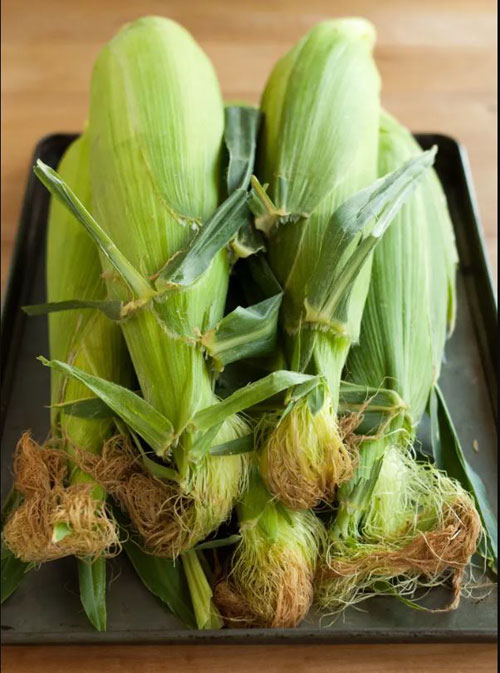
Good quality corn has full, evenly formed and filled ears with straight rows of kernels. The husks will be fresh-looking and bright green, and the silk ends free of decay or worm damage. The nub where the corn was cut off the stalk should be fresh, moist, and free of spots. Old cuts take on a rusty look. Be sure the coloring of the kernels is bright and shiny. Pull back the husk and poke one of the kernels at the tip of the silk end with a finger-nail. If juice squirts out and is only slightly cloudy, it's fresh. If the juice is thick or non-existent, the corn is old.
Avoid corn that has shriveled, burned looking husks or has dark-colored slime in the tassel. Large kernels, those with dark yellow and dents and wrinkled kernels with no juice in them are all indications of old corn. Also avoid underdeveloped kernels lacking good color (except in the white variety) and short or crooked ears that are not filled almost to the tip with kernels.
1. Look for a tightly wrapped husk.
We eat with our eyes first — same rule applies for choosing your corn. You’re looking for a vibrant green, tightly wrapped husk, one that’s hugging the cob snugly, says Taylor Choy, director of operations at Chicago’s Green City Market. If it’s loose, the corn has likely lost moisture, which means you won’t get that sweet juicy bunch of kernels you’re after.
2. While you’re at it, scope out the silk.
Next, look at the silks coming from the top, says Carol Waterman, owner of Waterman’s Family Farm based in Indiana. “If they are really dry and brittle, the corn has probably been harvested some time ago and won’t be as fresh and tasty as one would like,” she says. On the other end of the spectrum, avoid ears with silks that are overly wet, sticky and dark in color which indicate age, and not the good kind.
3. Give your cob a light squeeze.
And I do mean light. Just a gentle squeeze is all you need to feel the kernels, without damaging or removing the husk (more on that in a second). If your corn is ready, the kernels will feel plump and bunched close together, explains Choy. You’ll also be able to feel if there are dimples or empty spaces, shares Waterman, which imply the corn was harvested too early or is old.
4. Don’t remove the husk — until you’re ready to eat.
This one irritates farmers the most! It’s like taking off the peel of any fruit and wishing it the best as it sits on the shelf. The husk protects the corn in many ways, but its most important role is holding everything tight together to lock in moisture. Disruption of the husk and exposure of the kernels leads to dried out corn. That may be OK for popcorn, but not for enjoying right off the cob.
5. Buy as local as possible.
Ideally, we’d all live within walking distance to a family farm or farmers market. If you’re fortunate enough to have one nearby, then you should absolutely take advantage of it and get your corn there. Local farmers often sell their produce right when it’s harvested which means you’ll get the best of the best.
