Bland and Buttery Cheeses
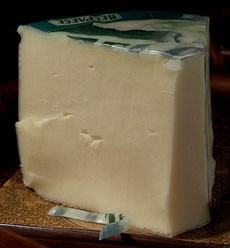
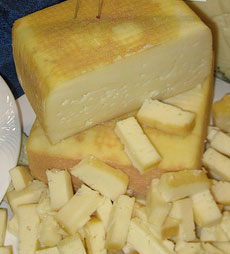
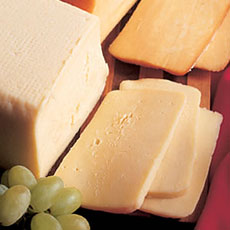
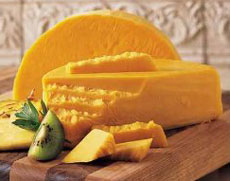
Into this category can be placed a great variety of essentially mild tasting, stable, all-purpose table cheeses. The range is considerable and includes the Samsoe group, Edam, Gouda, Bel Paese and Fontina. These are cheeses which are semi-firm to the touch, with a smooth, buttery texture inside that yields on finger pressure, or when cut with a knife. They are mild in flavor with a clean, fresh tang to them that varies in strength depending on the age. Because they slice easily, they have good melting qualities and are often used in cooking. But they are excellent as well for snacks, dessert courses with bread and fruit and a modest red wine. Most semi-soft cheeses have an inedible crust.
Semi-soft cheeses and the sub-group, Monastery cheeses have a high moisture content and tend to be bland in flavor. Some well-known varieties include Havarti, Munster and Port Salut.
Bel Paese
|
Bel Paese is a semi-soft Italian cheese. It was invented in 1906 by Egidio Galbani who wanted to produce a mild and delicate cheese to sell mainly in Italy. The name Bel Paese comes from the title of a book written by Antonio Stoppani. It is Italian for "Beautiful Country". Originally produced in Melzo, a small village near Milan in the Lombardy region, it is now made in both Italy and the United States. Bel Paese is a cow's milk cheese. It matures for six to eight weeks, and has a creamy and light milky aroma. The color is a pale, creamy yellow. It is made in small discs, and is very similar to the French Saint-Paulin cheese and to German Butterkäse. It has a mild, buttery flavor for which it has been popularly eaten with fruity wines, such as dry red or white. It is favored by many as a snack or dessert cheese and melts easily for use on pizzas or in casseroles. It is often used as a substitute for mozzarella cheese. |
Brick
|
Brick is a Wisconsin original, first made by John Jossi around 1877. Some Brick cheeses resemble Germany’s surface-ripened Beer Cheese or Beerkäse. Brick was named for its shape and because cheesemakers originally used bricks to press the moisture from the cheese. Flavor changes from mild and sweet, with a touch of nuttiness when young to pungent and tangy when aged. Available surface-ripened. Smooth, open texture. This has a mild flavor, a semi-soft texture, and is sometimes cream colored varying to orange. Works well for sandwiches, appetizers, and cheese trays. Slice for sandwiches; shred for casseroles. Goes well with crackers and bread. Also makes excellent nacho’s. Made in the United States. |
Butterkäse
|
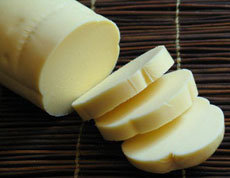
Butterkäse originated in Germany and is made throughout Germany and Austria. Its name literally means "butter cheese." Although it contains no butter, it has a butter-like texture. It is also called Dämenkäse or "ladies cheese" because it is delicately flavored, odorless and quite complementary to most foods. Butterkäse, produced in Wisconsin in the Alpine tradition, is readily available throughout the United States. This cheese ripens in one month and has a fat content of 50 percent. A very mild cheese that fits in the semi-soft texture category. This cheese is very creamy and mild in flavor. If you are looking for a cheese to melt over vegetables, this just might be your cheese as Butterkäse melts very nicely and will not overpower the vegetables. Try serving it with sausage, ham sandwiches, grapes, melons or plums. |
Colby, Longhorn Colby
|
Created in the small town of Colby, Wisconsin, Colby cheese was originally called Colby "Swiss" Cheddar. Colby is similar to cheddar, but does not undergo the cheddaring process. Colby is a softer, moister, and milder cheese than cheddar because it is produced through a washed-curd process. Colby is considered semi-hard. The washed-curd process means that during the cooking time, the whey is replaced by water; this reduces the curd's acidity, resulting in Colby's characteristically mild, gentle flavor. Monterey cheese is produced in an almost identical fashion as Colby, but is uncolored and softer. Longhorn is the best known of the Colby cheeses. Colby should not be aged. Colby dries out quickly, so it is best used shortly after purchasing. Colby cheeses are typically sold in half-rounds. Pinconning cheese is a sharp aged relative of Colby cheese. Substitutions: mild cheddar |
Edam
|
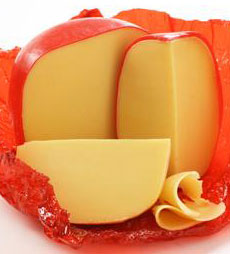
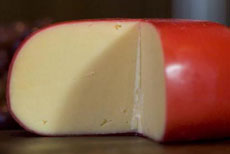
Edam and Gouda originated in Holland over 800 years ago. The name "Edam" comes from a town of the same name in Holland. The village of Gouda shares the same valley. Originally, cheesemakers shaped Edam into balls to roll down the gangplanks into ships for export. Since Edam has a firmer texture than Gouda, it maintained its round shape. Edam (Dutch Edammer) is a Dutch cheese that is traditionally sold in spheres with a pale yellow interior and a coat of red paraffin wax. Edam which has aged for at least 17 weeks is coated with black wax, rather than the usual red or yellow. Edam ages and travels well, and does not spoil easily; these qualities (among others) made it the world's most popular cheese between the 14th and 18th centuries both at sea and in remote colonies. Most "young" Edam cheese sold in stores has a very mild flavor, is slightly salty or nutty, and has almost no smell when compared to other cheeses. As the cheese ages, its flavor sharpens, and it becomes firmer. It has a significantly lower fat content than many other traditional cheeses: approximately as little as 28 percent of the cheese is made up of fat. Modern Edam is softer than other cheeses such as Cheddar, due to its low fat content. . Mild Edam goes well with fruit such as peaches, melons, apricots, and cherries. Aged Edam is often eaten with traditional "cheese fruits" like pears and apples. Like most cheeses, it is commonly eaten on crackers and bread. Works well for dessert, cheese trays or appetizers. Made in Holland. Substitutions: gouda, fontina |
Fontina
|
This cheese is semi-soft, and slightly nutty tasting with a semisoft to hard texture. It has a mild, sweet and almost honey like flavor. Ideal for melting or fondue. Works for sandwiches, desserts and appetizers. Goes well with fresh fruit, crackers and bread. Made in Italy. Fontina Val d’Aosta is made in the Val d’Aosta (Aosta Valley), high in the Italian Alps at Italy’s northwestern tip. It’s made from pasteurized cow’s milk and aged for 90 days. The cows graze in the Alpine pastures, eating delicious grasses, wild herbs and flowers that impart grassy/herbaceous and fruity flavors to the milk, along with a nuttiness that comes from aging. For those who like “stinky” cheeses, Fontina is extremely aromatic. Made from unpasteurized cow’s milk, aged 90 days. Fontina has PDO status (protected domain origin) under European law; the a consorzio (consortium) stamp an image of the Matterhorn and the word FONTINA on the rind of the cheese. As it ages it takes on earthy, mushroomy, and woody taste flavors and aromas. Substitutions: emmental, gouda, gruyere, edam |
Gouda
|
In the Middle Ages, the Van der Goude family built a castle on the bank of the Gouwe River. The settlement around the castle grew into the town of Gouda, which became known for its fine aged cheese, Goudse kaas (“Cheese from Gouda”) made from cow’s milk. The name is not origin-protected, so anyone can make Gouda (pronounced HOW-duh in Dutch). With an authentic Gouda, the longer the cheese ages, the harder and saltier it gets. Younger Goudas are creamier. Extra-aged and triple-aged Goudas (five years of aging) can be found. The longer the cheese is aged, the more intense and complex the flavors. Older Goudas deliver exciting butterscotch flavors that complement the pungency. The young Gouda cheese, aged between 1 and 6 months, is rich yellow in color and has a red or yellow paraffin wax coating. This cheese is easily sliced with a cheese slicer. Gouda which has aged more has a pungent underlying bitterness, yet is still considerably creamier and sometimes discernible by a black paraffin wax coating. This strong tasting cheese is hard and often too brittle to cut using a slicer, but it can be sliced by knife or served cut in cubes. Younger goudas have a mild, nutty flavor, rather soft and can come with or without a wax coating. Works well for appetizers or dessert. Goes with fresh fruit or crackers. Made in Holland. Substitutions: edam, muenster |
Havarti
|
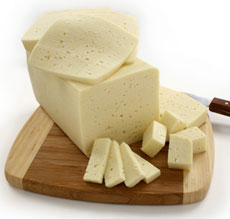
Havarti or Cream Havarti (Fløde Havarti in Danish) is a semi-soft Danish cow's milk cheese. It is a table cheese that can be sliced, grilled, or melted. Havarti cheese was initially created by Hanne Nielsen who operated an experimental farm called Havarthigaard, in Øverød, north of Copenhagen, in the mid-19th century. Havarti is made like most cheeses, by introducing rennet to milk to cause curdling. The curds are pressed into cheese molds which are drained, and then the cheese is aged. Havarti is a washed curd cheese, which contributes to the subtle flavor of the cheese. Havarti is an interior-ripened cheese that is rindless, smooth and slightly bright-surfaced with a cream to yellow color depending on type. It has very small and irregular openings ("eyes") distributed in the mass. Havarti has a buttery aroma and can be somewhat sharp in the stronger varieties, much like Swiss cheese. The taste is buttery, and from somewhat sweet to very sweet, and it is slightly acidic. It is typically aged about three months, though when the cheese is older it becomes more salty and tastes like hazelnut. When left at room temperature the cheese tends to soften quickly. The original Havarti is different from the otherwise popular flødehavarti ("cream havarti") which distinguishes itself by being made of high-pasteurized milk. This means that the whey proteins that would otherwise be eliminated during production remain in the curd, thereby raising yields but reducing taste and texture. Cream havarti usually ripens very little, since the remaining whey proteins cause problems (off-taste, odd appearance) during prolonged ripening. |
Monterey Jack
|
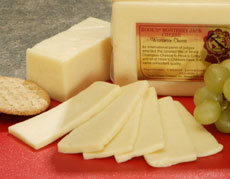
This semi-hard cheese is made from cow's milk, has a creamy texture and a can sometimes have a bland taste. Monterey Jack originated with the Spanish Franciscan founding fathers of California. Monterey Jack is a light-colored, creamy-textured relative of cheddar noted for its mild flavor. All Jack cheeses melt beautifully, and are especially good on broiled, open-face sandwiches. Jack's meltability has made it indispensable for Southwestern and "Tex-Mex" dishes, shredded over tacos, stuffed into enchiladas or melted over refried beans. Serve jack cheeses with beer and fruity wines. David Jacks, a Scottish immigrant who owned several dairies in Monterey, created this cheese in the 1890s. It was modeled after the Swiss-method of making cheese This semisoft, mild tasting cheese is white in color. Works well for snacks, sandwiches, making sauces and other dishes. Goes well with bread and crackers. Made in the United States. Substitutions: gouda, muenster |
Muenster
|
Muenster cheese is a mild American cheese, not to be confused with the pungent Munster cheese from the Alsace region of France. It is the evolution of the cheese made by European immigrants tot the U.S. in the 1880s. While some artisan cheesemakers make round aged muensters in the alsatian style, most are factory-made loaves meant to be eaten young as a sandwich, cooking or snack cheese (it is made in flavored varieties including caraway, cranberry and hot pepper). It is a great melter for grilled sandwiches, burgers and other dishes. While European-style munster is a washed-rind cheese, in U.S. the rind is generally not washed (washing provides more pungency), but annatto is used to provide an coating. The paste is semi-soft, smooth and elastic. Munster cheese, originally from the province of Alsace, has a strong aroma but is milder in taste. Square-shaped and rather orange-y in color, it is sometimes flavored with cumin or caraway. This is a mild and mellow semisoft cheese. Works well for sandwiches and cheese trays. Goes well with crackers and bread. Made in Germany. Substitutions: monterey jack, brick |
Munster Cheese
|
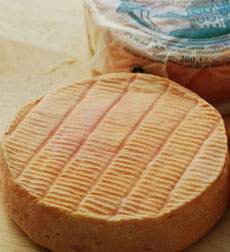
Munster cheese is an assertive cheese believed to have originated in the eastern Vosges Mountains of the Alsace region of France. It is a monastery cheese that dates to the early Middle Ages; the name munster derives from the local dialect for monastery (in Latin, monasterium). Made of unpasteurized cow’s milk in small and large flat wheels, munster is the only cheese native to Alsace. A washed rind cheese, Munster has a very pronounced, powerful aroma. In the five-week to three-month aging period, the rind is periodically washed with brine. It is rubbed by hand with a cloth moistened by a brine solution of rock salt and water (the salt inhibits the growth of mold). This added moisture encourages the development of the bacteria that gives munster its characteristically strong flavors and smells, as well as its “red” rind (actually orange). When ripe, munster has the aroma of porcini mushrooms and the runny interior evokes truffles. (When young, the paste is creamy.) |
Port Salut/Saint Paulin
|
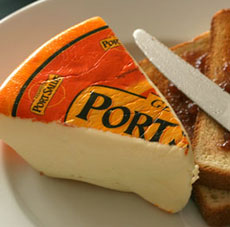
Originated by the Trappist monks in their Monastery of Port-du-Salut Entrammes, this popular cheese comes in a four-pound round with an inedible orange rind. It slices readily and is ideal in recipes. A semi-soft, wheel shaped shaped cheese made from cow's milk. A lightly pressed cheese with a smooth springy paste and a tawny washed rind. It has a buttery mild flavor. Good for crackers, fruits, soups and sauces. Port Salut can vary from mellow to robust in flavor and has a semisoft texture. Works well for cheese trays, appetizers and dessert. Goes best with fresh fruit and crackers. Made in France A factory made imitation of Port Salut is called Saint Paulin, which is made with pasteurized milk. St. Paulin is a look-alike to Port Salut, in shape and flavor, but it does not have an orange crust. A semi-soft wheel shaped cheese made from cow's milk. A pressed uncooked cheese with a mild bland buttery yellow interior. |
Provolone
|
A spun cheese of the Italian pasta filata group, a pulled or stretched curd cheese, which also includes mozzarella and scamorza. It is often found on antipasto plates. Provolone, meaning large provola, is a semi-hard cow’s milk cheese that varies in flavor from mild Provolone Dolce to aged, sharp Provolone Piccante. Dolce (mild Provolone) is aged 2-3 three months, and is a semisoft, mild, smooth table cheese. Piccante is aged 6-12 months and has a much stronger flavor. Provolone is made in unusual shapes. the most common is the salame shape, but it is also made in the shape of a watermelon, bottle, pear (mandarino) and cone. |
Taleggio [tahl-EH-zhee-oh]
|
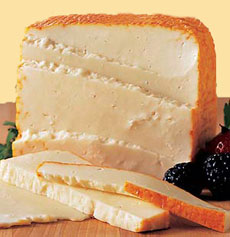
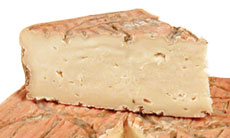
Hailing from Italy's Lombardy region, this rich (48 percent fat), semisoft cheese is a washed rind cheese made from whole cow's milk. Its flavor can range from mild to pungent, depending on its age. When young, Taleggio's color is pale yellow and its texture semisoft. As it ages it darkens to deep yellow and becomes rather runny. Taleggio is sold in flat blocks or cylinders and is covered either with a wax coating or a thin mold. It's excellent with salad greens or served with fruit for dessert. |
Tilsit
|
Tilsit is named after a town in East Prussia, Germany. It was invented by Dutch immigrants trying to recreate Gouda. Due to local bacteria, molds and yeast in a damp cheese cellar, they couldn’t recreate Gouda, but instead ended up with a brand new cheese, similar to Havarti. Tilsit is a washed rind cheese made from partially skimmed and pasteurized cow’s milk. It is semi-firm with a springy, elastic texture, dotted with irregularly spaced tiny holes. It was traditionally made in large wheels, but is now made in loaf form, making it easier to slice (the way it is generally eaten). The rind is washed and brushed regularly for the first two months of aging to form an outer crust that keeps its supple, smooth interior from drying out. Tilsit has a mildly pungent aroma and a tangy taste—delicate and fruity with spicy notes. A good melter, it is excellent on sandwiches (regular and grilled), burgers, and also can be melted over potatoes and other vegetables.There are Danish and German Tilsits. Danish Tilsit, also known as Tilsit Havarti, has a fuller and more intense flavor than Dutch Havarti (and is more yellow in color), but is milder than German Tilsit. |
French Semi-Soft Cheeses:
Chiberta - - - A specialty of the Basque country, in the south of France, this
cheese is made from cow’s milk, is ivory-colored on the inside with tiny
holes. It is avail able in a four-pound round and has a dark orange inedible
crust.
Livarot - . . A famous specialty of the province of Norman dy, this is a round
cheese with a strong and piquant flavor.
Pont l’Evêque - . . Again a Norman specialty, the name of the cheese
means Bishop’s Bridge. It is square shaped with impressions on its usually
edible rind which result
from the straw on which it is ripened.
Reblochon . . - Made in the French Alps, the name derives from the term for
the second-milking of the day, the cow’s milk, which is used to make this
cheese. A small, flat disk, it is mild in flavor.
Royaldieue - . . Similar in texture and body to Port Salut but has a higher
butter fat content. The crust is not edible.
St. Nectaire - . . Again, a cousin to Port Salut but its inedible crust is darkish
brown.
