Blue Veined Cheeses
These cheeses are characterized by their internal veining of blue, blue-black or green, and their pungent aromas and tangy flavours. All blue-vein cheeses are internally ripened after being inoculated with a Penicillium spore. They are usually classed as semi-soft cheeses but are often crumbly, especially when cold. Some, however, are exceptionally soft, even to the point of spreadability. Roquefort, Stilton and Gorgonzola are considered the three best blue veins in the world. Blue cheeses tend to increase in flavor and aroma with age. Most blue-veined cheeses are marvelous with fruit, crusty bread or unsalted crackers, either for snacks, hors d’oeuvre or as a dessert course. Their robust flavor calls for a full-bodied French red wine. In the U.S. these cheeses are widely used in salads and salad dressings.
Substitutions: any of these can be substituted for another, if need be.
Blue (Bleu) Cheese
|
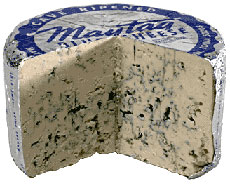
Piquant, full, earthy flavor; intensity of flavor varies among brands. Blue cheese has a sharp taste, is semi soft but with a crumbly texture, and marbled creamy white with blue veins. Works well for dessert, dips, salads, appetizers and cheese trays. Goes well with fresh fruit, vegetables and crackers. Crumble in vegetable, fruit and pasta salads, over grilled meat; blend for spreads, dressings, dips. Bleu cheeses are made in France. Blue Cheeses are of United States origin. Handmade in central Iowa, Maytag Blue was one of the first great American farmstead cheeses. It is ripened in caves dug into the rolling hills of the Iowa countryside, just as Roquefort is ripened in caves (though naturally-occurring) in southwest France. However, Maytag is a cow’s milk cheese, while Roquefort is made from sheep’s milk. |
Danablu (Danish Blue)
|
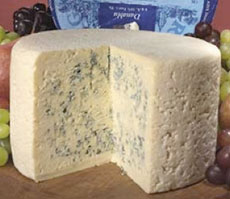
Danish Blue (more commonly known as Danablu) is a strong, blue-veined cheese. This semi-soft creamery cheese is typically drum or block shaped and has a white to yellowish, slightly moist, edible rind. Made from cow's milk, it has a fat content of 25-30% (50-60% in dry matter) and is aged for eight to twelve weeks. Before aging, copper wires or rods are used to pierce the formed curds to distribute the mold (Penicillium roqueforti) evenly through the cheese. The holes can still be seen when the finished wheel is cut open. Danablu was invented early in the 20th century by a Danish cheese maker named Marius Boel with the intention of emulating a Roquefort style cheese. Danish Blue has a milder flavor characterised by a sharp, salty taste. Danablu is often served crumbled on salads or as a dessert cheese with fruit. In Denmark, it is often served on bread or biscuits. Danablu and Esrom are the only two Danish cheeses that are PGI-marked by the EU, meaning that they may only be produced in Denmark from Danish milk and at approved dairies that produce the cheeses according to the specifications laid down. |
Gorgonzola
|
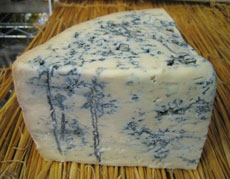
Italian semi-soft, ripened cheese with a clay-colored outer crust and marbled with blue-green veins in a creamy-white interior. Made of cow's milk, Gorgonzola is a soft table cheese. It is an antique cheese of great popular tradition with a compact, rough, hard, reddish crust and a firm but mellow paste interior which melts on the tongue. Its color ranges from white to straw-yellow with an unmistakable marbled green or bluish-green mold. The taste ranges from mild to sharp, depending on age. Gorgonzola is also excellent in salads and dips. Made in Italy. Gorgonzola comes from the Lombardy region of Italy; the actual town is outside of Milan, although the neighboring town of Pasturo claims the cheese originated there. A stracchino-type cow’s milk cheese,* Gorgonzola dates to 879 C.E. The cheese was originally made without its famous blue-green veining and piquant flavor, which happened sometime in the 11th century and come from Penicillium gorgonzola mold spores that are injected into the cheese. Gorgonzola is made in two varieties: Mountain Gorgonzola, the sharper and firmer version, and Dolce (sweet) Gorgonzola, a spreadable and elegant version that lacks the sharpness of the Mountain Gorgonzola. Both types are a wonderful dessert when served with a drizzle of honey. Heat and toss with hot pasta; spread on bread or toast; stir into risotto. |
Roquefort
|
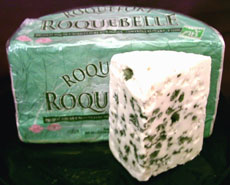
Roquefort is perhaps the world’s most famous blue cheese. It is made from Lacaune-breed sheep’s milk and is France’s second most popular cheese after Comté (out of 500 different cheeses made in France). It does not have a rind. The most famous blue-mold cheese, Roquefort is a French semisoft, ripened cheese, white, marbled with blue-green veins; crumbly. The flavor is sharp and salty. Authentic Roquefort is made exclusively from ewe’s milk in the south of France and is aged and ripened in the limestone caves of the small village of Roquefort. Authentic Roquefort can be easily identified by the red sheep emblem on the label. The French eat Roquefort as a dessert cheese, although most Americans prefer it in salads or dips. Works well in dips, desserts, salads and appetizers. Goes well with crackers, coffee and nut or raisin bread, figs, walnuts and apples. Made in France. A cheese like Roquefort is mentioned by Pliny the Elder in 79 C.E. |
Stilton
|
A semihard, ripened cheese, creamy white with narrow blue-green veins, flaky and crumbly. Historically referred to as "The King Of Cheeses," Stilton is a blue-mold cheese with a rich and mellow flavor and a piquant aftertaste. It has a wrinkled rind which is not edible. Stilton is milder than Roquefort or Gorgonzola and is excellent for crumbling over salads. Smooth, creamy and complex, it makes an excellent dessert cheese and is traditionally served with Port and walnuts. Works well for dessert, cheese trays, dips and salads. Goes well with fruit and crackers. (Sauternes is another excellent wine choice). Made in England. |
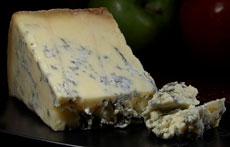
French Blue Cheeses:
Bleu d’Auvergne: From the mountains of the rustic region of the Auvergne,
this cheese is made from cow’s milk. It has a rich, sharp flavor.
Bleu de Bresse: Also made from cow’s milk in the region of Bresse, this
cheese is available either in cylinders or long loaves. It has a mild-ish flavor
for this type of cheese.
Pipo Creme: This cheese, available in six-pound rolls, has a very distinct flavor,
slices easily as it does not crumble. The thin crust is edible.
