Cheddar-style Cheeses
Originating in the Somerset County village of Cheddar in southwest England around 1170 C.E. or earlier, Cheddar is the most popular type of cheese in the U.K. and accounts for more than half of English cheese production and is one of the most popular and widely copied cheeses in the world. Cheeses that are 'cheddared' undergo a step in the making process which involves them being cut into pieces and stacked and turned at the bottom of the cheese vat for a period. The archetypal Cheddar cheese is firm-textured, yellow in colour with a clean, mellow taste which develops a sharp and tangy bite the further it matures.
English cheeses such as Gloucester, Cheshire, Leicester, Lancashire, Derby, Wensleydale and Caerphilly all belong to the Cheddar family. Even Stilton, a blue vein, is Cheddar based. America, Australia, Canada and New Zealand all make varieties of Cheddar in varying degrees of strength. Vermont is one of the best-known American types and the Canadian Cheddars, made from unpasteurised milk, are highly rated. Cantal is a French Cheddar-style cheese and Kashkaval is a distant Greek relative made from sheep's milk.
Cheddar
|
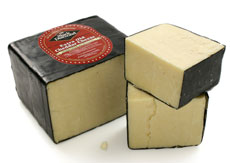
Cheddar cheeses were originally made in the English village of Cheddar; however, today they are manufactured in quite a number of countries. Prior to 1850, nearly all the cheese produced in the United States was Cheddar. Fully cured, Cheddar is a hard, natural cheese. Cheddar cheese is typically aged from 60 days to 4 years before being sold. The rind, if any, is artificial, most often times wax. The color of the wax used for coating does not indicate a level of quality. Normally, the color of Cheddar ranges from white to pale yellow. Some Cheddars however have a color added, giving the cheese a yellow-orange color. Cheddar is always made from cow's milk and has a slightly crumbly texture if properly cured. If the cheese is too young, the texture is smooth. Rich, nutty flavor becomes increasingly sharp with age. Smooth, firm texture becomes more granular and crumbly with age. Works well for cooking, cheese trays, appetizers, desserts, sandwiches and salads. Goes well with fruit, bread and meats. Made in England or the United States. Substitutions: |
Cheshire
|
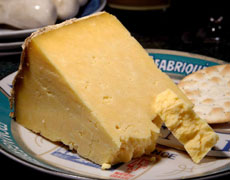
A rich, cow's milk cheese that originated in Cheshire county England. One of the oldest English cheeses, allegedly invented during the 12th century. Cheshire is firm in texture and a bit more crumbly than Cheddar. Cheshire is rich, mellow and slightly salty with an excellent aftertaste, its flavor sharpens as it ages. The blue Cheshire has a golden interior veined with blue. Made in England. Substitutions: |
Colby, Longhorn Colby
|
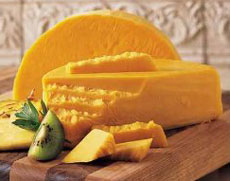
Cheesemakers first produced Colby, a close relative of Cheddar, in the central Wisconsin town of Colby in 1885. Similar in flavor to Cheddar, Colby is softer and has a more open texture and higher moisture content. Cheesemakers spray the curds with cold water and stir them while they are still in the vat to prevent the curds from knitting together. This procedure gives Colby a more elastic texture than Cheddar. Colby cheese was originally called Colby "Swiss" Cheddar. Colby is similar to cheddar, but does not undergo the cheddaring process. Colby is a softer, moister, and milder cheese than cheddar because it is produced through a washed-curd process. Colby is considered semi-hard. The washed-curd process means that during the cooking time, the whey is replaced by water; this reduces the curd's acidity, resulting in Colby's characteristically mild, gentle flavor. Monterey cheese is produced in an almost identical fashion as Colby, but is uncolored and softer. Longhorn is the best known of the Colby cheeses. Colby should not be aged. Colby dries out quickly, so it is best used shortly after purchasing. Colby cheeses are typically sold in half-rounds. Pinconning cheese is a sharp aged relative of Colby cheese. Substitutions: mild cheddar |
Double Gloucester
|
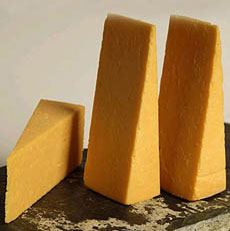
This English Cheddar-style cheese from Gloucestershire in southwest England has bold orange paste (from annatto) and a sharp flavor. The milk come from the Gloucester cow, a handsome black animal with a broad white stripe running down her back, and the ability to produce the creamy, rich milk from which this cheese is made. Double Gloucester is the cheese used for the annual spring Cooper’s Hill Cheese Rolling and Wake on Gloucestershire’s Cooper’s Hill. Competitors chase a wheel of Double Gloucester down a hillside; the winner is expected to catch the 80-pound wheel. However, as the wheel rolls in excess of 70mph, it might not be possible (or advisable). |