Ewe's Milk Cheeses
Like goat's milk cheeses, these cheeses taste quite different from cow's milk varieties. Their flavour ranges from mild to sharp. Some are noticeably salty, the result of being matured in brine. Many of the traditional Greek cheeses fall into this category, Feta being best known. Others, like Kashkaval and Kasseri, have a noticeable 'sheepy' flavour, a sourish tang, distinctive and attractive and, like many goat's milk cheeses, vaguely 'barnyardy'.
Feta
|
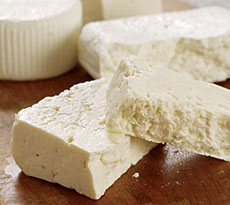
Feta is Greece’s most famous cheese, a pure white, aged curd cheese that crumbles easily. Genuine Greek Feta is made from sheep's milk, with a distinct salty, sharp flavor. Feta is a semisoft, ripened, flaky white cheese, crumbly in texture and white in color. It is formed into bricks and salted and cured in a brine solution. Feta is traditionally sold in glass jars, although modern packaging techniques have become more commonplace. Feta needs to be covered in brine at all times otherwise it will dry out and mold fast, and it needs to be refrigerated. Feta is a true eating cheese, although most Americans think of it as a salad topping. Used in cooking, in salads and for appetizers. Made in Greece. While the cheese has been made since antiquity, the current name came into the Greek language in the 17th century, from the Italian word fetta, slice, referring to slicing the cheese from the brick. Substitutions: aged chevre |
Halloumi
|
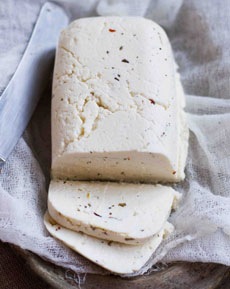
Halloumi, from Cyprus, is mostly a pasteurized sheep’s milk with up to 20% goat’s milk added. It has been called “the grilling cheese” for its ability to resist melting at high temperatures. Instead, it browns beautifully, and resembles grilled chicken or tofu. It is also served in salads and sandwiches. Halloumi’s springy, meaty texture (like mozzarella) is achieved by two rounds of cooking the curd. Try it pan-seared with eggs and toast for (a Cyprian breakfast), or jazz up kabob night by cubing and skewering. |
Manchego
|
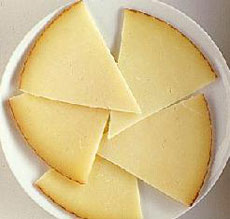
Manchego is named for the Spanish region of La Mancha, also home of Don Quixote. This historic cheese is produced in the La Mancha region from pasteurized sheep's milk. It has a black gray or buff colored rind with a crosshatch pattern, the interior ranges from stark white to yellowish, depending on age. The aroma should suggest lanolin and roast lamb. The final cheese is usually smeared with olive oil and surface mould is removed. It has a number of holes and a mild, slightly briny, nutty flavor. It is sold at various stages of maturity: at the age of 13 weeks it is described as curado (cured) and, when over three months old it is referred to as viejo (aged). There is a peppery bite to cheeses that have reached a great age. |
Pecorino Romano
|
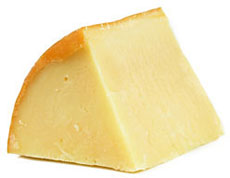
Romano means made near Rome and Pecorino is the name given to all Italian cheeses made from sheep's milk. Upon Pecorino Romano's arrival to America, its name was shortened; you will often find it called simply Romano. It takes eight to 12 months for Pecorino Romano to mature, during which time it develops its characteristic flavor - salty, with a fruity tang that becomes steadily more robust. Stronger in taste than Parmesan, it is a very popular grating cheese that sharpens as it matures. Used grated when aged, as a cooking ingredient. Only the young cheese is used as an eating cheese. Goes well with Italian sauces, foods and salads. Made in Italy. |
Ricotta Salata (rih-COH-tah sah-LAH-tah)
|
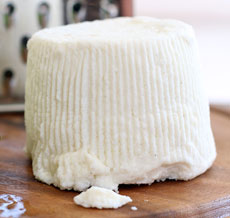
Unlike fresh ricotta, which is made from whey, ricotta salata is firm, rindless cheese made from lightly salted sheep's milk curd that is pressed and dried, then aged for a minimum of three months. Salata means salted in Italian. The cheese is neither salty nor “sheepy,” but has a nutty, sweet milky flavor. A milky-white firm cheese used for grating or shaving, ricotta salata is sold in wheels, decorated by a delicate basket-weave pattern. The curd is lightly salted, then pressed together tightly to form a dense, semi-firm cheese, which is aged for 2 months or more. It feels like a dense, dry version of Feta cheese. Cheeses that are aged longer, about 8 months, become hard enough to grate. Ricotta salata is used as a table cheese, added to salads (try it instead of goat cheese with beet salad or arugula salad) and cooked in, or grated onto, pasta dishes. Ricotta salata originated in Sicily. Look for it in Italian markets. |
Roquefort
|
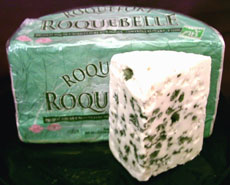
The most famous blue-mold cheese, Roquefort is a French semisoft, ripened cheese, white, marbled with blue-green veins; crumbly. The flavor is sharp and salty. Authentic Roquefort is made exclusively from ewe’s milk in the south of France and is aged and ripened in the limestone caves of the small village of Roquefort. Authentic Roquefort can be easily identified by the red sheep emblem on the label. The French eat Roquefort as a dessert cheese, although most Americans prefer it in salads or dips. Works well in dips, desserts, salads and appetizers. Goes well with crackers, coffee and fresh fruit. Made in France. |