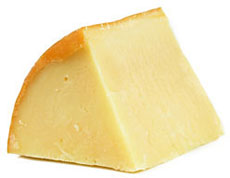
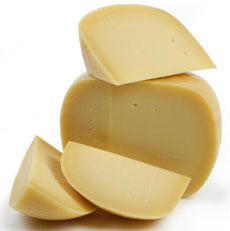
Extra-hard Cheeses (grating cheeses)
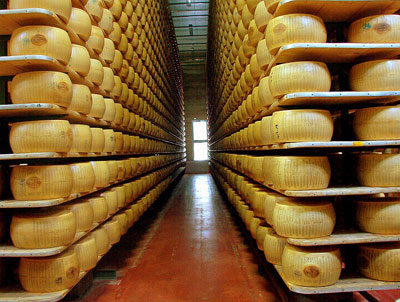 The majority of these cheeses are the Italian Grana style. They have an exceptionally
hard, brittle texture which makes them suitable for grating and are known for
their exquisitely sharp, piquant flavour. Cheeses of this type can be matured
for up to three years. Parmesan is the best known of the group but the Swiss
Sbrinz and Sapsago cheeses also fit into the category. Saanen, also Swiss, is
sometimes matured for seven years. Young versions of some grating cheeses are
used as table cheeses.
Substitutions: any of these can be substituted for another
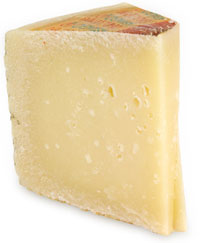
Asiago, aged (ah-zee-AH-goh)
|
Asiago is named for the northern Italian village in which it was created. It is a traditional, farmhouse and creamery, unpasteurized, hard cheese. Originally made of ewe's milk, now is made entirely of cow's milk. There are two types of Asiago: first one (mistakenly taken for Pressato) is a lightly pressed cheese made from whole milk matured for 20-30 days. Another one (Asiago d'Allevo) is the mature cheese made with skimmed milk. Long and slow maturation process creates fruity, slightly sharp cheese with a compact, granular interior full of small holes. Matured over 2 years, becomes intensely flavored. Can be grated and used as a condiment. This grating cheese is similar to Parmesan and Romano, but it's sweeter and not as sharp. Cheese makers in the United States began producing Asiago in the mid 1900s. |
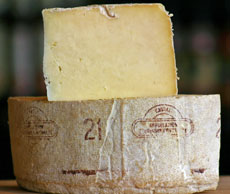
Cantal
|
A native of the Auvergne region, this is one of France’s oldest and most famous cheeses. Has a piquant flavor but its hard crust is not edible. It is low in fat and high in protein — making it an excellent choice for dieters. Fine for cooking or as a simple table cheese with bread and red wine. A wheel may weigh as much as 100 pounds. |
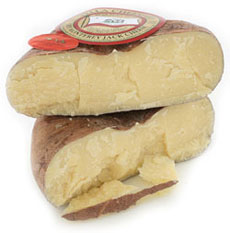
Dry Monterey Jack
|
A very hard, aged, dry version of fresh Monterey Jack with delicious nutty flavor. The cheese is used in cooked foods or grated onto pasta or salads. Dry Jack was inadvertently created in 1915 when a wholesaler had an overstock of Monterey Jack. Realizing he might have to store it for a long time, he hand-salted the cheese to protect it. What was uncovered later was the first delicious sample of Dry Jack. In San Francisco, Dry Jack is often used as a substitute for
Parmesan. Made in the United States and in Canada. |
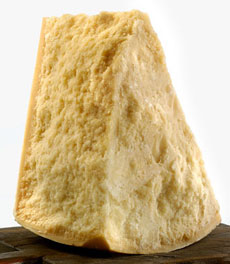
Parmigiano Reggiano
|
Known as the king of Italian cheeses, Parmesan originated in the Reggio and Parma regions of Italy. It tastes sweet, buttery and nutty compared to the sharper and more piquant flavor of Romano. A dry cow's milk cheese. This is a sharp tasting cheese, with a hard, brittle texture and is light yellow in color. Granular texture. The world's finest quality parmesan is "Parmigiano-Reggiano." The cheese is aged an average of two years. After it is aged 3 years, it is called "Stravechhio." At 4 years, they're called "Stavecchions." U.S. parmesans are aged about 14 months. When it's young, Parmesan has a pale yellow color, but as it ages, it acquires a deep straw color. The aged version of this cheese is generally grated and
used in cooking, while the unaged “young” cheese is used for
a eating cheese. As a grating cheese, Parmigiano Reggiano is a great topping
for soups, pasta dishes, veal, chicken, or salads. Goes well with Italian
foods and in sauces. Made in northern Italy, around the Parma region. |
Pecorino Romano
|
Romano means made near Rome and Pecorino is the name given to all Italian cheeses made from sheep's milk. Upon Pecorino Romano's arrival to America, its name was shortened; you will often find it called simply Romano. It takes eight to 12 months for Pecorino Romano to mature, during which time it develops its characteristic flavor - salty, with a fruity tang that becomes steadily more robust. Stronger in taste than Parmesan, it is a very popular grating cheese that sharpens as it matures. Used grated when aged, as a cooking ingredient. Only the young cheese is used as an eating cheese. Goes well with Italian sauces, foods and salads. Grate onto pasta and soups, shred into salads and stuffings. Made in Italy. |
Sardo
|
A grating cheese, made in Argentina, that is similar to Italian Romano. Initially, it was a copy of a Sardinian cheese called Fiore Sardo, but over time it has developed a personality all its own. The flavor of the cheese is mellow, rich and slightly salty. It is a cow's milk cheese and is less sharp than sheep's milk Romano. |