Monastery Cheeses
Trappist- or monastery-style cheeses are made around the world and include Saint-Paulin and Port-Salut, Pere Joseph from Belgium, Oka from Montreal, and Riddler from Norway. Trappist-style cheeses are mild and palate-pleasing, creamy and butter-like, yet firm enough for slicing. These cheeses are primarily soft & semi-soft and have natural rinds that are ‘washed’ (rubbed) or sometimes soaked in a brine of water and salt and sometimes wine or alcohol to add flavor & facilitate ripening which normally takes place in humid cellars. Although quite smelly at times, these cheeses can be mild, and range in flavor & intensity from mild to strong & piquant.
According to Frenchcheese.co.uk, the real development of French cheese began in the Middle Ages, in French monasteries. Most monasteries were rural and an essential facet of monastic life was raising livestock and tilling the land. Bread and cheese were the most basic staples of most monks' diets. By the year 1550, according to the website, French monks had successfully created more than 50 kinds of cheese. Munster cheese is perhaps one of the most famous cheeses developed by the monks; the name "munster" is derived from the Greek and Latin words for "monastery." Other famous monastery cheeses include Port Salut, Maroilles, Saint-Nectare and Livarot.
Cheeses in this group are often linked historically in that they have monastic origins. Such cheeses as Port Salut, Saint Paulin, the various forms of Trappist cheese made throughout the world, Esrom and Havarti have similarities of taste, although varying degrees of strength of flavour and aroma. Several mountain cheeses, such as Beaumont and Reblochon, are also classified as monastery type cheeses.
The majority of monastery cheeses are of the washed rind variety. Washed-rind cheeses are soft in character and ripen inwards like those with white molds; however, they are treated differently. Washed rind cheeses are periodically cured in a solution of saltwater brine and other mold-bearing agents that may include beer, wine, brandy, and spices, making their surfaces amenable to a class of bacteria Brevibacterium linens (the reddish-orange "smear bacteria") that impart pungent odors and distinctive flavors. Washed-rind cheeses can be soft (Limburger), semi-hard (Munster), or hard (Appenzeller). The same bacteria can also have some impact on cheeses that are simply ripened in humid conditions, like Camembert.
Cheeses that were origianlly developed in monasteries: Wensleydale (Rievaulx Abbey, Yorkshire), Port du Salut or Saint Paulin (Monastery de Notre Dame du Port du Salut, Laval, France), Fromage de Tamie (Abbey of Tamie, Lac d'Annecy, Geneva), Maroilles (Abbey Moroilles, Avesnes, France), and Trappist (Maria Stern Monastery, Banja Luka, Bosnia).
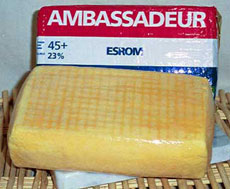
Esrom (Danish Port Salut)
|
Estrom is rich and aromatic. The Danish Cheese Institute rediscovered this old recipe in 1951. Previously known as Danish Port Salut, it is now named Esrom, after the monks who made this forgotten cheese in Esrom Monastery. Made from partially skimmed cow's milk, it is slow-ripened with starter cultures for 10-12 weeks. Esrom has an orange, semi-hard rind that has been rubbed with brine during the aging process. Its interior is semi-soft with a supple texture and irregularly shaped holes. It is full-flavored with a big, rich, pungent aroma and becomes spicier as it ages. Serve on rye, with a good ale. |
Limburger
|
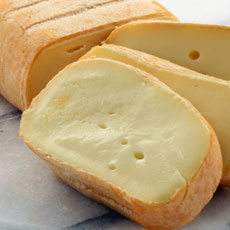
Limburger Cheese, famous for its stinky pungent aroma, is a soft washed-rind cheese. Limburger Cheese was originally created by Belgian Trappist Monks in the 1800s in the Limburg region of Belgium. By 1830, due to its popularity, German cheesemakers in the Allgau region of Germany began copying Limburger Cheese. This tradition has continued today, as Germany is the largest producer of Limburger in the world. Limburger Cheese has an orange-brown rind and has a pale straw colored interior. After maturation of thirty days, the texture of Limburger Cheese is still firm and crumbly, similar to Feta, but by two to three months of aging, Limburger softens and becomes spreadable and extremely pungent. This strong scent is caused by a particular strain of bacteria that grows on the surface of the cheese. But don't let the permeating smell fool you, because once the rind is trimmed, the cheese becomes much milder! Limburger is smooth, creamy and spicy with a hint of sweetness. Limburger's flavor is Brie-like, grassy and tangy. |
Munster Cheese
|
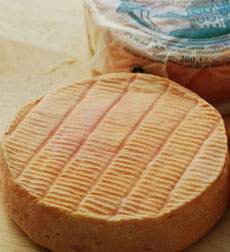
Munster cheese, not to be confused with the bland and butter Muenster cheese, is an assertive cheese believed to have originated in the eastern Vosges Mountains of the Alsace region of France. It is a monastery cheese that dates to the early Middle Ages (Benedictine monks who were prohibited from eating meat, created the cheese in the 12th century); the name munster derives from the local dialect for monastery (in Latin, monasterium). Made of unpasteurized cow’s milk in small and large flat wheels, munster is the only cheese native to Alsace. A washed rind cheese, Munster has a very pronounced, powerful aroma. In the five-week to three-month aging period, the rind is periodically washed with brine. It is rubbed by hand with a cloth moistened by a brine solution of rock salt and water (the salt inhibits the growth of mold). This added moisture encourages the development of the bacteria that gives munster its characteristically strong flavors and smells, as well as its “red” rind (actually orange). When ripe, munster has the aroma of porcini mushrooms and the runny interior evokes truffles. (When young, the paste is creamy.) |
Port Salut
|
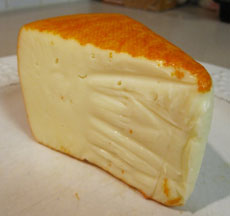
Port Salut is one of the milder French cow's milk cheeses. It is characterized by its orange crust, mild flavor, and sometimes pungent smell. Lactic bacteria is used in Port Salut's production, which gives the cheese a acidity to complement its mild taste. It is shaped in thick wheels with a dense, pale yellow interior and an edible, bright orange rind. This is a popular breakfast cheese and is made for snacking with fruits and different kinds of rye. |
Here are a few more:
Chaumes~ Now factory made, the soft rind is a bright tangerine color. The interior is smooth, supple and rubbery. The flavor is full and creamy with a subtle nuttiness.
Maroilles~ was created in a monastery sometime between the seventh and 10th centuries. It could be one of France's strongest-smelling and tasting cheese. The square cheese is the prototype for a number of cheeses of different shapes and sizes. The rind is covered with a brownish-yellow mold, the interior soft and slice-able.
Oka~ Made in Quebec, this washed-rind cheese has a French heritage and was brought to Canada by Benedictine monks. Now made commercially under license from the monastery, it is still aged for 2 months in the monastery's cellar, located right next door to the modern cheese plant. Distinctive and full-flavored.
Pont l'Eveque~ from the Normandy region, Pont l'Eveque is made in a distinctive square shape. The yellow interior is supple with a few small holes. The aroma from the rind is strong but not overpowering. The flavor is mild and sweet, like a more intense Camembert.
