Smoked Cheeses
Smoked cheese is simply a cheese variety, often Cheddar or Emmentaler, which has been treated and flavoured with smoke. Most of this type of cheese is processed. It is often made in traditional sausage shapes. In most cases the smoke flavour is produced by chemicals rather than by hanging the cheeses over a fire. Smoked cheeses are often additionally flavoured with ingredients ranging from caraway seeds to a textured vegetable protein tasting like ham.
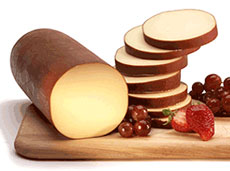
Smoked Gouda
|
Smoked slowly in ancient brick ovens over smoldering hickory chip embers, this sausage shaped semi-hard cheese is perfect for impromptu picnics, party platters or midnight snacks. Sensational with beer, this hardy cheese has an edible brown rind and a creamy, yellow interior. |
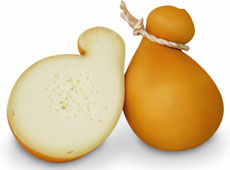
Smoked Caciocavallo
|
This smoked specialty hails from the Southern Italian provinces of Abbruzo, Calabria, Campania and Sicilia. A D.O.C. certified cheese, with a similar flavor and texture to Provolone, made in southern Italy. The name means cheese "cacio" on horse "cavallo", which refers to the balls of cheese, tied two to a rope and dried on poles, probably transported this way through the ancient Roman empire. The name still used in various forms for cheeses made in eastern Europe. A good cheese for snacks and sandwiches. Caciocavallo is a traditional pasta filata (stretched curd) cheese made from cow's milk. Other pasta filata type cheeses are mozzarella and provolone. Caciocavallos are gourd-shaped and come to us in pairs, tied together by a rope that loops around the "neck" of each cheese. After smoking and aging for a period of three months this ancient cheese takes on a tangy, meaty flavor. |
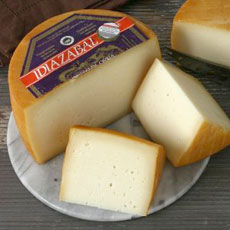
Smoked Idiazabal
|
A D.O.C. certified cheese, from the Spanish Basque country. Great for variety of uses because it slices easily, melts well and may be one of the best smoked cheeses available. Serve with olives, ham or salami, crusty country bread and a good red wine. Idiazabal is a pressed cheese made from unpasteurized sheep milk, usually from Latxa and Carranzana sheep in the Basque Country and Navarre, Spain. It has a somewhat smokey flavor. The cheese is handmade and covered in a hard, dark brown, inedible rind. It is aged for a few months and develops a nutty, buttery flavor, eaten fresh, often with quince jam. If aged longer, it becomes firm, dry and sharp and can be used for grating. Smoking is an optional touch, reflecting a history of hanging wheels near a fireplace to dry. The optional smoking takes place at the end of the aging process, using woods from the beech-tree, birch-tree, cherry tree or white pine. The intensity of the smoked qualities depends upon the type of wood and length of smoking. The cheeses are usually cylindrical in shape, although they are occasionally cone- or octagonal-shaped. The rinds of artisan cheeses may be engraved with drawings or symbols characteristic of the Basque culture. The rind is closed, smoked, waxy, without mold. The unsmoked cheeses have a yellow-beige color, while smoked cheeses are brownish. The interior is compact, without air pockets or with only pin-head size holes, and is beige or pale yellow in color. The interior of the smoked cheeses has a brownish border. The taste is strong and pronounced, slightly acidic and piquant, buttery and consistent, with a characteristic sheep milk flavor. The smoked version is somewhat drier and stronger, with a pleasant aroma. |