Soft Ripened Cheeses
These cheeses are known as bloomy or flowery-rind cheeses because of the light, downy white rind that grows on their surfaces, the result of their being treated with the Penioillium candidate spore. Inside, the cheese is golden yellow, creamy, buttery smooth and “runny”. If the cheese is at its peak, the paste bulges out from beneath the rind when the cheese is cut. Mild when young, they usually develop a fuller flavor as they age. As with all French cheeses, this type must be served at room temperature. Once the crust is cut, the cheese ceases to ripen. Tangy, richly delicate and delicious in flavour, Camembert and Brie are widely copied, but the French versions, of which there are many, are generally acknowledged as the best and the most fullflavoured. Other cheeses of this type include Carre de l'Est, Coulommiers and Chaource. Serve them with crusty French bread, apples, grapes, peaches or pears, and for most of them a light to medium French red wine makes an ideal accompaniment.
Brie (bree)
|
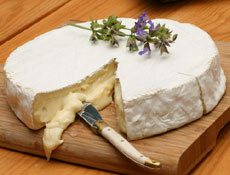
French. The “King” of soft-ripened cheeses, brie has a slightly sharp taste and a soft creamy texture. Its powdery, white edible crust becomes tinged reddish brown when the cheese is fully ripened (only those that have not been stabalized for export from France). Rich, earthy mushroom flavor changes from mild when young to pungent with age. The bloomy rind on Brie results from Penicillium Candidum, a white mold applied to the surface. The mold produces enzymes which ripen the cheese from the outside in. Ripening occurs in just a matter of weeks. As with each of this type of cheese, it reaches its peak at room temperature. Made from whole or skim milk. Slice on sandwiches; spread on bread; wrap and bake in pastry. Good on cheese trays. Brie dates back to 11th century France and the province of Le Brie. There are now many varieties of Brie made all over the world, including plain Brie, herbed varieties, double and triple Brie and versions of Brie made with other types of milk. Brie is perhaps the most well-known French cheese, and is popular throughout the world. Substitutes: Camembert |
Fougerus Brie
|
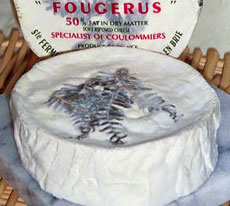
Made by one of the most respected makers of bloomy rind cheeses, Rouzaire,
in the Ile-de-France region. Slightly larger than it's cousin, Coulommiers,
it is rich, slightly salty with a slight herbiness from the fern leaf.
May be used as any Brie, but serving whole or in sections with fern on
each wedge makes a showy appearance, a good crowd pleaser. |
Camembert (KAM-ehm-behr)
|
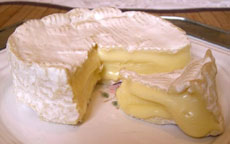
One of France’s most popular cheeses of this variety, known and admired throughout the world. Camembert was first made in the late 18th century in Normandy in northwestern France. This cow's milk cheese has a white, downy rind and a smooth creamy inside. When ripe, the cheese should ooze thickly. It is produced in small rounds, about 250 grams in weight, which are then typically wrapped in paper and packaged in thin wooden boxes. When fresh, it is quite crumbly and relatively hard, but characteristically ripens and becomes more fluid and strongly flavoured as it ages. Camembert can be used in many dishes, but is also popularly eaten uncooked on bread or with wine or meat, to enjoy the subtle flavour and texture which does not survive heating. It is usually served at room temperature. Why are Brie and Camembert virtually the same cheese? In 1791, during the French Revolution, a priest from the village of Brie (where the cheese was made) arrived in the village of Camembert, and was hidden there by Marie Harel, a farmer. Following his direction, she created the bloomy-rind cheese that came to be known as Camembert. Her children and grandchildren continued the cheesemaking. |
Coulommiers (koo-lum-YAY)
|
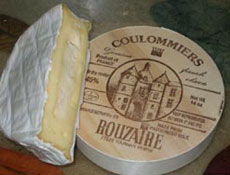
Made in the same region as Brie, it is smaller in size, plumper than its cousin, but similar in flavor and texture. |
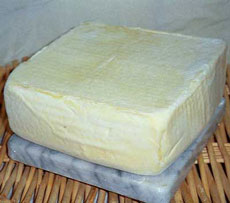
Teleme (TEHL-uh-may)
|
A very soft cheese at room temperature. Large pieces may have
rice flour crust. Excellent as is as a snack, with crackers or bread, in
salads or with fruit. Teleme is a California original. An American Cheese
Society award winner and former Best of Show. The luscious creamy texture
is great for sandwiches, melting in pasta or on potatoes, or spread on toast
for breakfast. Serve with a fruity red or white wine. |
Other French Soft Ripened Cheeses:
Bibress: A cylinder-shaped creamy cheese with a flavor similar to a mild blue cheese.
Bache Lorraine: Similar to Brie in texture and flavor, is available in the shape of a log.
Cambree: This newcomer is a combination of Brie and Camembert, with 50 per cent butter fat. It comes in a rectangular loaf which weighs six pounds.
Caprice des Dieux: An oval-shaped cheese, slightly creamier than Camembert with an edible crust.
Carre de 1’ Est: A square-shaped cheese, similar in flavor to Brie, but milder. As with most of this variety, the crust is edible.
Chaource: A specialty of Champagne country, this cheese is creamy, plump and round in shape. Its white crust is edible.
Fol Amour: An oval-shaped cheese, made in the north of France, and similar to Brie in flavor and texture.
St. Benoit: A specialty of the area of Orleans, it is made from skimmed cow’s milk and is in the shape of a small, thick disk. Inside it is ivory-colored and very creamy.
Valdieue: This cheese is a close cousin to Carré de 1’ Est, in shape, size and flavor.
Valmeuse: This is again in the Brie family, but it contains a special stabilizer
to retard ammoniation.
