Swiss-style Cheeses
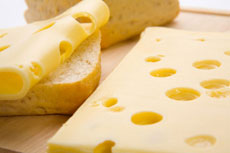
The most famous of these is Emmentaler with its tough outer rind, distinctive holes or 'eyes' and characteristic mild, sweetish, nutty flavour. Relatives of Emmentaler include Appenzell, Gruyere, Royalp, Sbrinz and Raclette. Swiss-style cheeses usually have tough hard rinds and interiors dotted with holes. They are formed and flavored through the breaking down of lactic acid by bacteria, which generate carbon dioxide bubbles in the cheese as it ages.
American cheesemakers, not Swiss, modernized Swiss production. About fifty years ago, the only way to protect Swiss wheels as they ripened was to allow a hard rind to form. The advent of plastic packaging, which keeps moisture in but allows carbon dioxide to escape, made it possible to produce rindless Swiss cheese in blocks. Rindless blocks were developed for better yield in foodservice; retailers appreciate the higher yield and ease of cutting.
Substitutions: any of these can be substituted for another.
Baby Swiss
|
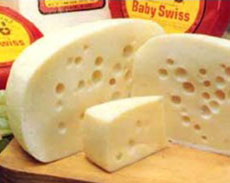
Baby Swiss is a cheese closely related to traditional Swiss cheese, the generic name for the family of holey cheeses popular all around the world. What sets Baby Swiss apart from its close relative is its mild taste and smooth, creamy texture. It also has smaller "eyes", which is the common term used for the holes in Swiss cheese. Baby Swiss cheese originated in the mid 1960's just outside of Charm, Ohio, and was invented by cheese connoisseur Alfred Guggisberg, an alumnus of the famous Swiss Federal “Molkereishulle” (cheese maker’s institute). The name Baby Swiss was coined by Alfred’s wife, Margaret Guggisberg, who thought that in comparison to the larger wheels of traditional Swiss cheese, when placed side by side, the new cheese looked like a baby. In Wisconsin, cheesemakers traditionally produce Baby Swiss from whole milk, unlike traditional Swiss, which they make from partially skimmed milk. Whole milk gives Baby Swiss a creamier texture and more buttery flavor, which makes it ideal for melting. One other of the key differences when it comes to making Baby Swiss, as opposed to traditional Swiss, is that it is aged only for a matter of weeks, whereas old fashion Swiss is typically aged for several months, time varying depending on the desired sharpness of the cheese. Baby Swiss is most commonly enjoyed in the United States, but can also be found in Europe and Australia. Most common uses include snacking, slicing for sandwiches, and melting for fondue. |
Emmentaler
|
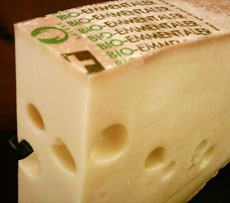
Emmental cheese is the original Swiss cheese, a creamy colored cow's milk cheese with characteristic large holes. The cheese originated in the Emme Valley of Switzerland, in the region of Bern, although it has been duplicated by many nations. Most grocers carry Emmental cheese or regional duplications of the cheese. As the cheese cures, the bacteria inside generate a great deal of carbon dioxide. The thick rind on the outside traps the gas inside, causing it to form its distinctive large holes. Typically, the cheese is aged for at least four months, and often much longer. The cheese melts extraordinarily well, making it a popular choice for grilled sandwiches and baked dishes which include cheese. It can also be sliced and eaten plain, and is a popular inclusion on cheese plates. |
Gruyère (groo-YEHR)
|
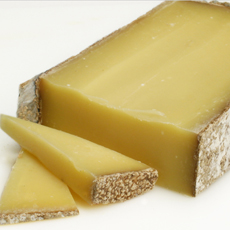
Since the 11th century, cheesemakers in the Alpine area between Switzerland and France have produced Gruyère. The pride and joy of the region, this cheese received its name from the town of Gruyères in the Swiss canton of Fribourg. Famous for its use in Swiss Fondue, Gruyère is a hard cheese that is similar to Emmental but with smaller hole formation. Its texture is chewy and it develops small cracks as it ages. In addition to its role as a Fondue cheese, Gruyere is also an excellent sandwich cheese that melts evenly. A type of Swiss, moderate-fat cheese made from cow's milk. It has a rich, sweet, nutty flavor that is excellent for both eating out of the hand and cooking. Works well for desserts and appetizers. Goes well with fresh fruit. Gruyère, with its golden brown rind and firm pale yellow interior is usually aged for 10-12 months. It's made in 100 pound wheels that are cut into wedges for wholesale. Not only produced in Switzerland, gruyère is made in France and several other countries. Gruyère is generally known as one of the finest cheeses for baking, having a distinctive but not overpowering taste. In quiche, Gruyère adds savoriness without overshadowing the other ingredients. It is a good melting cheese, particularly suited for fondues, along with Vacherin and Emmental. It is also traditionally used in French onion soup, as well as in croque monsieur, a classic French toasted ham and cheese sandwich. Gruyère is also used in chicken and veal cordon bleu. It is a fine table cheese, and when grated, it is often used with salads and pastas. |
Jarlsberg
|
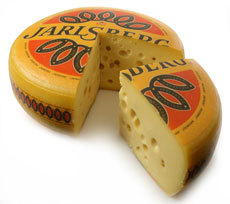
Jarlsberg is a traditional, creamery, hard, Norwegian cheese made from cow's-milk. The world's most famous "Baby Swiss", Jarlsberg has the consistency texture and hole formation of Swiss Emmental but its flavor is more nut-like and sweeter. The paste is golden yellow with holes of various sizes. This firm cheese has a mild, nutty flavor. Works well for making sandwiches, snacks and soup. Goes well with fruit and bread. |
Lacey Swiss
|
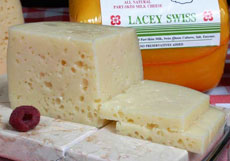
Lacey swiss cheese is sometimes mistakenly called baby swiss. The reason for the confusion is that baby swiss cheese looks very similar to lacy swiss cheese. Both cheeses are marked by smaller and more prevalent holes than the traditional swiss cheeses made in Europe, like Jarlsburg, Emmthaler, and Gruyere. Yet lacey swiss cheese is not a European cheese, and is instead an American product, with significant difference in taste and ingredients. The number of holes in lacey swiss cheese vary, but overall, when the cheese is sliced its white to ivory slices look like pieces of lace. The main differences between lacey varieties and most other swiss cheese aside from appearance are ingredients. Like many swiss varieties, lacey swiss is made from cow milk. However, instead of being made from whole milk and occasionally cream, lacey varieties are made from lowfat milk. The taste of lacey swiss differs from especially its European counterparts. Swiss may have mild, creamy and sometimes even sharp notes. You’ll notice this especially with cheeses like Gruyere and Jarlsburg. In contrast, lacey swiss cheese is mild, and bears more resemblance to cheeses like Monterey Jack and Provolone. It can have a very slight taste of nuts, but it won’t resemble the sharpness of the fatter cheeses. It’s a little softer than European swiss cheese, though it still slices well. If you’re looking for that true swiss flavor in a dish, lacey swiss cheese is not the best choice. Especially if you’re planning to melt swiss in dishes like quiche, you need the sharper notes of Gruyere or Jarlsburg. On the other hand, if you’d like mild cheesy flavor without a lot of calories, lacey swiss may be the perfect choice. Consider using lacey swiss on deli sandwiches, to top hamburgers for patty melts (it melts very well, given its low fat content), or alone for excellent sandwiches. |
Swiss
|
Swiss cheese is a generic name in North America for several related varieties of cheese which resemble the Swiss Emmental. The manufacuring process is specifically designed so that no rind forms on the cheese (maturing takes place in vacuum-packed plastic wrapping) for mass-production purposes. The taste of the cheese is very mild. It can be eaten with apples, pears, grapes and thinly-sliced prosciutto ham and salami, fruity white wine, aged red wine, cran-raspberry juice, tomato or vegetable juice. Baby Swiss and Lacey Swiss are two varieties of US Swiss cheeses. Both have small holes and a mild flavor. Baby Swiss is made from whole milk, and Lacey Swiss is made from low fat milk. This sweetish, nutty tasting cheese is known for it’s large holes. This works very well for dessert, cheese trays, sandwiches, salads and as a cooking ingredient. Goes well with bread, meats and fresh fruit. |