Dried Chiles
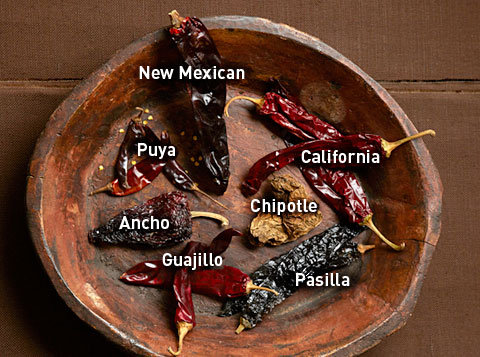
Dried peppers used in Mexican cooking
Dried Peppers Used in Mexico
The Mexican “Holy Trinity” of chilies is ancho, guajillo, and pasilla. These chilies are used to make mole sauces and other Mexican dishes.
Along with two members of the “holy trinity,” the Ancho and Pasilla Chiles, the Mulato chiles are a key ingredient in mole poblano, which is also known as Mexican mole, a dark brown chocolatey and spicy sauce that is usually served over chicken or meat.
You’ll also find Mulato Chiles used in other Mexican sauces and stews, including chicken with rice. Cooks in Mexico make stuffed Mulato peppers (similar to stuffed Poblanos) by rehydrating the chile pods, removing the seeds and then stuffing the pods with breadcrumbs, cheese and shrimp. These are then pan fried in oil.
The staple chile in authentic Mexican cooking, Anchos are a critical ingredient in red chili, tamales, many moles, enchiladas, salsa, soups and any sauce that may need some extra mild heat. You can add them directly to your recipes – sliced, diced or pureed. The whole dried pod can be ground in a blender (with or without the seeds, depending on your heat tolerance)
In addition to Mexican moles, Pasilla Chiles are used in adobo sauces and salsas. In central Mexico they're used as the signature flavor in tortilla soup. When used in soup it is more common to add the crushed Pasilla Negro chiles on top of the soup than to have them added to the base during cooking but you can certainly do both for more complex depths of flavor. This chile is a flavorful ingredient when used in your favorite Mexican recipes such as tacos, enchiladas, burritos, quesadillas and toasados but they also work well in cream sauce dishes (especially for fish).
The Guajillo is the second most popular chile in Mexcio surpassed only by the Ancho chiles. Guajillos are usually combined with Ancho and Pasilla chiles to make Mexican moles. Guajillo chilies may be used in butters, pastes or rubs to flavor all kinds of meats, especially chicken. In addition to Mexican moles use this chile in enchiladas, salsas, sauces, soups, stews and tamales. Guajillo chiles are also used to make Harissa, a hot chile paste mixture used in Tunisian cooking.
Chipotle peppers have been a staple of Mexican cuisine for centuries. These smoky, dried jalapeño peppers have a unique flavor profile that adds depth and complexity to many traditional Mexican dishes. But the cultural and historical significance of chipotle peppers goes far beyond their culinary uses. The origins of chipotle peppers can be traced back to ancient Mesoamerica, where they were cultivated by the Aztecs and other indigenous peoples. The Aztecs used a variety of chili peppers in their cooking, including chipotle peppers. Chipotle peppers are made by smoking and drying jalapeño peppers. The name “chipotle” comes from the Nahuatl word “chilpoctli,” which means “smoked chili pepper.” This process was also convenient to preserve them for later use. Chipotle peppers were also used for medicinal purposes in Aztec culture. Today, chipotle peppers are used in a variety of cuisines around the world, but their cultural and historical significance in Mexican cuisine remains strong. They are a key ingredient in many traditional Mexican dishes, including adobo sauce, mole, and chiles rellenos.
In Mexican Spanish, there are peppers that change names when changing state.
- Smoked jalapeños become a 'chipotle,' 'morita' is a type of chipotle made from a fully ripened jalapeño and is smoked for a shorter time than other chipotles which are called 'meco.' Mecos are lighter brown color and usually larger.
- A dried chilaca pepper is a pasilla or 'little raisin.'
- Dried poblanos are 'ancho,' which is Spanish for 'wide.' Mulattos are also dried poblanos, but picked when ripened to dark brown.
- Dried mirosol peppers are called 'guajillo' peppers
- Dried serrano and chile de arbol peppers are called 'chile seco'
- Dried anaheim are called California or Colorado
Chili Descriptions from J. Kenji López-Alt, https://www.seriouseats.com/. From his Original Texas Chili Con Carne Recipe:
Sweet and fresh: These peppers have distinct aromas reminiscent of red bell peppers and fresh tomatoes. They include: costeño, New Mexico (aka dried Anaheim, California, or Colorado), and choricero.
Hot: An overwhelming heat. The best, like cascabels also have some complexity, while others like the pequin or arbol, are all heat, and not much else.
Smoky: Some chile peppers, like chipotles (dried, smoked jalapeños), are smoky because of the way they are dried. Others, like ñora or guajillo have a natural musty, charred wood, smokiness.
Rich and Fruity: Distinct aromas of sun-dried tomatoes, raisins, chocolate, and coffee. Some of the best-known Mexican chiles, like ancho, mulato, and pasilla, are in this category.
The Holy Trinity
Ancho
- The dried form of the poblano pepper
- A staple in traditional Mexican dishes like mole and tamales
- A sweet, fruity flavor and lower in heat than many other peppers
Guajillo
- The dried form of the mirosol pepper
- A deep red, shiny, leathery chile that is 3-1/2 to 4 inches long and about 3/4 inches wide
- Bright, tangy, and spicy-sweet
- Used in salsas, sauces, caldos, and stews
Pasilla
- The dried form of the Chilaca chile
- Dark brown wrinkled skin
- Use fresh for enchilada sauce or salsas
- Use it dried and powdered in Mexican mole sauces
The Holy Trinity can be used as an all-purpose Mexican seasoning as well as in chili con carne and stews, salsas and casseroles.
Mild Chiles |
Medium Chiles |
Hot Chiles |
Aji Panca  (fruity) |
Chipotle  (smoky) |
Cayenne  |
| Ancho (fruity) |
Guajillo  (smoky) |
de Arbol (heat) |
| California Chile (sweet, fresh) |
Pulla |
Habañero  |
| Cascabel |
Mirasol |
|
| New Mexico (sweet, fresh) |
Pequin (heat) |
|
| Mulato (fruity) |
Tepin/Chiltepin |
|
| Pasilla Negro/Chile Negro (fruity) |
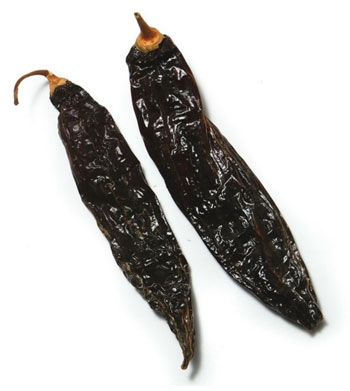
Ají panca, Peruvian red pepper, is a variety of Capsicum chinense (a chili pepper) grown in Peru and used in Peruvian cuisine. It is commonly grown on the coast of Peru and measures 3 to 5 in (7.6 to 12.7 cm) long and 1 to 1.5 in (2.5 to 3.8 cm) across. It has thick flesh and fruity overtones, it turns deep red to burgundy when ripe.
It is commonly sun-dried at the farms and sold dry. It is very mild and if deseeded and deveined is considered to have no heat but is instead used for its flavor and color. It's often sold dried or prepared into a paste.
Aji panca is an essential seasoning for one of the most popular Peruvian specialties - anticuchos. Anticuchos are pieces of marinated beef (or chicken) that are placed on wooden skewers and grilled. They are a popular street food item.
Heat Scale:
2 on the heat scale
Common Uses:
Peruvian chile used mostly with fish.
Substitutes:
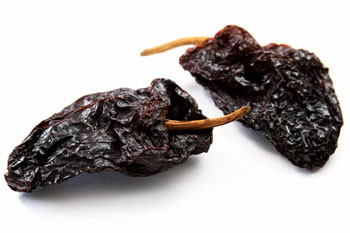
The name means "wide chile" in Spanish, a fitting moniker for this wide-shouldered, nearly black pepper. The Ancho chile is the dried form of the Poblano chile pepper. The chile pod is approx. 3" broad at the stem end, heart shaped with tapering tip, and 4" to 7" long.
Deep reddish brown to almost black. Pliable, wrinkled, prune like texture. They have a high yield of flesh to skin, which makes them a workhorse in sauces. A mild and fruity aromatic earthiness with hints of prunes, raisins, licorice and coffee. Most commonly used Mexican chile.
This large chile is among the most-used dried peppers in Mexican cooking and has a mild spice (1,000 to 2,000 SHU). It's loved for its sweet and smoky flavor that's reminiscent of paprika. Perfect for mole or adobo sauce, the ancho can tame the spiciest peppers when mixed into a chile paste.
Heat Scale:
3 on the heat scale
1,000-1,500 Scoville Heat Units
Common uses:
A versatile chile good for general purpose sauces, especially
Chile Relleno. Used in mole, enchilada sauces, tamales and stews.
The traditional mole has Ancho, Mulato and Pasilla Chiles. Green:
roast, peel and use for salsa, sauces (especially chile verde)
or stuff with cheese, shrimp or various spiced meat/vegetable
mixtures, or freeze. Red: dry in the sun; dried chiles can be
used for red chile sauces or ground into chile powder for use
in moles.
Substitutes:
Mulato (darker with earthier, more pungent flavor) OR pasilla
chile OR California chile OR dried New Mexico chile peppers
Recipes:
Homemade Chili Powder
Description:
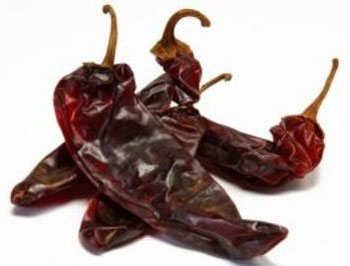
Shiny red with fairly smooth skins, these are dried, ripe Anaheim chiles with an uncomplicated, sunny flavor that is very mild. They are usually blended with more interesting chiles when making sauces.
Heat Scale:
Common Uses: Extremely flexible in use, makes all your red chile sauces.
Substitutes: dried New Mexico chile peppers (a bit hotter)
Recipes:
Homemade Chili Powder
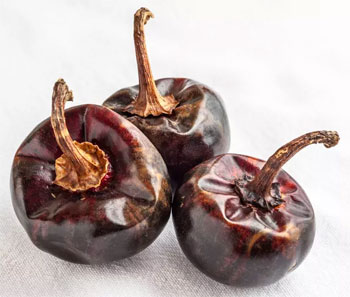
Cascabel (Bola Chile, Rattle Chile)
Squat and round, the cascabel chile pepper grows no more than 2 inches in diameter. It's a dark brown-red color when dried and hollow inside. The seeds rattle when shaken, which explains its names; cascabel means "little bell" or "rattle," and it's known as the rattlesnake chile.
The taste of the cascabel is earthy and nutty with a nice smokiness. Falling between 1,500 and 2,500 SHU, it's a mild pepper and there's no need to remove the seeds. You'll find it in traditional Mexican dishes like birria, and its best pairings are tomatoes and tomatillos. Ground cascabel peppers are a nice addition to meat stews and taco seasonings.
Heat Scale:
4 on the heat scale
Common Uses:
Used in soups.
Substitutes: guajillo OR pequin (much hotter) OR tepin (much hotter) OR cayenne (hotter)
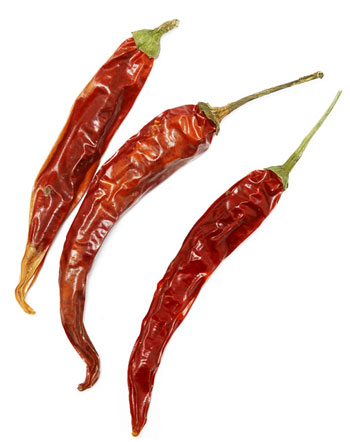
Dried Cayenne chile peppers are small and thin, bearing a wrinkled, shriveled, and textured appearance and are about 2 to 5 inches long. The pods are often curved or slightly contorted, and the dark to bright red skin is thin, glossy, delicate, and creased. Underneath the surface, a hollow cavity encases many tiny and bright yellow, round seeds. The peppers have a faint aroma and a smokey, earthy, and acidic flavor with an intense heat.
Cayenne peppers are considered a somewhat hot pepper, ranging from 30,000 – 50,000 Scoville Heat Units (SHU) on the Scoville Scale, which is about as hot as a serrano pepper. Until the habanero became widely known, most cooks considered this the hottest chile. The cayenne is mainly sold as a finely ground powder, and some supermarkets sell it as "red pepper."
Probably the most commonly used chile in the world. Cayenne pepper is ideal for adding heat to a dish without changing its flavor. Cayenne is an important ingredient in Creole Seasoning used in such Cajun dishes as gumbo and blackened redfish.
Heat Scale:
Common Uses:
Substitutes: chile de Arbol OR guajillo
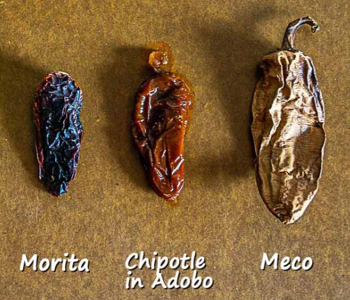
Description:
When a Jalapeno pepper is smoked and dried it becomes a Chipotle
chile (chipotle being the process of smoking and drying). The
Chipotle pod is 2" to 4" in length and 1" wide.
Dark brownish red to black. Pliable, wrinkled and raisin-like
with a rich, nutty flavor. Hints of chocolate and a subtle, smoky,
sweet heat. Also called Chipotle Morita. Chipotle Brown is a light tan,
larger version on the Morita, also called Meco. Chipotles are available dried whole, powdered, canned in "adobo sauce" or pickled.
There are actually two types of chipotle chiles - "Morita" and "Meco". Both the Morita and the Meco are smoked jalapenos. The more commonly used in our country is the Chipotle "Morita" chile. "Morita" translates to "little blackberry" in Spanish, these chiles are the smaller of the two and are more leathery and pliable. The "Meco" is larger and stiffer with a grayish-tan coloring and is best described as looking like a cigar butt. "Morita" Chipotles are picked when the jalapenos are still green and are then smoked. "Meco" Chipotle chiles are mature jalapenos that are left on the bush even longer than those that are picked as red jalapenos to be sold at various markets. This additional time on the bush results in an even deeper red color and as these chiles start losing their moisture they're then harvested to be transformed into "Meco" chipotles.
Heat Scale:
5 to 6 on the heat scale
2,500 to 5,000 Scoville Heat Units
Common uses:
Used for salsas, sauces, soups, and stews. They lend a wonderful
smoky flavor. They're usually canned in adobo sauce, but you can
also buy the dried peppers in cellophane bags.
Substitutes: (for chipotles in adobo sauce) 1 tablespoon catsup + 1/2 teaspoon liquid smoke + 1 jalapeno pepper OR morita (smaller) OR mora OR ancho (larger and milder)
Recipes:
Homemade Chili Powder
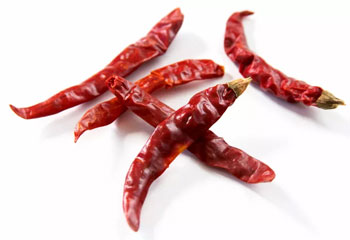
A member of the cayenne family, the chile de Arbol pod is shiny, thin and elongated with a slightly curled point. 2" to 4" long and 1/4" to 1/2" wide at stem end. Bright, translucent to brick red. Smooth skin, acidic heat with smoky grass overtones. Available fresh or dried, keeping its bright red color in both forms.
De Arbol chile peppers are a favorite in Mexican cuisine because of their bold heat and subtle smoky taste. Unlike many chiles, these remain bright red even after they’re dried and are often used to make chili pepper wreaths, or ristras, because of this feature. It is exceedingly hot - 6 times hotter than a jalapeño pepper. Use it in place of cayenne as the heat levels are similar but the cayenne really provides no additional flavor just heat.
De Arbol is not from a tree as the word árbol suggests, árbol means “tree chili” in Spanish, but from a tall, rangy plant. The fresh chile is a bright green that ripens to bright red, a color that it retains when it is dried with care. This chile can be toasted and ground with other ingredients for a piquant table sauce or added to fried beans. They are often used in thin “hot sauce”-style salsas. But perhaps most commonly it is lightly toasted and ground to a powder for sprinkling on peanuts, fruits, cucumbers and jicama. When you want to kick up any dish's spice, a single àrbol will do the trick.
Other names for this pepper include Bird’s beak chile, and Rat’s tail chile.
Heat Scale:
7 to 8 on the heat scale
15,000-30,000 Scoville Heat Units
Common uses:
Used whole in stews and soups, ground for red chile sauces. The
primary heat source for table sauces, chile oils and vinegars.
Substitutes:
Cayenne pepper OR pequin chiles
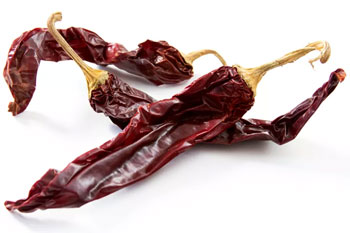
Guajillo (gwah-HEE-yoh)
These "little gourds" (for the rattling sound the seeds make when shaking the dried pods) are dried mirasol chiles. Related to the Pulla chile and also known as Mirasol, Pullia, and Puya. The Guajillo chile is very tough and must be soaked longer than most dried chiles. This chile pod is elongated, slightly curved and tapered to a point. Measures about 4" to 6" long, 1" to 1 1/2" wide. Color is deep, reddish brown to purple. Shiny, thin, though tough skinned with a mild, sweet heat. Along with the ancho, the guajillo is essential in Mexican food.
It's a medium to hot pepper, ranging from 2,500 to 5,000 SHU, or similar to a semi-mild jalapeño. Its complex smoky flavor balances the heat perfectly.
Guajillo chillies are sometimes used to make the salsa for tamales; the dried fruits are seeded, soaked, pulverized to a thin paste, then cooked with salt and several other ingredients to produce a thick, red, flavorful sauce. They may be used in pastes, butters or rubs to flavour all kinds of meats, especially chicken. Alternatively, they can be added to salsas to create a sweet side dish with a surprisingly hot finish. A Mexican workhorse chile, very flexible and distinctive.
Heat Scale:
3 on the heat scale
1,000 to 2,500 Scoville Heat Units
Common uses:
Used widely for coloring and flavor in salsas, soups, stews, sauces,
meat dishes and corn dishes.
Substitutes:
Cascabels (rounder and shorter) OR New Mexico chiles OR California
chiles (milder)
Recipes:
Homemade Chili Powder
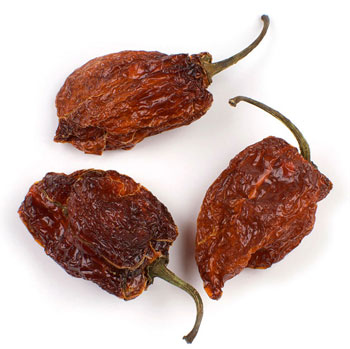
The Habañero pepper (ha-ba-NEH-ro)
These extremely hot chiles are wrinkled
and orange.
These peppers are small, boxy, lantern-shaped chiles, approximately 1 ½-2 inches long and just over an inch wide. While they are small, they are mighty. They contain a tremendous amount of heat; from 1994-2006, the Guinness Book of World Records named the Habañero the world's hottest chile, but other peppers have since toppled it. Jalapeños measure 2,500-8,000 SHU so a Habañero at 100,000-350,000 SHU can be as much as 50-60 times hotter than a jalapeño.
A Habañero pepper is not the same as a Scotch Bonnet. People often confuse the two peppers. They look a lot alike. They are both boxy and small and are both members of the Capsicum chinense family, so they share a similar heat profile. Habañero peppers have a SHU of 100,000-350,000, and Scotch Bonnets deliver 200,000-300,000 SHU. They can be used in the same ways and equal amounts. However, Scotch Bonnets taste like apples and tomatoes, while Habanero has coconut, papaya, and berry flavors.
It’s commonly accepted that Habañero chiles are an ancient variety of pepper, with ancestors that emerged in the Amazon roughly 8,000 years ago. The peoples of that region were active traders, carrying the Habañero seeds up through Mexico. This pepper thrived in the hot, dry climate of the Yucatan peninsula, where it became a domesticated and tradeable crop. Eventually, this pepper came to Havana, Cuba, which had been a trading port for Spain since the 1500s and is the center of the La Habana Province. This pepper became very popular in the Cuban markets, eventually being given the name Habañero to indicate its association with the trade there.
The original name of the Habañero pepper has been lost, with one exception. The brown variety of Habañero was extensively grown by the Aztecs. It was known as xocolātl (sho-co-LAT) since the color of the pepper was reminiscent of the drink they enjoyed made from bitter brown cacao. From this same root came the word for one of the world’s favorite treats, chocolate.
Heat Scale:
10 on the heat scale, 100,000-350,000 SHU (Scoville Heat Units)
Common Uses: Salsas, sauces, spice rubs, omelets, and frittatas
Salsa and BBQ.
Substitutes: chile de Arbol
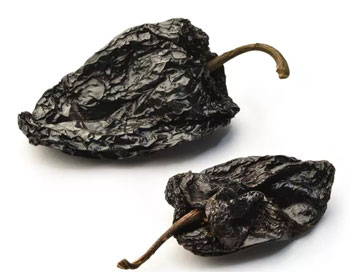
Mulato chiles are the same in shape to Anchos but somewhat longer and flatter. The flattened, heart-shaped, blunt-ended chiles are 4" to 6" long. Very dark brown, almost black in color. They are sweeter and a little more pungent (smokier flavored) than Anchos. Mulato chiles have a light fruity, licorice or chocolate flavor.
Ancho Peppers and Ancho Mulato Peppers are both the dried form of Poblano Peppers. The difference is in the time they were picked. Ancho Peppers are picked when they are red while Mulato Peppers are allowed to ripen longer until dark brown. Both Peppers have mild to medium heat with subtle difference in flavor. Ancho Peppers are more fruity while Mulato Peppers are more smoky. The heat typically ranges from 3 to 5 out of 10 on the chile heat scale (2,500 and 3,000 SHU). To accurately identify the ancho, slit it open and hold it up to the light: it should be a reddish color; the mulato, a brownish color.
The most common use for these peppers is in Mole however, Mulato chiles are great in any sauce and they can be substituted for Poblanos, Anchos or Pasilla Chiles in any dish.
Mulato Peppers are used in their dried form. The dry peppers are flat, wrinkled and a deep brown/black color. Dried Mulato are part of the famous "trilogy" (with Ancho and Pasillo Chiles) used to make Mexican mole sauces which are a combination of chocolate and chiles.
Heat Scale:
3 on the heat scale
1,000-1,500 Scoville Heat Units
Common uses:
Traditionally used in sauces, chile pastes, enchiladas, and chile
con carne to add a distinctive rich mellow flavor. The traditional
mole has Ancho, Mulato and Pasilla Chiles.
Substitutes: ancho chile (sweeter)
Recipes:
Homemade Chili Powder
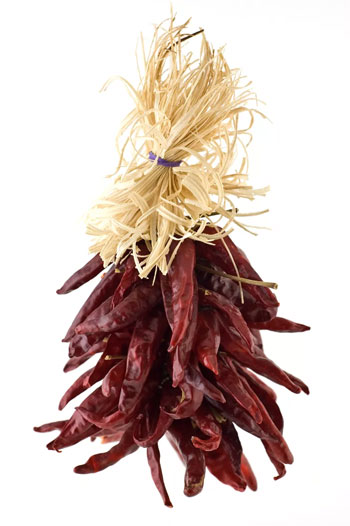
New Mexico Red Chile (chiles de ristra)
The state of New Mexico has a special kind of chile pepper. A variation of dried Anaheim chiles, these long, tapered chiles are often labeled "Colorado chiles."It was developed in the late 1800s to standardize the chile pepper's size and heat. Today there are so many "New Mexican" chile pepper cultivars that the spice range extends from a mild 1,000 SHU to a spicy 8,000 SHU, or hotter. The most famous are Hatch chiles.
These chiles have an earthy flavor and resemble the California chile, only they're hotter and more flavorful. Hotter than California chiles, but with the same sunny flavor, they are sometimes crumbled dry over soups or reconstituted for a simple chile puree.
New Mexican chiles are most often eaten while green. The vine-ripened red chiles are popularly seen hanging in bunches called ristras to dry before they're ground into chile powder.
Heat Scale:
4 on the heat scale
500-2500 Scoville Heat Units
Common Uses:
Extremely flexible in use, makes all your red chile sauces. Used
for traditional hot red chili sauce
Substitutes: California chile OR ancho chile
Recipes: Homemade Chili Powder
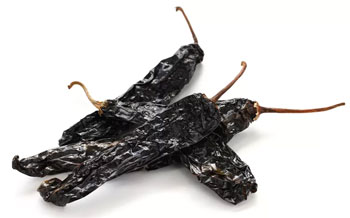
Also known as Pasilla Negro and Chile Negro. This dried form of the Chilaca chile pod is elongated with slight taper. 5" to 8" long with fairly uniform width of 1" to 2". Deep, purply, brownish black. Pliable, wrinkled, prune-like texture. It's often mislabeled or confused for an ancho, though this chile is considerably thinner.
Mild, aromatic with dried grape-like flavor (hence 'little raisin'). Hints of licorice and herbs. Very dark green, ripens to a dark brown; sometimes called chile negro when dried. Up to 8-10" long, thin walled, wrinkled skin.
These long, tapered chiles sport black, wrinkled skins and lend a subtle, prune-like flavor with a whisper of licorice to sauces. Complex and quite spicy, the dark flesh of these "chile negros" yields a mahogany brown puree that is often blended with cream.
The name is derived from the Spanish for "raisin," and the taste is reminiscent of dried fruits like raisins and prunes. It has a medium heat ranging from 1,000 to 2,000 SHU. Pasilla peppers are often paired with anchos and guajillos for chile sauces or spicier chiles like jalapeños for salsa.
Heat Scale:
3 on the heat scale
1,000-1,500 Scoville Heat Units
Common uses:
Used in moles and sauces for seafoods. A specialty in soups. The
traditional mole has Ancho, Mulato and Pasilla Chiles. Dried pods
used for mole sauces, fresh can be used in enchilada and chile
sauces.
Substitutes:
Ancho chile (sweeter) OR mulato chile (stronger, earthier flavor). Guijillo peppers are often used as a substitute for Chili Negro which is harder to find.
Recipes:
Homemade Chili Powder
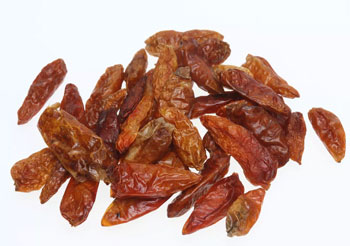
The pequín chile is also called chile pequeño (little chile) or bird pepper (birds eat them and aren't affected by capsaicin). It's a tiny pepper that grows no longer than 1 inch and dries down to an orange-brown color.
This chile packs a lot of heat into its small package. At 40,000 to 60,000 SHU, it is 12 times hotter than the jalapeño and more like a cayenne. It's at the milder end of the superhot chile peppers, making it useful in food dishes. Once you get past the spice, the pepper has a smoky, fruity taste. While they are not very common, the pequín is used in salsas, spicy soups, and oils and is a key ingredient in Cholula Hot Sauce.
Heat Scale:
8 on the heat scale
Common Uses:
Substitutes: chile de Arbol OR tepin OR cayenne OR cascabel
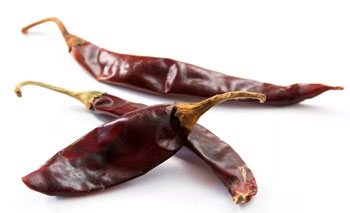
The Pulla (or puya) chile is the smaller, more potent relative of the Guajillo chile pepper, but not as common or easily found. This chile looks like a guajillo, with a similar glossy, crimson skin, but just a few inches long. It is narrow and elongated with curved and tapered tip, 3" to 5" long and 1/2" to 3/4" at the widest point. Deep, translucent, burgundy red. Shiny, thin skinned with hints of licorice and a sharp and fruity aromatic flavor.
Similar in flavor, color and shape to the guajillo, pulla chiles (sometimes spelled "puya") are smaller and, more importantly, hotter (5,000 to 8,000 SHU) -- without being scorching. They're excellent pureed into sauce or fried for chile oil.
Enjoyed for its fruitiness, the pepper is excellent in purées, stew water, and sauces for meat dishes.
Heat Scale:
6 on the heat scale
5,000-15,000 Scoville Heat Units
Common uses:
Excellent seasoning for sauces, salsas and stews. Wonderful with
fruits such as mangos, pineapples, papayas and melons. Also used
as a spice on chips and popcorn.
Substitutes:
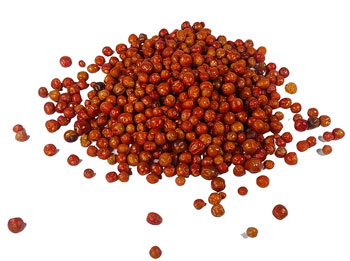
Tepin (chiltpin, chiltepin, chiltecpin)
These look a bit like large dried cranberries. They're also sold fresh. Cheaper alternative to habanero. Small and torrid. These are wild peppers, sometimes called Tepin, Bird, or Bird's Eye peppers. The seeds need to pass through the digestive tract of a bird before they will germinate. Heat is similar to a Serrano, but varies quite a bit and it dissipates quickly, unlike other chiles or hot sauces with a lingering burn. Sun-dried chiltepíns are noticeably smoky, carrying a distinct earthiness that rounds out their powerful kick. They typically fall between 50,000 to 100,000 units on the Scoville chart. For comparison, jalapeños usually fall between 2,500 to 8,000 units.
“Chiltepín is often called the ‘mother of all chiles,’ and is believed to be where all chiles trace their genetic origins,” says Janos Wilder, a James Beard Award–winning chef and cookbook author based in Tucson, Arizona. First domesticated in central Mexico 6,000 to 7,000 years ago, the word chiltepín comes from the Nahuatl words chilli and tepin, directly translating to “small pepper.”
Heat Scale:
7 on the heat scale
Common Uses:
They have subtle flavor, and are good to use in soups, stews or
sauces.
Substitutes: pequin OR cascabel OR cayenne
