
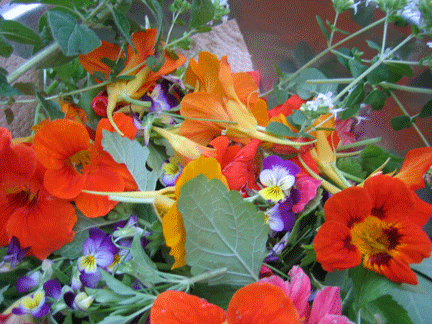
Eating flowers has been in and out of style since the early days of the Roman Empire, when roses, mallows, violets and gladiolus bulbs were part of the feast on the banquet table.
In the 13th century, Moorish recipes called for syrup flavored with rosewater. Nasturtiums, violets and marigolds have been in English salads since the 17th century, and by the Victorian era, violets were being candied and preserved.
Flowers make colorful garnishes for food and drinks. Larger flowers, such as squash blossoms, can be stuffed and fried. They all can be added to brighten the look and flavor of salads, chopped and mixed with butter, used in jellies, infused into vinegars, candied for wedding cakes, frozen in ice cubes or molds, and used to scent sugars or add fragrance to baked goods.
Lavender, lilacs, violets, roses and scented geraniums have a fragrant sweetness. Nasturtiums are peppery, and pansies taste a little like grapes.
Other flowers, too, can be battered and fried -- elderflowers, apple blossoms, acacia flowers and lilacs. Nasturtium, violets, marigolds and snapdragons give salads color, texture and cheerfulness. Herb flowers such as those from chives, basil, rosemary and dill are also good in salads and cold soups, or to infuse vinegar.
Day-lily buds are one of the most flavorful of all edible blossoms. They have long been part of Chinese cuisine, in which they are added to soups and stir-fries. They are the only flower to eat unopened.
You can't just go to the florist and get a bunch of flowers to munch on the way home, however. You should only eat flowers that are grown organically. Flowers from florists, nurseries or garden centers are likely to have been treated with pesticides not used for food crops.
And like mushrooms, some flowers are poisonous. For example, don't eat azaleas, daffodils or oleander. If you have any doubt, consult a reputable reference book or horticulturist. The Internet, too, has many reputable sites listing poisonous flowers. Many farmers markets carry edible flowers, as do some supermarkets and specialty food stores.
For some flowers, such as tulips and chrysanthemums, only the petals are edible. It's also nice to separate large blooms into petals or florets and remove the sometimes-bitter disks from flowers such as marigolds and daisies.
You can, of course, grow your own edible flowers. Just pick them early in the morning but after the dew has dried. Use flowers soon after they're picked or else they may develop a bitter taste. If they don't taste or smell good, don't use them.
Also, remove the pistils and stamens from flowers before eating, since the pollen can affect the flavor as well as cause an allergic reaction in some people.
If your flowers have stems, keep them in water until you use them. Otherwise, swish them in a little water and spread on a damp towel and refrigerate no longer than overnight.
Flowers are a colorful, happy addition to the summer table. It's true that a rose is a rose is a rose. But in some instances, it also can be a very good dinner.
Edible Flowers |
||
| Common Name | Botanical Name | Comments & Recipes |
| Angelica | Angelica archangelica | May be skin allergen to some individuals. Good with fish and the stems are especially popular candied. Celery-flavored. |
| Anise Hyssop | Agastache foeniculum | Sweet, anise-like, licorice flavor |
| Apple | Malus species | Eat in moderation; may contain cyanide precursors. Delicate floral flavor |
| Arugula | Eruca vesicaria | Nutty, spicy, peppery flavor |
| Basil | Ocimum basilicum | Different varieties have different milder flavors of the corresponding leaves, such as lemon, mint. |
| Bee Balm | Monarda species | Used in place of bergamot to make a tea with a flavor similar to Earl Grey Tea. |
| Borage | Borago officinalis | Light cucumber flavor. |
| Burnet | Sanguisorba minor | Faint cucumber flavor, very mild. |
| Calendula | Calendula officinalis | Poor man's saffron, spicy, tangy, peppery flavor, adds a golden hue to foods. |
| Carnation | Dianthus caryophyllus (aka Dianthus) | Spicy, peppery, clove-like flavor |
| Chamomile | Chamaemelum nobile | Faint apple flavor, good as a tea |
| Chicory | Cichorium intybus | Buds can be pickled. |
| Chives: Garden | Allium schoenoprasum | Mild onion flavor. The leaves, flowers and bulbs can be eaten. The seeds don't have much flavor. Omelette aux Fines Herbes *Asparagus w/ Sesame & Chive Blossoms |
| Chives: Garlic | Allium tuberosum | Garlicky flavor Korean Sauteed Garlic Chive Flower Stems |
| Chrysanthemum: Garland | Chrysanthemum coronarium | Slight to bitter flavor, pungent |
| Citrus: Lemon | Citrus limon | Waxy, pronounced flavor, use sparingly as an edible garnish, good for making citrus waters. |
| Clover | Trifolium species | Raw flowerheads can be difficult to digest. |
| Coriander | Coriander sativum | Pungent. A prime ingredient in salsa and many Latino and Oriental dishes. Some palates detect a disagreeable soapy flavor while others adore it. |
| Cornflower | Centaurea cynaus (aka Bachelor's Buttons) | Sweet to spicy, clove-like flavor |
| Dandelion | Taraxacum officinalis | Very young buds fried in butter taste similar to mushrooms. Makes a potent wine. Dandelion Honey |
| Day Lily | Hemerocallis species | The Lillium species contain alkaloids and are NOT edible. Daylillies may act as a laxative. Sweet, crunchy, like a crisp lettuce leaf, faintly like chestnuts or beans |
| Dill | Anthum graveolens | |
| Elderflowers | Elderflower Fritters | |
| English Daisy | Bellis perennis | Tangy, leafy flavor |
| Fennel | Foeniculum vulgare | Sweet, licorice flavor. |
| Fuchsia | Fuchsia X hybrida | Slightly acidic flavor |
| Gardenia | Gardenia jasminoides | Light, sweet flavor |
| Gladiolus | Gladiolus spp | Similar to lettuce |
| Hibiscus | Hibiscus rosa-sinensis | Slightly acidic flavor, boiled makes a nice beverage |
| Hollyhock | Alcea rosea | Very bland, nondescript flavor |
| Honeysuckle: Japanese | Lonicera japonica | Berries are highly poisonous. Do not eat them! |
| Hyssop | Hyssopus officinalis | Should be avoided by pregnant women and by those with hypertension and epilepsy. |
| Impatiens | Impatiens wallerana | Very bland, nondescript flavor |
| Jasmine: Arabian | Jasminum sambac | Delicate sweet flavor, used for teas. |
| Johnny-Jump-Up | Viola tricolor | Contains saponins and may be toxic in large amounts. Sweet to bland flavor |
| Lavender | Lavendula species | Lavender oil may be poisenous. Floral, slightly perfumey flavor |
| Lemon Verbena | Aloysia triphylla | Lemony flavor, usually steeped for tea |
| Lilac | Syringa vulgaris | Lemony, floral, pungent flavor |
| Mallow: Common | Malva sylrestris | Sweet, delicate flavor |
| Marigold: Signet | Tagetes tenuifolia (aka T. signata) | Spicy to bitter flavor |
| Marjoram | Origanum majorana | |
| Mint | Mentha species | |
| Mustard | Brassica species | Eating in large amounts may cause red skin blotches. |
| Nasturtium | Tropaeolum majus | Buds are often pickled and used like capers. Sweet, mildly pungent, peppery flavor |
| Okra | Abelmoschus aesculentus (Hibiscus esculentus) |
Similar to squash blossoms |
| Pansy | Viola X wittrockiana | Very mild sweet to tart flavor |
| Pea | Pisum species | Flowering ornamental sweet peas are poisonous. |
| Pineapple Guava | Feijoa sellowiana | Similar to the ripe fruit of the plant, flavorful |
| Primrose | Primula vulgaris | Birdseye Primrose (P. farinosa) causes contact dermatitis. Bland to sweet flavor |
| Radish | Raphanus sativus | Milder, sweeter version of the more familiar radish heat |
| Redbud | Cercis canadensis | Mildly sweet flavor |
| Rose | Rosa rugosa or R. gallica officinalis | Sweet, aromatic flavor, stronger fragrance produces a stronger flavor. Be sure to remove the bitter white portion of the petals. Rose hips are also edible. |
| Rosemary | Rosmarinus officinalis | Pine-like, sweet, savory flavor |
| Runner Bean | Phaseolus coccineus | Nectar, bean-like flavor |
| Safflower | Carthamus tinctorius | Another "poor man's saffron" without the pungent aroma or strong flavor of the real thing |
| Sage | Salvia officinalis | Sage should not be eaten in large amounts over a long period of time. Taste varies by type. |
| Savory: Summer | Satureja hortensis | |
| Scented Geranium | Pelargonium species | Citronella variety may not be edible. Taste varies with differing varieties from lemon to mint. |
| Snapdragon | Antirrhinum majus | Bland to bitter flavor |
| Society Garlic | Tulbaghia violacea | Very mild garlic flavor |
 Squash Blossoms |
Cucurbita pepo species (aka Zucchini Blossom) | Sweet, nectar flavor. All summer & winter squash blossoms are edible. |
| Sunflower | Helianthus annus | Leafy, slightly bitter. Lightly steam petals to lessen bitterness. Unopened flower buds can be steamed like artichokes. |
| Thyme | Thymus vulgaris | Lemon flavor, adds a nice light scent. |
| Tuberous Begonia | Begonia X tuberosa | ONLY HYBRIDs are edible. The flowers and stems contain oxalic acid and should not be consumed by individuals suffering from gout, kidneystones, or rheumatism. Further, the flower should be eaten in strick moderation. Crisp, sour, lemony flavor |
| Violet | Viola species | Sweet, nectar flavor |
| Yucca | Yucca species | Only the petals are edible. Other parts contain saponin, which is poisonous. Large amounts may be harmful. Crunchy, fresh flavor |
| Flowers to Avoid | Some flowers in particular to be avoided (but not a complete list) are: azalea, crocus, daffodil, foxglove, oleander, rhododendron, jack-in-the-pulpit, lily of the valley, and wisteria. | |
