King or Chinook Salmon
from http://fishcooking.about.com/
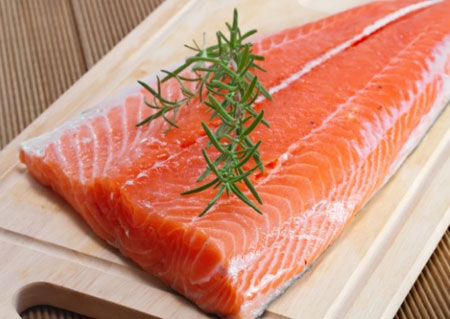
For a list of the different types of salmon, see below.
King salmon is so called for a reason. It is the largest salmon in the world and many think it is the best tasting, although the silver and sockeye have their fans. Also called the chinook salmon, king salmon can grow well over 100 pounds and can vary wildly in flavor.
From an eating standpoint, ocean-caught fish are the finest flavored. At their best, kings are a blinding chrome on the outside, with meat that is a vibrant orange inside.
So-called "bright" salmon caught in rivers are also good eating, but once the fish begin to turn dark or, even worse, red, they rapidly become useless for all but pet food: the meat becomes watery, mushy and tasteless, often with an undertone of mud. Not good eats.
A wild, ocean-caught or even a bright river-caught salmon will always taste better than a farm-raised salmon. But a farm-raised fish will surpass a poor quality river fish, and are often fattier.
Remember that all farmed salmon are Atlantic salmon, which is a different species.
You must assume every salmon you see in the market that is listed just as "salmon" will be farm-raised. Wild fish command higher prices and will be advertised as such. There are numerous environmental concerns over farm raising salmon, so be aware that this is not yet an ecologically friendly fishery.
Alaskan wild salmon, however, remains so, as does the fishery from Washington state. California king salmon vary widely in numbers from year to year and are currently at a low point in their population cycle.
From a cooking standpoint, kings are extremely versatile.
They are loaded with omega-3 fatty acids, and that fat makes a king salmon very forgiving to a novice cook. Salmon fat can be so creamy that a sushi-grade salmon belly is, at least in my opinion, superior to that of toro tuna.
And every part of a chinook lends itself to grilling, slow barbecuing and especially the even slower process of smoking.
But this fat is also salmon's enemy, as it goes rancid fast. Even the best frozen fish will not keep at its prime condition in a home freezer more than three months. If you find yourself with more salmon than you can eat in that time, my advice is to make friends and give some away.
A word on salmon skin: Don't waste it. Once it's been scaled, salmon skin crisps up beautifully and can be served as the fishy equivalent of chicarrones, or deep-friend pork rinds. Trust me on this one, crispy salmon skin is a treat not to be missed.
Types of Salmon Available at the Grocery Store
King (Chinook): Expect rich, buttery flavor and a price that will cost you more than any other variety. Think of King as the Cadillac of salmon. Chinook salmon are commercially harvested in Alaska, Washington, Oregon and in small amounts off California. Most Chinook salmon is sold fresh or frozen.
Atlantic salmon: The majority of salmon currently consumed in the U.S. is farm raised Atlantic salmon from Canada, Chile and Norway. Farmed Atlantic salmon is primarily sold as fresh or frozen dressed fish, fillets or steaks. Commercial fishing for wild Atlantic salmon is prohibited in the U.S. because wild population levels in the eastern U.S. are extremely low.
Sockeye: Expect flesh with a deep, red color, and don't worry if the skin is light gray—chances are those varieties are just from extremely cold glacial waters. The best Sockeye are from sources like the Copper River, where the salmon have a long "run" to make and, as a result, must gorge themselves in advance for fuel, creating fish with plenty of rich, delicious fat. Sockeye salmon is caught by U.S. fishermen, mainly in Alaskan waters. Sockeye salmon is sold fresh, frozen and canned.
Coho (Silver): Most Coho salmon is caught in Alaskan waters, and some is imported from Canada and Chile. They're widely available and freeze well. One thing to note: If you have access to extremely fresh fish, you'll want to avoid Coho at the very beginning of the season (the first week of July), since they need a bit more time to bulk up than other varieties. Most Coho salmon is sold fresh or frozen.
Pink: Almost all Pink salmon consumed in the U.S. is harvested in Alaska. Very mild in flavor and very fragile. A Pink is at optimal quality the day it's caught. But it doesn't freeze well or age well. As a result, a retailer like Whole Foods rarely sells Pink in its retail case. Pink salmon is primarily sold as a canned product—and they're delicious in salmon cakes.
Chum: You might see this also labeled as Dogfish or "Keta." Chum salmon breed at the mouth of the rivers and streams and are lower in fat, making them great candidates for smoking. Typically, though, Chum is harvested for its roe. But, if you happen upon chum from the Yukon River or Johnstone Straight, you should jump at the chance to buy them, as they're meatier and great for grilled and smoke preparations. Chum salmon are primarily harvested by U.S. fishermen in Alaska. Wild fish populations in Alaska are supported by the release of hatchery raised fish. Chum salmon are sold fresh, frozen and canned.
