Types of Crabs
When it comes to seafood, sweet and meaty crabs are king. But just as there are many fish in the sea, there are plenty of these crustaceans, too. From blue crab to soft-shell to, yep, king crab, here's how to identify, cook with, and eat it all.
Crabs are much more versatile than most people realize. They can be steamed or boiled of course, or made into crab cakes. However, they’re also great in soups, chowders, stews, casseroles, and other wonderful dishes. Soft-shell crabs can be battered and fried whole, and crabs and crab legs are amazing on the grill, too.
King Crab and Snow Crab are prized for their sweet and succulent leg meat. Although meat from the body is edible, the King Crab and Snow Crab are typically broken down before pre-cooking and freezing. The claws and legs are most commonly available, frozen.
Dungeness Crab, Blue Crab and Soft-shell Crabs are typically prepared whole, and meat from the legs, claws, and bodies is consumed. Tackling the tricky business of extracting the meat from the hard bodies is all part of the experiences—albeit a messy part.
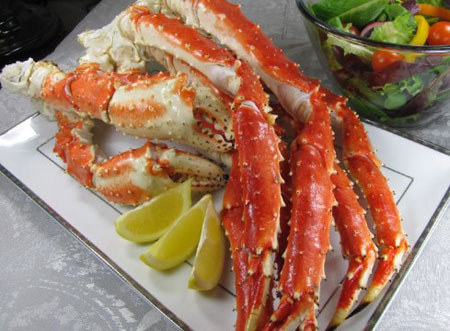
King Crab
Delicious, bright white meat, but notoriously difficult to coax out of the hard, spiny shell. The delicately flavored meat is snowy white with a bright red outer edge.
The largest crab species is fished from October to January in Norton Sound, Alaska, and the Bering Sea. Only males are harvested.
Latin name Paralithodes camtschaticus, King crab are identified by their big, spiny shells and enormous legs—the entire crab, including the legs, can span as large as 5 feet across. Unsurprisingly, they are prized for the meat contained in their legs, which is very sweet.
How to Prepare: When seeking King Crab, you'll most likely encounter pre-cooked and frozen legs, so be aware that when purchasing pre-cooked, all you have to do is thaw and reheat them; avoid overcooking, or the meat will be tough. Your fishmonger may sell them pre-split, which makes harvesting the meat from them easier. You can prepare them by steaming, boiling, or grilling. They're excellent with melted butter or a remoulade-style sauce. Use a cracker on the tough, spiny leg clusters to access long, thick spears of meat inside.
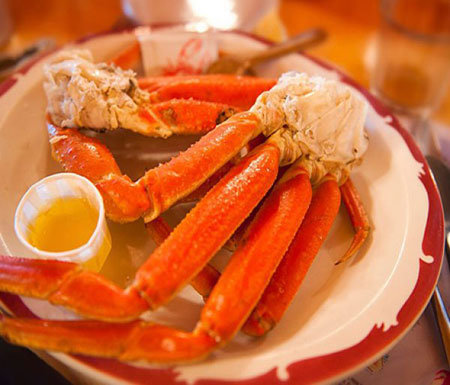
Snow Crab
A sweet, easy staple at all-you-can-eat seafood buffets.
Fished from both North Atlantic and North Pacific Oceans through the cold months of January through April.
Latin name Cancer quanbumi, it is found along the East coast of the US, living among rocks and in deep water. Its spindly legs make it resemble a spider, and is also known as "spider crab." It's smaller and thinner than King crab, but the legs are equally coveted. Four walking legs plus a claw arm are sold in clusters and easy to snap and eat without any tools. Snow crab is so-named for its pristinely white meat.
How to Prepare: You know the drill: Thaw, reheat (or not), extract, dip, devour.
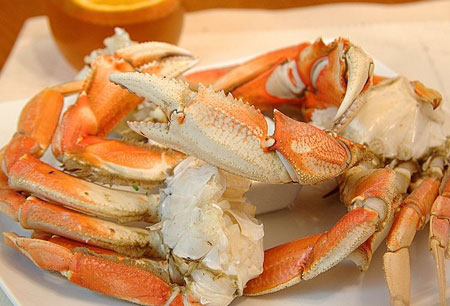
Dungeness Crab
The pink flesh is succulent, sweet, tender, and flaky.
Latin name Cancer magister, this crab is found in coastal waters from Alaska to Baja, Mexico and are commonly sourced from the Pacific coast in Northern California, Oregon, Washington, or British Columbia. It is named for the former small town of Dungeness on the Olympic Peninsula in Washington state, which first began commercially harvesting the delicacy.
This large crab usually weighs in from 1 3/4 to 4 pounds and is brown to purple in color. Law requires the crab to be at least 6 1/4 inches long to be harvested, and only males can be taken. Marketed year-round, but harvested from late fall to late spring, from Alaska down the West Coast. Prime season is in the winter months.
How to Prepare: Boil or steam for 5-10 minutes until cooked through, season, and crack open with mallets or hammers.
One whole crab - heated and cracked, served simply with butter or dipping sauce - can feed 2 people. They're larger than blue crabs (and sweeter, according to some), but are prepared in a similar way. If you live on the West Coast, you’re likely to find whole, live Dungeness crabs for sale as the season gets going. Elsewhere, they’re often sold as split and cleaned sections.
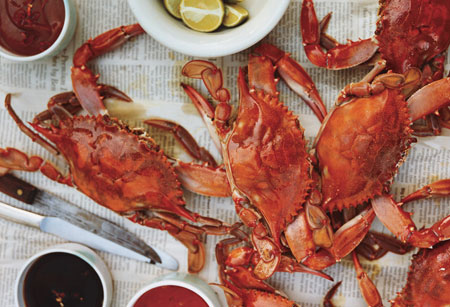
Blue Crab
Delicious salty sweetness, but only after considerable effort.
Synonymous with summer and the Chesapeake Bay area. Its Latin name, Calinectes sapidus, means "beautiful swimmer," and it is indeed a beautiful blue-green color.
With bright blue claws, this variety of crab is easily recognizable. They're found in the Western Atlantic ocean, and are particularly abundant around Maryland's Chesapeake Bay area. The most prolific species on the East Coast of the US, they range in size from 3 1/2 inches up to 5 1/2 inches or more on the market. Though their blue color is their most common identifying feature, these crabs do turn the traditional reddish color when cooked. Fished along the Atlantic coast, particularly the Chesapeake Bay, and the Gulf of Mexico from April through December.
How to Prepare: Blue crabs are usually steamed and served whole. Ask a Maryland local, and they'll tell you that blue crabs should be steamed until cooked (they turn bright red), tossed with a ton of Old Bay, and attacked with mallets (or just your hands) over newspaper. They're messy, but that's really half the fun. You must basically dissect the whole carcass yourself, removing claws, legs, gills, and other viscera before snapping the entire body in half to pick out the meat.
Extracted and packaged lump crab and jumbo lump crab meat typically comes from blue crabs; it's what's used in crab cakes and salads.
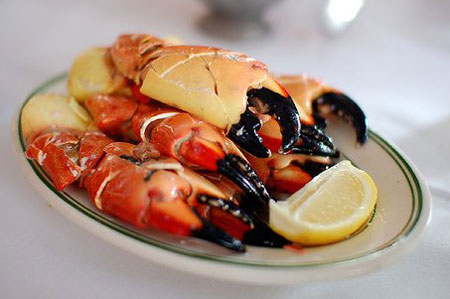
Stone Crab
When in-season, a flaky white delicacy inside a fancy little black-tipped claw.
Latin name Menippe mercenaria, it is also called "moro" or "morro" crab. It has large, very hard claws that are prized for their meat. Most of the harvest comes from Florida, US, where it is a prized delicacy harvested from October 15 to May 15. Fisherman snap off a single claw and throw the rest of the crab back into the water, where it will regenerate a new one within a year and a half.
They're squat and compact, and named "stone crab" for their extremely hard shells (although the meat they contain is quite soft and sweet). The law requires these claws to be boiled for 7 minutes and then either put on ice or frozen. The freezing process seems to remove an unpleasant iodine taste which is often noticed in the meat. To determine which claws have the most meat, they are floated in a tank of water, with the less meaty claws rising and being sold as "lights."
How to Prepare: To serve, the claws are cracked with a mallet and served cold with dipping sauces. The minimum size for claws is 2 to 2.75 ounces. The meat has a firm texture and a sweet, succulent flavor.
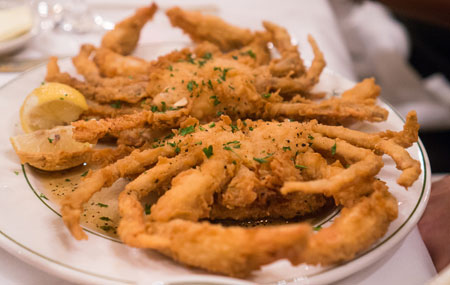
Soft-Shell Crab
Soft-shell crabs are blue crabs with a bit of a misnomer. Not a kind of crab, but a culinary term for crabs that have recently molted, so their new exoskeletons have not yet hardened. Perhaps more accurate would be "no shell" crab, as they have shed their shells before growing new, larger ones.
In North American, the species is typically the blue crab, captured within days of molting in spring and early summer. The season begins in late April or early May, when the crabs start the molting process; they're available until June or early July.
Aside from the gills, mouthparts, and abdomen, the entire body is edible; the salty, chewy remaining sections are usually served battered and deep fried or sautéed.
How to Prepare: Soft-shell crabs must be cleaned before preparing. You can ask your fishmonger to do it for you, but if you choose to clean them yourself, you'll have to use sharp shears to snip off their faces, and pull out their gills. Then, proceed with the recipe. Fried Soft-Shell Crab Sandwich with Old Bay mayonnaise is popular.
