Truffles
Tuber aestivum, T. gibbosum, T. magnatum, T. melanosporum, T. texensis
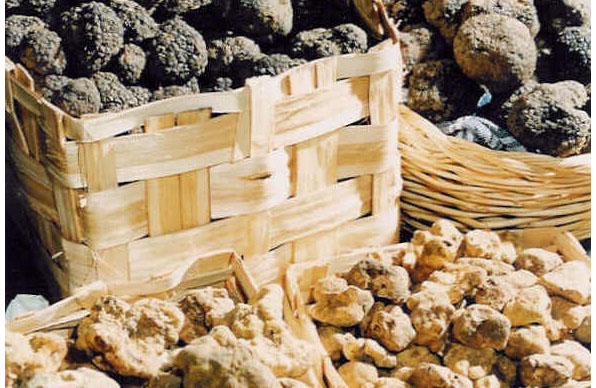
Truffles have been found in Europe, Asia, North Africa, and North America, but only three species are commercially important. They live in close mycorrhizal association with the roots of specific trees. Their fruiting bodies grow underground.
The term "truffle" as commonly used refers to members of the genera Tuber and Terfezia. There are many other kinds of subterranean fungi, "false truffles," which outwardly resemble the ones we eat. They are far more common than the ones that are collected for food, and some are poisonous.
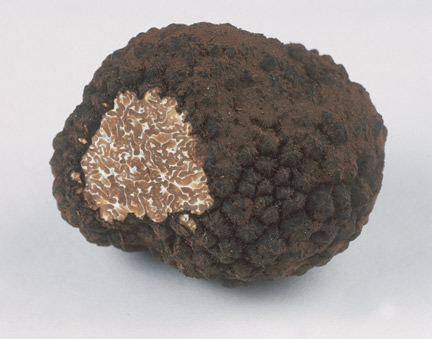
Truffles are round, warty, and irregular in shape and vary from the size of a walnut to that of a man's fist. The season for most truffles falls between September and May.
The mention of truffles conjures up images of the expensive French black truffle (Tuber melanosporum) from the Périgord region of southwest France, used in making pâté de foie gras, or the renowned odorous white truffle (Tuber magnatum) of Alba, in the Piedmont district of Italy.
Since the times of the Greeks and Romans these fungi have been used in Europe as delicacies, as aphrodisiacs, and as medicines. They are among the most expensive of the world's natural foods, often commanding as much as $250 to $450 per pound.
Truffles are harvested in Europe with the aid of female pigs or truffle dogs, which are able to detect the strong smell of mature truffles underneath the surface of the ground. The female pig becomes excited when she sniffs a chemical that is similar to the male swine sex attractant. The use of pigs is risky, though, because of their natural tendency to eat any remotely edible thing. For this reason, dogs have been trained to dig into the ground wherever they find these odors, and they willingly exchange their truffle for a piece of bread and a pat on the head. Not a bad trade for the truffle hunter! Some truffle merchants dig for their prizes themselves when they see truffle flies hovering around the base of a tree. Once discovered, truffles can be collected in subsequent years at the same site.
The flavor of the truffle is directly related to its aroma. The chemicals necessary for the odor to develop are created only after the spores are mature enough for release, so they must be collected at the proper time or they will have little taste. This is the only sure indication that the mushrooms are ready to be harvested. That is why animals have proven to be the best means of assuring that the fungi collected will be flavorful.
Although commercial truffles are more plentiful in Europe than in America, fewer are found there now than in the past. A harvest of 2,200 tons was reported in 1890. Three hundred tons were harvested in 1914, but lately only 25 to 150 tons per year have been found. Truffles appear to have predictable life cycles. To ensure future production, appropriate tree seedlings are inoculated with truffle spores, and when the sapling tree is established, it is transplanted to the proper environment, usually a barren, rock-strewn calcific soil. It takes about seven years before the first truffle begins to grow. A bearing tree will produce for about fifteen to thirty years. For the European market to survive it is necessary to regularly replenish the population of truffle-bearing trees. Inoculated trees have been brought to North America, but it is too early to predict how successful these experiments will be.
Truffles are also found in North Africa, in the Middle East, and in North America. On the desert after rainfall, knowledgeable Middle Eastern people collect the "black kame," Terfezia bouderi, and the "brown kame," Terfezia claveryi. They prefer the darker ones. In Texas, Tuber texensis is collected, and in Oregon, the white Tuber gibbosum.
Gaining in popularity and comparing favorably with the Italian truffle, the Oregon truffle is harvested in sufficient quantity to support commercial sales. Although the Oregon truffle industry is in its infancy, it commands as much as $150 per pound for its truffles. James Beard claimed that the mature Oregon white truffle could be substituted for European varieties.
Originally found in California, the Oregon truffle grows in association with Douglas fir trees and is a major food source for many small rodents and other mammals. These underground fungi depend on animals to remove them from below the surface of the earth and to disperse the spores that result in the continuation of their species. Here is an example of complex ecology in which the tree, the fungus, and the animal depend on each other.
Collecting truffles requires training and experience. A small hand rake or cultivator is used to gently uncover the soil near the base of suspected host plants. As a rule, in the Northwest, these hosts are various kinds of conifer trees. Small freshly made holes at the bases of trees, which are not part of animal tunnels, are excellent indicators that animals have been digging for fungi.
To enjoy the wonderfulness of the variously described pleasure of dining on truffles, you must eat fresh, uncooked specimens shortly after they have been harvested. The strength of the truffle flavor decreases rapidly with time, and much of it is lost before some truffles reach the market. However, lovers of these earthly gems advise us that freshly harvested truffles can be purchased in advance from some local specialty stores. Wholesalers cover them with rice on restaurant serving trays in a refrigerated room as soon as they arrive via overnight air freight. The next day they are delivered to the store where your order was placed. When you spend as much money as will be needed for such culinary experiments, try to assure that you get truly fresh truffles.
The Italian white truffle is considered to be superior in smell and taste to the French black truffle. What does a truffle smell like? "A combination of musk, nuts, and ozone," was one observer's description. T. aestivum, a black summer truffle found in Germany, smelled to one observer like "a freshly opened can of creamed corn." This black variety is not considered as choice as the other two European truffles. In Italy one Ping-Pong ball-sized Italian truffle has been said to have perfumed an entire apartment. The powerful pungency of this small tuber was such that some of the inhabitants were forced to flee!
The Allure of Truffles
For centuries, truffles have been said to possess mystical aphrodisiac powers. What is it about truffles that make them so irresistible to gourmet cooks? Why this allure? It's all in the particular odor of a few types of truffles. Connoisseurs actually consider truffles an aphrodisiac, but there is no scientific evidence to this claim. Some describe their smell as musky, earthy, pungent, or even sexy, although none of these terms adequately describe the odor. Once you have smelled a truffle, you long to smell it again and again.
Truffles don't really have much of a 'taste," but the smell is so overwhelming that it infuses any meal (and often the refrigerator). The actual taste of truffles is a little bland and when sliced over food, they are chewy. It's the smell that keeps you coming back.
Part of the reason is also their scarcity. Truffles are buried in the earth like little black diamonds (so nicknamed by French gastronome Brillat-Savarin). It seems to be human nature to crave what is hard to come by. Finding them is not easy. It takes patience, persistence, and knowledge of their growing conditions, as they're elusive.
Purchasing and Storing Oregon Truffles
Not only do truffles need to be ripe to develop the strongest odors, but they need to be fresh. Make sure that the black or white truffles you're buying are fresh. Look for mature truffles that are firm with a slight give, not spongy or slimy. If they feel soft or have soft spots, they're starting to decay. They get slimy and smelly when old. If you can see the interior, white truffles should have a light brown marbling on the inside; black truffles will have charcoal-gray marbling.
Ripe Truffles:
The scent should be pungent, but in a good way - floral, chocolate or fruit aromas in black truffles, and musky-spicy perfume in white truffles. Truffle should smell, but not stink! Any truffle that has an ammonia smell should be tossed! Proper handling, quick shipment, and prompt use preserve these qualities and enhance the dining pleasure.
Once you purchase and take home your truffle/truffles, use it as soon as your can before the truffle dries out and the wonderful aroma dissipates.
Lightly rinse the truffles, pat dry with paper towels, brush use a soft basting brush or mushroom brush, and carefully pick out any dirt and mold in the nooks and crannies with the tip of a knife.
Don’t cut the truffles until you’re ready to use them - they lose aroma rapidly.
Storing Ripe Truffles: As truffles grow underground, you will need to clean them before cooking. Options for storing:
Wrap each truffle with a paper towel and refrigerate in a paper bag or a perforated plastic container. Store the container on the lower shelf or door of the refrigerator, where it is less cold. This will maintain freshness for 2 to 3 days. NOTE: Do not seal them in a plastic bag, as they will succumb to moisture and will rot.
Store truffles in a glass jar with hard-cooked eggs for 1 to 2 days in the refrigerator. This will infuse the eggs with the wonderful aroma of the truffles.
Truffles can be frozen, for a maximum period of 6 months, in a vacuum package or in an air-tight container with a minimum of air space in order to conserve their aroma. If freezing, do so in small usable quantities. As long as they are not defrosted and refrozen, the original freezing process will not harm the flavor of the truffles. Wrap the truffles in saran or plastic wrap, then in aluminum foil. Place in a closed container (even a baggie with a tie) and into the freezer.
The truffle can also be stored in olive oil prior to freezing. Completely cover the truffles with the oil (the truffles must be completely covered with oil or fat to avoid freezer burn. Freezing truffles in oil should force most of the aromatic esters (the elements which truffles are sought after) into the oil, where they should be captured for later use.
Unripe Truffles:
If you use truffles immediately after collection from the ground, they are often unripe and will have almost no aroma, even if they are mature enough to eat. If your truffles are real hard and don't smell like much, wait!
They must be washed with water and brushed just before using or storing.
The outside must be immaculate since they will be used unpeeled. Rinse the truffles, brush with a damp towel, dry with a paper towel, and brush or pick out the dirt in the nooks and crannies with the tip of a knife.
Your truffle may take several days to ripen so as to develop their flavor and odor. Store them in an air-tight container (re-sealable plastic bag) in your refrigerator until the aroma "comes up" - you will know when that happens as you will smell the aroma.
Some condensation will build up inside the bag. This is normal and actually hastens the ripening process.
According to Jack Czarnecki, world-renowned wild mushroom expert, and chef/co-owner of the Palmer House Restaurant in Dayton, OR:
Truffles are bone-white on the inside when unripe, then mature so that the interior looks like a slice of pepperoni with a dark brown background with multiple veining networking throughout the interior. This is the state at which it is best consumed. A fully ripe truffle has three main characteristics:The truffle will turn color white white to light tan, and finally to medium brown.
The truffle will become softer and exhibit a little "give" when squeezed.
The truffle will give off an odor of musty, earth, and a spicy, garlic-like gaseous smell.
Cleaning
Remove any soil from truffles just before eating. They must be washed with water and brushed. The outside must be immaculate since they will be used unpeeled. Dry with a paper towel.
Cooking
The fungus is scraped or grated onto food and into sauces and soups just before eating because the volatile scent is easily lost when truffles are heated. Truffle slicers have been especially designed for this purpose. Experts recommend that veal, chicken, fish, soufflés, omelettes, pasta, and rice can be glorified with thinly sliced truffles. Cream and cheese sauces avidly take up their flavor.
Insert thin wedges of truffle under the skin of a chicken and store it overnight in the refrigerator before roasting.
A well-known chef prepares a high-quality pâté de foie gras baked with a stainless steel tube running through the center. As soon as the pâté is cooked, he fills the tube with diced uncooked truffles and then removes the tube.
T. magnatum, the white truffle and the most aromatic of the truffles, is crushed in olive oil in Italy, filtered, and dispensed in 3-ounce medicine bottles with eye droppers. Some suspect that the crushed truffles are then packed in cans for sale in foreign markets. Call local cooking schools or specialty shops to locate this juice. Only a few drops are needed to strengthen the flavor of prepared truffles.
Cooking with Oregon Truffles
Grated over a dish of food, a tiny amount of truffle shavings can change a common dish into food for royalty. The ripeness or maturity of the truffle is the key, because the odor only becomes intense when the spores are ready to be released. The truffles flavor and aroma can be destroyed by heat, so finding ways to incorporate their use into food preparation with little or not heat is important.
To extend these expensive treats, keep in mind that a little truffle goes a long way. A small amount will give you a lot of flavor and aroma. Don’t cook truffles, because the flavor escapes too much. Delicate white truffles are best when not cooked at all, but shaved raw over your favorite dish. You always want to maximize the truffle flavor, using the least amount of the ingredient as possible. So always slice into paper-thin wedges or strips. Use a truffle shaver (similar to a cheese grater) when shaving truffles.
Truffles can be stirred into a risotto or scrambled eggs, but should be added at the end of the cooking time, as a finishing touch. When shaved paper thin, it makes dime-size rounds of an attractive dark-tan color, accented with a pretty, lacy network of white veins.
Preserving
The pungent odor of a truffle will penetrate the shells of eggs and flavor kernels of rice when stored with them in a closed glass jar placed in a refrigerator. Once the prize truffle has been consumed, the eggs may be enjoyed in an omelette and the rice in pilaf.
Truffles can be frozen for two weeks in a freezer-proof glass jar. Another recommendation is to store them whole in bland oil.
|
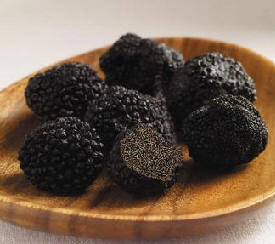
Winter Black Truffles (Tuber melanosporum) (Tartufi Neri) The black truffle or “black diamond” (better known amongst foodies), grows slowly in the undergrowth throughout the winter. Black truffles absords all the rustic, subtle, strong, intense essences the soil has to offer. Fresh Winter Black Truffles have a black or chocolate colored flesh, and carry an aroma that is out of this world! These gastronomic treats flourish from January through March and that is when the black winter truffles have their most intense aroma. These fresh winter black truffles are hand picked in France or Italy, and arrive in the USA within 4 days. Winter Black Truffles can be stirred into a risotto or scrambled eggs, but should be added at the end of the cooking time, as a finishing touch. When shaved paper thin, black truffles makes dime-size rounds of an attractive dark-tan color, accented with a pretty, lacy network of white veins. Try putting some of these fresh winter black truffles in a jar them with some bourbon. The resulting essence will make a wonderful sauce for your cooking. |
|
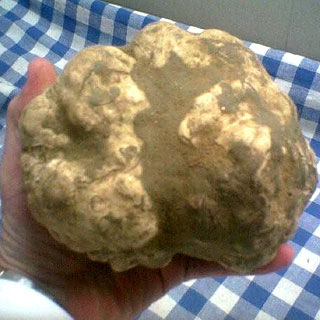
White Truffles (Tuber magnatum) Italy is famous for its Piedmont white truffles. Every winter day in the Piedmont region of Italy there are hounds and humans who rummage through the fogged forests looking for buried treasure. The treasure they seek is one of the diamonds of the culinary world (Fresh Italian White Truffles). Like the French black truffles, Italian white truffles are very highly esteemed. The white truffles of Alba in Piedmont definitely rank in the luxury class. They are appreciated for their overpowering yet extraordinarily delicate aroma. Italians eat them raw, shaved paper-thin over egg dishes, plain pastas (dressed with butter and cheese only) and other light foods. They are expensive because production is highly limited since they grow solely in the wild and fluctuations in weather conditions can play havoc with their reproduction and growth. The Fresh White Truffles Season is available from September to end of December. White Truffles, also known as Alba Truffles, come from the northern region of Italy. It is of a yellowish/gray color. The shape of the fresh white truffle is irregular and it is often likened to a potato. Also the common potato is a "tuber". White Truffles vary in sizes from a walnut to a fist. Always eat fresh white truffles raw! Occasionally there are exceptional fresh white truffles that weight a pound or more, as in the picture to the left. White Truffles or Tuber Magnatum, have a pungent aroma that some describe as reminiscent of cheese and garlic. This volatile scent is easily lost when white truffles are heated, therefore it is strongly recommended not to cook them at all, and instead serve them shaved on top of a hot dish. They can be purchased fresh when in season, and also preserved in jars or cans, in this case they often contain other species (like Tuber Borchii and Tuber Maculatum). They are easy to identify. Their color ranges from a mix of pale-yellow and white to ochre and grayish, with black and brown spots. Their surface is soft and smooth, they can weight from only a few grams to more than 1 kg. The peridium shows small rounded cells, the gleba is crossed with lots of fine veins, which can be white or yellow when immature and brown when they reach maturity. White Truffles can be found between August and January; however, truffles maturing before and during September often have an unpleasant taste and aroma, due to high summer temperatures. |
Other Varieties
The increasing demand for truffles and the complexity of their market is making producers, distributors, gourmets and consumers alike turn their attention towards a more diverse range of truffle varieties, other than the most sough-after species, such as the Périgord Black Truffle and Piedmont White Truffle.
Some of these species —like the Asiatic truffles— have been used for centuries in their country of origin, and are being “discovered” by the western world only until recently. Some others —like the Burgundy or Summer Truffle— have had a fluctuating reputation along the years. Regardless of their history, it is a fact that these truffles are becoming more and more popular; getting to know them better is necessary for the discriminating buyer, not only to avoid the risk of buying a lesser variety “camouflaged as the real thing”, but also to make the most out of their (often undervalued) culinary attributes.
Truffles are given a scientific name following the binominal taxonomy system established by Linnaeus (Carl Von Linée) in the 18th Century. This system designates 2 names for each organism: a generic name and a specific name. There are about 200 species of truffles grouped in several genres. Commercially speaking, the most popular are: Tuber, Terfezia and Tirmania.
Burgundy and Summer Truffle
The Burgundy truffle (Tuber Aestivum or Tuber Uncinatum) is regaining popularity, thanks to its culinary qualities and the increasing appreciation of the species by connoisseurs and gourmets. It is not rare to use it as a substitute for black Périgord truffles and it’s being increasingly commercialized, preserved in cans and jars.
The Burgundy truffle has a penetrating aroma, with a taste that is often associated to hazelnuts. Its size is relatively large, ranging in diameter from 2 cm to 10 cm. The peridium is brown to black and presents pyramidal warts. When mature, the color of the gleba is dark brown and it shows fine white veins. The Summer truffle is very close in appearance to the Burgundy truffle, although its scent and taste are considerably less intense. They are also similar in size, shape and color, only the inside of the Summer Truffle is paler and its surface generally has larger warts than the Burgundy truffle.
Culinary speaking, there is some distinction between what is commonly called the Burgundy truffle (or Truffe de Bourgogne) and the Summer truffle; this is mainly due to the difference in their harvest time: the Burgundy truffle is gathered between September and December whereas the Summer truffle is harvested between May and August. The contrasting climate conditions for both crops create a discrepancy in taste, the Summer truffle has a poorer flavor and for this reason, it’s less gastronomically valuable. From a strictly organic standpoint, it is proven that they have exactly the same components. Both are the same species, and therefore should be referred to only as Tuber Aestivum, on a scientific context.
|
Summer Black Truffles (Tuber Aestivum) Fresh Black Summer truffle as mouthwatering sweetness that some have described as "chocolaty". Since the summer truffle has a more delicate flavor, it shouldn't be used in dishes that are cooked. Like good extra-virgin olive oil, the heat will destroy the flavor. Instead, shave thin slices of the truffle onto dishes to finish them. A little goes a long way! This black variety is not considered as choice as the other two European truffles. It is harvested during the months of June to November. |
|
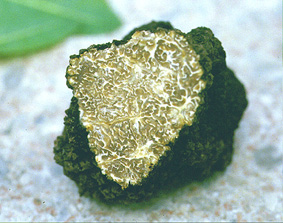
Burgundy Truffles (Tuber uncinatum) The Burgundy Black Truffles, also known as Autumn Truffles because its season is from September to December, are widely consumed in Italy and in parts of France. The Burgundy Black Truffle is easily distinguished from the Perigod black truffle by it's coffee colored interior and the network of ridges that cover the surface of its pores. |
Bianchetto
The Bianchetto (Tuber Orchii or Tuber Albidum) has long been undervalued despite its excellent qualities and commercialized almost entirely in preserved products, like truffle cheese and patés. There are signs however showing that this tendency is being reversed and a larger number of fine restaurateurs are including them on their menus.
The overall appearance of the Bianchetto can make them easy to confuse with white winter truffles. Bianchetto truffles vary in size, ranging from something comparable to a pea to the size of an egg. Their color goes from pale yellow to reddish brown. The peridium is smooth, the gleba is slightly darker than the one of white winter truffles, their smell and flavor are also similar to the Piedmont white, perhaps more garlicky. Their spores have an elliptical shape (as opposed to the round shape of white truffles).
Winter Truffle
The Winter Truffle or (Tuber Brumale) is a black truffle that occurs naturally in France and Italy and in other parts of Europe, although its taste has something reminiscent of tar. Canning companies have been able to override this peculiarity through special cooking procedures, creating a preserve that is not too far in flavor from the Périgord black.
Its appearance is indeed similar to the Périgord black, but can be distinguished by its peridium; the latter is loosely attached to the gleba and can be easily removed with a fingernail. The warts on its surface are considerably flatter than those of the Périgord truffle.
Asiatic Truffles
Truffles have been used as traditional dishes or tonics in Asian countries for centuries. Some of them are becoming extremely competitive around the world, due to their resemblance to black Périgord truffles. Among them, the most popular are Tuber Indicum and Tuber Himalayense.
Oregon Truffles
The mention of truffles brings up images of the expensive black and white truffles of France. But the truffles from Oregon are just as aromatic, and less than one-tenth the price of their famous French counterparts. Oregon truffles are emerging as one of the world's great delicacies, taking their richly-deserved place next to their legendary European cousins. Only in the past 20 years or so have several species of Oregon truffles become recognized for their culinary quality and potential value in the marketplace. In fact, with truffle production declining in Europe since 1900, Oregon's relatively untapped supply is gaining more and more notice.
Oregon white truffles (Tuber Oregonense) and Oregon black truffles (Tuber Gibbosum) both have excellent qualities and are also gaining terrain in the truffle trade. Their main limitation probably comes from the fact that they are harvested by raking though the soil, rather than using traditional methods (detection with animals); this causes the crops to include immature truffles that undermine their value.
Truffles grow west of the Cascade Mountains, from Vancouver Island, British Columbia, south to northern California. Fortunately for Oregonians, prime habitat for Oregon's culinary truffles (both white and black) is found in young, fast-growing Douglas Fir tree plantation in the foothills of the Willamette Valley. Two main types of Oregon truffles are currently harvested in the state, the Oregon white truffles (Tuber oregonense) and (Tuber gibbosum). The while truffles are actually two species that fruit at different times of the year, but are sold as the same truffle.
Truffle Butter
The aroma and flavor of truffles are heat sensitive. Truffle butter is a good way to get the most from your aromatic gem since it is not heated. |
Finely grate a fresh truffle and add to softened unsalted butter in proportions to suit your taste. Use enough butter so that the mixture is spreadable and not crumbly. Let stand at room temperature for an hour. Spread on crackers, French bread, or baked potatoes. Truffle butter freezes well. --Anne B. Marin |
Truffled Eggs
Henry and Wanda are members of the North American Truffling Society in Oregon that is devoted to the collection and study of truffles. Members have made generous contributions to this book. |
Cut an egg carton in half crosswise. Place 1 or 2 (preferably 2) medium truffles in each carton in the middle of the eggs. Enclose the cartons in a plastic bag and seal. Place in the refrigerator. The eggs will be ready for use after 3 days. (Do not keep the eggs in the refrigerator longer than 1 week, as their odor and flavor may become too strong, and the lack of fresh air may cause them to spoil.) The eggs may be used to prepare scrambled eggs, omelettes, or your favorite deviled egg recipe. --Henry J. and Wanda A. Pavelek |
Truffle Pâté
Makes 5 cups
This recipe was developed for the Oregon white truffle, but other truffles can be substituted.
|
Clean the truffles with a soft brush. Dice large specimens to 1/4 inch and split small truffles to release the flavor. In a saucepan, bring the beef broth to a boil, then simmer the truffles for 20 seconds. Pour the broth through a sieve into a bowl and set the truffle pieces and the broth aside. Oil a 5-cup mold or enough small crocks to hold 5 cups. Combine the livers, onion, apple, reserved broth, and shallots in a medium saucepan and bring to a boil over medium heat. Reduce the heat, cover, and simmer for 5 minutes. Blend the lemon juice, water, and gelatin in a small bowl, stirring well until the gelatin dissolves. Pour into the liver mixture and mix thoroughly. Remove from the heat and add the butter a little at a time, blending well after each addition. Stir in the remaining ingredients. Let cool 15 minutes. Transfer the mixture to a blender or a food processor and puree until nearly smooth. Let stand 10 minutes. Pour into a mold or crock, layering in about 3 layers of truffle pieces. Cover and chill overnight. Even better, allow 24 to 48 hours to develop the truffle flavor in the pâté. --Frank and Karen Evans |
Crab and Truffle Salad
Serves 4 as a first course
|
To make the dressing, combine the mustard, vinegar, salt, and pepper. Add the oil and mix well. Add more mustard, salt, and pepper to your taste. Place thin truffle slices between chunks of crab on individual salad plates. Arrange the asparagus or broccoli on each plate. Pour the dressing over and garnish with lemon wedges. --John and Pat Rawlinson |
Autumn Truffled Potatoes
Serves 6 as a side dish
An attractive and delicious way to serve baked potatoes.
|
Peel the potatoes. Using a zester, "rib" the outside of each potato; cut the bottom so it stands upright. Wrap in aluminum foil and bake in a preheated 350º oven until tender, about 45 minutes. Unwrap and let stand until cool enough to handle. Cut a cap from the top of the potatoes. Scoop out the pulp, leaving enough of a wall to support the stuffing. Mix the potato pulp with the grated truffles, cream, salt, and pepper. Place the mixture in a pastry bag and pipe it into the cavity of each potato shell. Replace the cap; brush each potato with butter. Place on a baking sheet. Bake in a preheated 400º oven for 20 minutes or until heated through and golden brown. --Sharon Polster, Edible Art |
Maccheroncini alla Boscaiuola
Serves 5 or 6 as a main course
The name of this luxurious dish of pasta with wild mushrooms and truffles translates as "pasta in the style of the wood-cutter's wife."
|
If using dried porcini, soak for 20 minutes in warm water to cover, then squeeze dry (reserve the soaking liquid and add to the mushrooms later with the cream). Heat the butter in a large sauté pan or skillet until melted. Add the mushrooms and cook until golden. Stir in the cream; cook until thick enough to coat the back of a spoon. Cook the pasta in a large amount of boiling salted water until al dente; drain and add to the sauce. Add the truffle and cheese; toss over low heat. Add salt and pepper to taste and serve immediately. --Michael Hart, Donatello Ristorante |
Copyright © 1987, 2000 by Louise Freedman and the Mycological Society of San Francisco
A MykoWeb and MSSF Page
