PearsWhen selecting pears, choose those that are firm to the touch, lacking in blemishes or abrasions. Pears do not ripen to perfection on the tree. They are picked while they are not quite ready and stored at room temperature where they grow soft & juicy. Pears are a unique fruit, in that if allowed to ripen on-tree, natural deposits of lignin and cellulose will develop in the flesh, causing a "gritty" texture. Handle with care all types of pears, since they may bruise easily, especially if they are ripe. A little known fact about the pear is that it is one of the few fruits that does not ripen on the tree. The pear is harvested when it is mature, but not yet ripe, and, if left at room temperature, it slowly reaches a sweet and succulent maturity as it ripens from the inside out. So, how do you know when the pear has ripened to sweet and juicy perfection? While a Bartlett’s skin color brightens as it ripens, most varieties of pears show little change in color. The best way to judge ripeness for non-Bartlett varieties is to apply gentle pressure to the neck of the pear with your thumb. If it yields to pressure, it’s ripe. Why do you “Check the Neck?” Because pears ripen from the inside out, and the neck is the narrowest part of the pear, which is closest to the core. If you wait for the wider, bottom half of the pear to become soft to the touch, you’ll find the inside to be over-ripe. When that happens, though the mouth-feel may not be perfect for eating fresh, this is the perfect time for your super-ripe pear to be pureed into a tasty smoothie! Once the pear is ripe, it can be refrigerated to slow the ripening process and saved for use up to five days later. Pear flesh tends to oxidize or turn brown when cut and exposed to the air. You can minimize any browning in salads by dipping the sliced pears in a mix of about 1/2 cup water and 2 tablespoons lemon juice first. They can also be tossed with a fairly acidic salad dressing. For recipes, 1 medium-sized pear equals approximately 1 cup of slices or a half pound of fruit. Best Pears to Eat RawWhich should you choose when you want to eat a pear as a snack or add fresh pear to a salad? All ripe pears can be enjoyed raw, either eaten out-of-hand or sliced into salads. The juiciest pear varieties are Anjou pears, Bartlett pears, and Concorde pears. Expect to use a lot of napkins when eating them because of their juicy flesh. Here's what you can expect in terms of flavor and texture from common pear varieties:
Pears That Keep Their ShapeHow about if you're making a pear tart or a poached pear? Different pears are best for different types of dishes since there are times when you want pears to keep their shape and other times when you want them to fall apart. You'll want to choose pears that hold together well when making poached, baked, or grilled pears. Although there are ten major pear varieties grown commercially in the United States not all of them may be used for baking because some types of pears, like Comice pear, have tender flesh that easily falls apart when exposed to heat. Look to the crispest raw pears to find those that can withstand heat. The popular Bosc pear is the best option. Anjou pears are another top choice and Concorde and French butter pears are also reliable. These pear varieties are best for cooking or baking as they can hold their form and flavor well even when cooked at high temperatures. Also, they do not easily turn brown after being cut. Pears That Fall ApartPears should fall apart when making things like pear sauce or butter. For these recipes, turn to the Bartlett pear, which will turn to mush under the slightest heat. As an extra bonus, Bartletts are plentiful at markets, so they're always there when you need them. Comice is another option. Consider too, mixing pears of both types. For instance, a combination of Bartletts and Bosc in a pie can be lovely. The Bosc pears hold their shape beautifully when surrounded by a Bartlett pear sauce. |
||
 |
 |
 |
|
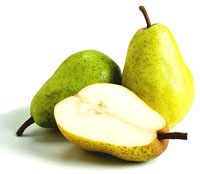
Bartlett |
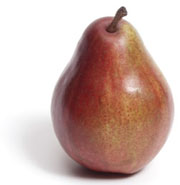
Red Bartlett |
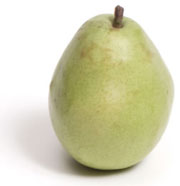
Anjou (red & green varieties) |
The Bartlett pear is an English variety that was introduced into the United States by Enoch Bartlett. It’s known in Europe as the Williams pear. Bartletts are extremely aromatic pears, and have that definitive "pear flavor" and are the first choice available for those waiting for the new pear season to begin, Often, the Bartletts found in grocery stores are green, and then they change to yellow as they ripen at home when left at room temperature. Its skin changes from green to golden yellow during ripening, and its smooth, white flesh is very aromatic. Bartletts are very sweet and juicy and are excellent for fresh eating or in salads and desserts. They are also good for dried pear products, cooking and canning. Northwest-grown Red and Yellow Bartletts are harvested in late August to early September and usually remain available through December to January or February. |
Red Bartletts are another Bartlett variety to choose, and they are usually located in produce departments right next to the green Bartletts. Aside from color, there are only slight differences in flavor between the two Bartlett pears. Consider Red Bartletts as a second color alternative for displays in fruit baskets and bowls. Together in a beautiful fruit bowl, Red & Green Bartletts make a striking table-top centerpiece. Red Bartlett pears are delicious too and turn bright red when ripe. Use as you would the green Bartlett. Northwest-grown Red and Yellow Bartletts are harvested in late August to early September and usually remain available through December to January or February. |
Anjou, also know as d'Anjou pears are thought to have originated in Belgium, and they are named after the Anjou region in France. The variety was introduced to England early in the 19th century. Called Beurré d' Anjou, they were introduced to America in about 1842. It is medium-sized with a very short neck and light green or yellowish green skin. They do not change color as they ripen. The flesh is very juicy and has a fine, buttery texture. While you can expect a juicy texture from Anjou pears, their taste is not overly sweet. Instead, expect a hint of lemon when you bite into them. Many professional chefs choose the Anjou pear for their menus for their nearly year-round availability, as well as for their versatility in culinary uses. Green Anjou pears are perfect for just about any use, from slicing fresh into salads to baking into pies to pureeing for sauces and beverages. They are available from October through June. They are the most widely available variety into the summer. |
 |
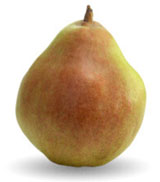 |
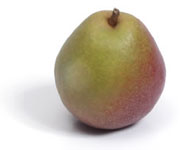 |
|
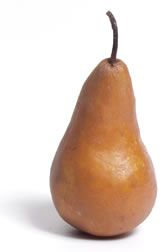
Bosc |
Comice |
Seckel |
| The Bosc pear, originally from Belgium, has a thicker and rougher skin than that of other varieties—the skin is cinnamon brown in color, verging on yellow, and do not change color as they ripen. The Bosc is oblong, with a long, thin neck and a juicy, white flesh that is granular and strongly perfumed. Bosc pears are are sweet and juicy and are excellent for eating fresh, particularly by those who prefer a firm texture. Because they have a more firm, dense flesh than other pear varieties, they are ideal for use in baking, broiling or poaching; also their flavor is less likely to be overwhelmed by the use of strong spices like cinnamon, clove or nutmeg. They are available from September to April. |
Considered to be one of the finest pears in the world, the Comice (pronounced ko-MEESE) pear was developed in France. Large and round with a short neck, it has tender greenish-yellow skin with pink or brown tinges when ripe. Because Comice have very fragile skins, the pears may appear to be bruised on the surface, but more often than not this does not indicate damage on the juicy interior. Its fragrant, yellowish-white flesh is exceptionally juicy and sweet and are great for eating fresh or in salads and desserts. The Comice is often served with good-quality cheeses. especially soft ripening cheeses like Brie, Camembert, or any of the blues. It is the extreme juiciness of Comice, which coincidentally makes them a poor choice for any process requiring cooking. Comice can be purchased from September through February. |
Seckels are believed by many to be the only truly American variety of pear grown commercially. Unlike other varieties planted in the U.S. from European cultivars, Seckels are thought to have originated as a wild seedling near Philadelphia. They were discovered in the early 1800's. However, it is possible that German immigrants travelling westward through the area dropped fruit or left seeds behind. Seckels are tiny pears, with a chubby, round body, small neck, and short stem. Their skin is usually olive green, but frequently exhibits a dark maroon blush. There is no color change when ripened. These pears have and ultra-sweet flavor. Because of their petite size, Seckels can easily be overshadowed by the larger varieties. However, it's their size which makes them a perfect choice for certain uses:
Sweet Seckel pears are in season from September through February, and harvest begins in the fall. |
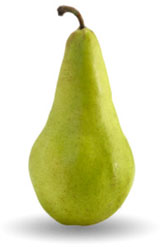 |
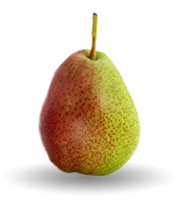 |
 |
|
Concorde |
Forelle |
Starkrimson |
| The elegantly shaped Concorde is best identified by its exceptionally long neck that tapers to an almost pointed top, with a stem that is also long and oftentimes curved. It has a round bottom, and its yellow-green skin oftentimes features a golden russet on some or all of the pear. Much like the more common Bosc pear, the Concorde has a dense flesh that is sweet and juicy even when it is still firm. It doesn’t have to soften to be sweet! They show only slight color change as they ripen. The Concorde is an excellent all-purpose pear. Eat it fresh out of hand, slice it into salads, roast, grill, poach, or sauté them. The more dense flesh of the Concorde make them ideal as a cooking pear as they hold shape and flavor even when cooked at high heat. Plus, they are naturally slow to oxidize, or turn brown, after being cut, so they are amazing in salads and for sharing the spotlight on cheese boards. Harvest for Concorde pears begins in the fall, and the season lasts until the variety is sold out, which typically occurs in December. |
Forelles are a very old variety, and are thought to have originated sometime in the 1600's in northern Saxony, Germany. The name Forelle translates to mean "trout" in the German language. It is believed that the variety earned this name because of the similarity between the pear's brilliant red lenticles and the colors of a Rainbow trout. Forelles were introduced to the United States by German immigrants in the 1800's. This pear is easy to identify due to its small size, ovalish shape, smooth skin, and striking yellowish-green freckled skin, which turns a beautiful red as it ripens. Because of their small size, Forelles are typically not the best choice for most recipes; the exception being those that showcase the Forelle's unique characteristics, like in colorful salads and other fresh uses. It is their small size, however, that makes Forelles a good choice as snacking pears. They are very sweet, with a flesh that is slightly firmer than most other pears. Their overall crop size is among the most limited of all commercially grown pears in the Northwest. They are available from September through January. Don't pass an opportunity to buy these bite-size delights whenever you find them displayed in the markets where you shop. |
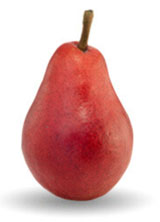
Starkrimson pears are named for their brilliant crimson red color and feature a thick, stocky stem. The Starkrimson is a mild, sweet pear with a subtle floral aroma. It is very juicy when ripe and has a pleasant, smooth texture, making it perfect for snacking, salads, or any fresh use that shows off the brilliance of its skin. Just like Red Anjou and Red Bartlett, Starkrimson pears are often simply labeled as Red Pears in the grocery store. The Starkrimson is one of the few pears whose skin changes color as it ripens. Its color turns from deep crimson to bright crimson red, and its skin also becomes more thin and delicate. Its floral aroma and sweet juice develops during the ripening process, so a bit of patience will allow you to coax out this pear’s flavor potential. Pear connoisseurs select the Starkrimson for any fresh use that shows off the vivid color of its skin. Slice them fresh into salads, bowls of cereal, or to accompany charcuterie for an indescribably gorgeous pop of color. The Starkrimson is a summer pear, meaning that harvest begins in August and it’s one of the first varieties to be found in markets at the start of pear season. It’s in season from August through November. |
