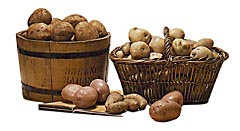
PotatoesNote: Do not store raw potatoes in the refrigerator. Cold turns the starches to sugar. |
||
For all practical purposes, potatoes fall into two easy categories — baking, or starchy, potatoes and boiling, or waxy, potatoes. Probably the chief difference between the two types is the amount and nature of starch each contains. Baking potatoes are relatively high in a starch, called amylose starch. Boiling potatoes are low in a starch, called amylopectin. This pectin (just as with fruit for jams) is what holds the potato together when boiling or in soup and stews. Baking/Starchy Potatoes These are also called starchy potatoes. They tend to be long and have a coarse, cork-like skin. They are high in starch, with a dry, mealy texture. But, they turn light and fluffy when cooked. They are ideal for baking, mashing and French fries. They are light and fluffy baked, light and creamy mashed, and frankly, the only potato worth frying. They are often used in potato soups that are pureed because they break down better than boiling potatoes. They are not good for potato salads or soups with chunks of potatoes because they will break down and become mushy. Some of the names you’ll see them under in the supermarket are Russet Burbank, Russet Arcadia, Norgold Russet, Goldrush, Norkotah, Long White (or White Rose or California Long White), and Idaho. Boiling/Waxy Potatoes (Red potatoes, white boiling potatoes) These are also called waxy potatoes. They come in a variety of shapes and can be long or round. They have a thin, smooth skin and an almost waxy flesh. They are relatively high in moisture and sugar, but low in starch. They are ideal for soups, casseroles, potato salad, roasting, and barbecuing because of their tendency to hold their shape. You can mash them, but instead of smooth and creamy, the results tend to be thick and lumpy. Red potatoes are a good choice for salads because they look great, keep their shape, and offer a creamy texture. You will find them sold as Round White, Round Red, Yellow Potato, Red Potato, Salad Potato, La Soda, Red La Rouge, Red Pontiac, Red Nordland, Red Bliss, Yellow Finnish, Ruby Crescent, and Australian Crescent. A new potato is just that — an immature, small potato of whatever variety. Red potatoes may be the type most often sold, but that does not mean that a red potato is a new potato or that a new potato is a red potato. All-Purpost Potatoes There are some potatoes that fall in the middle, in the "all-purpose" category, such as the Yukon Gold, Peruvian Blue, Superior, Kennebec, and Katahdin. They are moister than baking potatoes and will hold together in boiling water. They are particularly well-suited to roasting, pan frying, and using in soups, stews, and gratins. They can be baked, mashed, and fried, but will not produce the same results as the bakers. |
||
|
Russet Potatoes
|
Round White Potatoes
|
Long White Potatoes
|
| This is the most widely used potato
variety in the United States. A large majority is grown in the Northwest.
These are available year-round. These potatoes are high in starch
and are characterized by netted brown skin and white flesh. Russets
are light and fluffy when cooked, making them ideal for baking and
mashing. They are also wonderful for frying and roasting. There
is no Idaho potato, but since 99% of Idaho’s potatoes are Russets,
many stores call Russets Idahos. |
These are grown and used most often
in the Eastern United States. These potatoes are available year-round.
Round whites are medium in starch level and have smooth, light tan
skin with white flesh. These are creamy in texture and hold their
shape well after cooking. Regarded as an all-purpose potato, round
whites are very versatile and can be used in most potato preparations.
|
These are grown primarily in California
and are available spring through summer. Long whites are oval-shaped,
medium in starch level and have thin, light tan skin. These potatoes
have a firm, creamy texture when cooked. These all-purpose potatoes
are very versatile and can be used in most potato preparations.
|
|
Round Red Potatoes
|
Yellow Flesh Potatoes
|
Blue and Purple Potatoes
|
| These potatoes are available mostly in late summer and early fall. These potatoes are characterized by their rosy red skin and white flesh. Red potatoes have a firm, smooth and moist texture, making them well suited for salads, roasting, boiling and steaming. Round reds are often referred to as "new potatoes"; however, technically, "new" refers to any variety of potatoes that is harvested before reaching maturity. | These potatoes are very popular in
Europe and increasingly popular in the United States, although they
are still not grown in large quantities. Yellow flesh potatoes are
available in late summer and early fall. These potatoes have a dense,
creamy texture. With their golden color, you can be fooled into
thinking that they are buttered. |
These potatoes originated in South America and are not widely cultivated in the United States. Blue and purple potatoes are most available in the fall. These relatively uncommon tubers have a subtle nutty flavor and flesh that ranges in hue from dark blue or lavender to white. Microwaving preserves the color the best, but steaming and baking are also favorable methods of preparation. |