Wild Rice
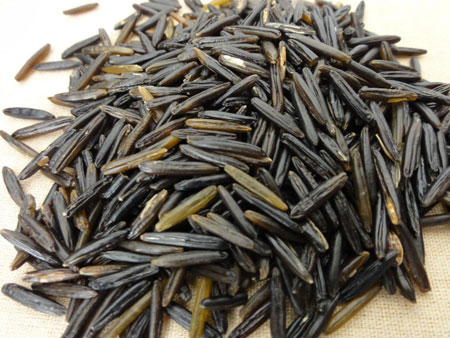
Harvested in the early autumn, wild rice was an immensely important commodity to Native Americans, particularly the Ojibwe and Menominee, who lived in the areas where it grew abundantly. The Menominee even took their name from the Indian word for wild rice, manomin, and were often referred to as the Wild Rice People by Europeans.
According to Menominee oral traditions, wild rice was a gift to humans from one of the Underneath Beings. When the rice was mature, the Menominee offered tobacco to this spirit to insure a good harvest. After that, the Underneath spirits and the Thunderbirds could claim their share of the rice. The chief threw tobacco into the fire as an offering to the Thunderbirds so they would not interfere with the weather. At the end of his speech, all the elders would smoke from a pipe passed around the group, and a feast began. Unless someone acted with disrespect, this ceremony assured calm weather for the upcoming harvest.
Botanically, wild rice differs from common rice, and is actually a cereal grass that grows in shallow lakes and streams, ripening in late summer. While the range of wild rice stretches from Manitoba to Florida, the most prolific stands are located in the upper Great Lakes of Michigan, Wisconsin, and Minnesota. Today Wisconsin has seventy major rice fields in thirteen counties. The grain usually begins to ripen in sections of the Wolf and Wisconsin rivers before lakeside areas are ready to be harvested.
Before white settlement and land cessions transformed Indian life, entire communities would move to the lakeshore in time for the fall wild rice harvest. Working in family groups, a man poled two women out to the family's section of the lake in a canoe, where the women, armed with two sticks, would bend the rice stalks over the canoe and knock off kernels until the canoe was full. On shore, the rice was sun-dried or parched over low fires and then pounded and winnowed. Today, double-ended rowboats are often used in place of canoes and instead of the traditional pairing of a man and two women, pairs of men or women now harvest rice as a team.
Wild rice continues to be an important staple food for Great Lakes Indian people. Today, the federal government protects most rice fields, though many Indian families continue to harvest where their families have for generations.
Wild rice usually requires more time to cook than regular rice. Undercooked wild rice has a hard texture and is difficult to chew. It often is beneficial to soak the grain for several hours or even overnight prior to cooking. Wild rice that is cooked perfectly consists of tender chewy grains that are butterflied, well rounded, and plump. Many people prefer wild rice grains that are only slightly split with a texture that is firm and chewy. The cooking time may vary widely depending on the texture desired and the type of wild rice that is used
