What is Couscous?
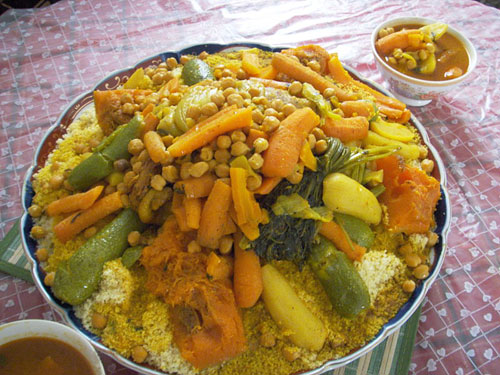
Couscous with vegetables and chickpeas
Couscous is a traditional North African dish of semolina (granules of durum wheat) which is cooked by steaming. It is traditionally served with a meat or vegetable stew spooned over it. Couscous is a staple food throughout the North African cuisines of Morocco, Algeria, Tunisia, Mauritania and Libya.
In Algeria, Morocco, Tunisia, and Libya couscous is generally served with vegetables (carrots, potatoes, turnips, etc.) cooked in a spicy or mild broth or stew, and some meat (generally, chicken, lamb or mutton).
Couscous served with fish is also a staple food in Western Sicily, and is featured as a traditional food product officially recognized by the Italian Ministry of Agricultural, Food and Forestry Policies.
History
One of the first written references is from an anonymous 13th-century North Africa/Andalusian cookbook, Kitāb al-tabǐkh fǐ al-Maghrib (North Africa) wa'l-Andalus (Arabic) "The cookbook of the Maghreb and Al-Andalus", with a recipe for couscous that was 'known all over the world'. To this day, couscous is known as 'the North Africa national dish'. Couscous was known to the Nasrid royalty in Granada as well. And in the 13th century a Syrian historian from Aleppo includes four references for couscous. These early mentions show that couscous spread rapidly, but generally that couscous was common from Tripolitania to the west, while from Cyrenaica to the east the main cuisine was Egyptian, with couscous as an occasional dish. Today, in Egypt and the Middle East, couscous is known, but in Algeria, Morocco, Tunisia and Libya couscous is a staple. Couscous was taken from Syria to Turkey in the 16th century and is eaten in most of the southern provinces.
Couscous is a traditional meal of the cuisine from Trapani. In Rome Bartolomeo Scappi's culinary guide of 1570 describes a Moorish dish, succussu; in Tuscany.
One of the earliest references to couscous in France is in Brittany, in a letter dated January 12, 1699. But it made an earlier appearance in Provence, where the traveler Jean-Jacques Bouchard wrote of eating it in Toulon in 1630. Couscous was originally made from millet. Historians have different opinions as to when wheat began to replace the use of millet. The conversion seems to have occurred sometime in the 20th century, although many regions continue to use the traditional millet. Couscous seems to have a North African origin. Archaeological evidence dating back to the 10th century, consisting of kitchen utensils needed to prepare this dish, has been found in this part of the world.
In some regions couscous is made from coarsely ground barley or pearl millet. In Brazil, the traditional couscous is made from cornmeal.
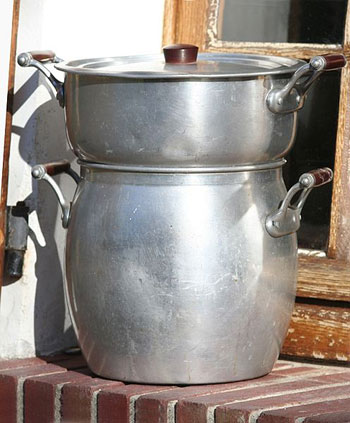
A couscoussier, a traditional steamer for couscous.
Preparation
The semolina is sprinkled with water and rolled with the hands to form small pellets, sprinkled with dry flour to keep them separate, and then sieved. Any pellets which are too small to be finished granules of couscous and fall through the sieve will be again rolled and sprinkled with dry semolina and rolled into pellets. This process continues until all the semolina has been formed into tiny granules of couscous. This process is very labour-intensive. In the traditional method of preparing couscous, groups of women would come together and make large batches over several days.[citation needed] These would then be dried in the sun and used for several months. Couscous was traditionally made from the hard part of the durum, the part of the grain that resisted the grinding of the relatively primitive millstone. In modern times, couscous production is largely mechanized, and the product is sold in markets around the world.
Properly cooked couscous is light and fluffy, not gummy or gritty. Traditionally, North Africans use a food steamer (called a كِسْكَاس kiskas in Arabic or a couscoussière in French). The base is a tall metal pot shaped rather like an oil jar in which the meat and vegetables are cooked as a stew. On top of the base, a steamer sits where the couscous is cooked, absorbing the flavours from the stew. The lid to the steamer has holes around its edge so steam can escape. It is also possible to use a pot with a steamer insert. If the holes are too big the steamer can be lined with damp cheesecloth. There is little archaeological evidence of early diets including couscous, possibly because the original couscoussière was probably made from organic materials which could not survive extended exposure to the elements.
The couscous that is sold in most Western supermarkets has been pre-steamed and dried, the package directions usually instruct to add 1.5 measures of boiling water or stock and butter to each measure of couscous and to cover tightly for 5 minutes. The couscous swells and within a few minutes it is ready to fluff with a fork and serve. Pre-steamed couscous takes less time to prepare than regular couscous, most dried pasta, or dried grains (such as rice).
