History of Casseroles
from http://www.foodtimeline.org/foodfaq.html#casseroles
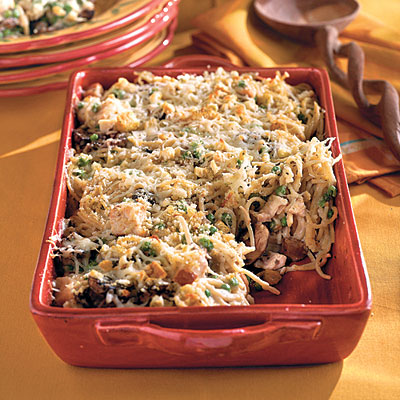
Turkey Tetrazzini
Casserole cookery has been around since prehistoric times. It's a method that predates ovens, when it was discovered that cooking food slowly in a tightly covered clay vessel buried in hot embers softened fibrous meats and blended succulent juices. Medieval pies are also related, in that pastry was used as a receptacle for slowly cooking sweet and savory fillings. Over the centuries, that method has produced some of the most enticing recipes in the world.
Take cassoulet, the classic French mix of beans, duck confit and sausages, baked with bread crumbs on top. (Like a casserole, cassoulet was named for the dish in which it's traditionally baked: the cassole.) There is the tagine, another dish that shares a name with its cooking vessel, while moussaka, shepherd's pie and lasagna are other exalted examples of the form. Gratins are simply casseroles by other names, and let's not forget savory bread puddings and stratas, which move the casserole concept from dinner to brunch.
The casseroles we know today are a relatively modern invention. Perhaps the most remarkable aspect of its history is the complete and sudden change in the dish it refers to that has taken place within the past hundred years.
When English took it over from French at the beginning of the eighteenth century [the word entered the English language in 1708], it meant a dish of cooked rice moulded into the shape of a casserole cooking pot and then filled with a savoury mixture, say of chicken or sweetbreads. It was also applied by extension to a border of rice, or even of mashed potato, round some such dish as fricassee or curry. Like their Medieval ancestors, they were both savory and sweet.
Then some time around the 1870s this sense of casserole seems to have slipped imperceptibly and swiftly into a dish of meat, vegetable, and stock or other liquid, cooked slowly in the oven in a closed pot', its current sense. Recipes for creamy casseroles composed of white sauce and meat and noodles/rice appear at this time.
In the twentieth century, casseroles took on a distinctive American identity. Casserole, as Americans know it today, is an economical meal. During the depression of the 1890s, the economic casserole provided a welcome way to stretch meat, fish, and poultry. Certain items were also scarce during World War I and leftovers were turned into casserole meals. The same was true during the Great Depression of the 1930s and World War II. With the addition or subtractions of leftovers or inexpensive cuts of meat, the casserole is flexible and economical in terms of both ingredients and effort. Casseroles became even more popular in the mid-20th century as a vehicle for leftovers — often bound together with a can or two of condensed cream of what-have-you soup.
[1912] About casseroles:
"There is no doubt that the fashion of cooking in casseroles or eathenware dishes has come to stay in this country; and it is hardly a matter of surprise when the advantages of this form of cookery are really understoood, whether it be actual casserole cookery, so called, or cookery in fireproof utensils. Cooking "en casserole" is a term which signifies dishes cooked and served in the same eartheware pot or utensil, though, as every one knows, the original French word is the generic name for a stewpan or a saucepan. The old idea of a caserole was some preparation of chopped fish, or vegetables enveloped in a crust of cooked rice, macaroni, or potato. Properly speaking, however, a casserole is a dish, the material for which in many instances is first prepared in the saute or frying pan and then transferred to the earthenware pan to finish cooking by a long, slow process which develops the true flavors of the food being cooked. The sooner the casserole utensil becomes an indispensable part of our everyday kitchen outfit the better...When casserole cookery is thoroughly understood, many combinations of food and many inexpensive viands will be put to use and very palatable results obtained."
---How to Cook Casserole Dishes, Marion H. McNeil [David McKay: Philadelphia] (p. vii-viii)[1924] "Casserole cookery
The expression en casserole is frequently misunderstood, for the reason that the word casserole is used in two quite different ways by writers on domestic subjects. Properly speaking, a casserole is the coarse clay saucepan so common in France in which meats and vegetables are not only cooked, but served on the table. The other usage of the word casserole is intended to describe a case or mold, either of potato, rice or fried bread, inside of which is placed some preparation of meat or vegetables. The word casserole in this case really signified a border or croustade and is therefore more or less misleading. ....The casserole saves washing dishes, for the food is brought to the table in the dish in which it is cooked. Frequently, also, it contains a one dish meal which eliminates all but the one cooking and serving dish. It makes possible the use of left-overs in attractive, palatable, and appetizing ways, the cooking tender of tough meat, and an unlimited variety in the ways of preparing vegetables. ..Food cooked in this way requires little watching, and is not likely to burn..."
---The New Butterick Cook Book, Flora Rose (p. 622-623)
Recipes from this book include Pigeons en Casserole, Chopped Beef in Casserole, Casserole of Rice and Liver, Bananas en Casserole & Tamale Pie.
The idea of casserole cooking as a one-dish meal became popular in America in the twentieth century, especially in the 1950s when new forms of lightweight metal and glassware appeared on the market. The virtues of easy-to-prepare meals were increasingly promoted in the women's magazines of the era, thereby supposedly freeing the housewife from the lengthy drudgery of the kitchen. Casseroles had now become a convenience. By the 1970s casserole cookery took on a less-than sophisticated image.
A brief survey of casserole recipes through time:
[1747] "To dres[s] Rabbits in Casserole.
Divide the Rabbits into Quarters, you may lard them or let them alone just as you please, shake some Flour over them, and fry them with Lard or Butter, then put them into an earthen Pipkin with a Quart of good Broth, a Glass of White Wine, a little Pepper, and Salt if wanted, a Bunch of Sweet Herbs, and a Piece of Butter as big as a Walnut rolled in Flour; cover them close and let them stew Half an Hour, then dish them up and our the Sauce over them. Garnish with Seville Orange cut into thin Slices and notched, the Peel that is cut out lay prettily between the Slices."
---The Art of Cookery, Made Plain and Easy, Hannah Glasse, [London] (p. 51)[1869] "Rice Casserole with Lamb Sweetbreads
Wash 2 pounds of rice in water, twice; drain, and put it in a stewpan with doule its quantiti of water; season with salt and pepper, and put it on the fire; when the water boils, cover the rice with some thin slices of fat bacon, and put it on a slow fire with some live coals on the cover of the stewpan; When the rice is cooked, pount it in a morter; then gather it up in a ball; put it on a baking-sheet, and mould it with the hands to the shape of a casserole; Brush the casserole over with a brush dipped in clarified butter, and put it in the oven until it asumes a nice yellow colour; Trim and remove some of the rice from the inside, and fill the casserole with a blanquette of lamb sweetbreads...place a circle of larded and glazed lamb sweetbreads round the top, and finish with some cock's combs in the centre; and serve."
---The Royal Cookery Book, Jules Gouffe, translated to English by Alphonse Gouffe [London] (p. 450)[1880s] "Casserole of Rice (English method)
Wash a pound of the best rice in two or three waters, a boil it very gently until it is quite tender by whole. Drain it and beat it well. If for a sweet casserole, use mik, sugar, a little butter, and lemon or other flavouring. If intended for meat or fish, stew the rice with water and fat, and season it with salt, pepper, and nutmeg. When quite cool, put a bordering about three inches high and three wide round the edge of a shallow dish, brush it over with egg or clarified butter, and set it in the oven to brown. Then place in the middle of the stew, curry or sweets which are prepared for it. Time to boil the rice, three-quarters of an hour...Sufficient for five or six persions."Casserole of Rice (French method)
Wash one pound of the best Carolina rice in two or three waters. Drain it, and put it into a stewpan with a quart of water, a large onion, a tea-spoonful of salt, and two ounces of fat. The skimmings of saucepans will answer for this purpose, or fat bacon, but if these are not at hand, use butter. Simmer very gently till the rice is quite soft but whole. Then drain it, and pound it to a paste. Well butter a baking dish or casserole mould, and press the paste into it. Mark the top a cover, making the mark rather deep. Pour a little butter over the whole, let it get cold, then turn it out of the mould, and bake it in a very hot oven till it is brightly browned, but not hard. The oven can scarcely be too hot for it. Take off the marked cover about a inch in depth. Scoop out the middle, and fill it with whatever is prepared for it. This may consist of mincemeat, Irish stew, rechauffed curries, hashes, or macaroni. Pour it a suitable sauce, replace the cover, and before service return it to the oven for a few minutes. Time to boil the rice, about three quarters of an hour...Sufficient for six persons."
---Cassell's Dictionary of Modern Cookery, London (p. 110-1)[1884] Casserole of rice and meat, Boston Cooking School Cook Book, Mrs. D. A. Lincoln
[1924] "Casserole cookery
"Pork Chops en Casserole:
6 pork chops
6 sweet potatoes
salt & pepper
1/2 cup brown sugar
1 to 2 cups milkPlace a layer of sweet potatoes, sliced crosswise, in a greased casserole, dust with salt, pepper, and a little brown sugar; continue the layers until the casserole is about two-thirds full. Heat the milk and pour it over the potatoes; it should just cover them. Place the pork chops on top of the potatoes, cover and bake for an hour, then remove the cover and season with salt and pepper. Leave the cover off and cook until the chops are tender and niceley browned on top."
---The New Butterick Cook Book, Flora Rose (p. 626)[1955] The Good Housekeeping Cook Book, edited by Dorothy B. Marsh is the penultimate casserole cookery guide. The introduction to the chapter on casserole dinners reads "When you're planning a casserole as the main dish, why not have an oven meal? Choose a vegetable, bread, and/or dessert that bakes at the same temperature as the casserole. Then, with the aid of a minute timer, slide each dish into the oven at its correct time." (p. 556)
Here is the recipe for Martha's Company Casserole:
"1/2 lb noodles (4 cups)
1 tablespoon butter or margarine
1 lb chuck, ground
1 8 oz cans tomato sauce
1/2 lb cottage cheese (1 cup)
1 8 oz pkg. soft cream cheese
1/4 cup commercial sour cream
1/3 cup snipped scallions
1 tablespoon minced green pepper
2 tablespoons melted butter or margarineStart heating oven to 375 degrees. Cook noodles as label directs; drain. Meanwhile, in 1 tablespoon hot butter in skillet, saute beef until browned. Stir in tomato sauce. Remove from heat. Combine cottage cheese, cream cheese, sour cream, scallions, green pepper. In 2 quart casserole, spread half of noodles; cover with cheese mixture; then cover with rest of noodles. Pour on melted butter, then meat mixture. Bake, uncovered, 30 minutes. Makes 6 servings."
---(p. 239)
Tuna Noddle Casserole (recipe)
Forerunners of tuna noodle casseroles have been composed for hundreds of years. In 19th century America, the meat of choice was typically the same as for salad-sandwiches: chicken, turkey, and lobster. Recipes for creamy casseroles composed of white sauce and meat and noodles/rice also appear at this time.
Tuna was first commercially canned in 1903. It took much corporate promotion to convince home cooks to substitute this canned product for *traditional* protein sources. If tuna salad sandwiches can be used as a "food barometer," this product was not readily accepted until the 1950s.
Although it’s mainly associated with Middle America, and the 1950s housewife, the earliest printed recipes for tuna casserole appeared two decades earlier in the Pacific Northwest. The first one, “Noodles and Tuna Fish en Casserole,” came from Sunset Magazine, from a “Mrs. W. F. S.” residing in Kennewick, Washington, in 1930. The same year, a “tuna fish and noodles casserole” appears on a menu suggested by the The Modern Hospital magazine. At the height of the Great Depression, people were looking for ways to stretch out food. No surprise that a resident of a tuna canning community came up with a new way to use it. California, Oregon, and Washington served as hubs for the tuna and salmon industry. Mrs. W.F.S. of Kennewick’s tuna noodle casserole recipe began with creamy béchamel sauce. Canned tuna combined with mushrooms and noodles was added, and topped with cheese.
Two years later a version appeared in Cook Book of Many Lands—a cookbook that the Americanization Department of Portland, Oregon’s Parent-Teacher Association established to help Portland women relate to their immigrant neighbors. Although there is nothing specifically German about the “German Noodles and Tuna Fish” recipe, it does bear a striking resemblance to the Sunset recipe. It’s made from the same Holy Trinity of noodles, tuna, and white sauce, with a pretty pimento garnish.
Mrs. W. F. S.’s groundbreaking recipe included the mushrooms and the cheese topping familiar today; in fact, the addition of mushrooms probably had something to do with the widespread switch to canned cream of mushroom soup in lieu of laborious white sauce. The introduction of Campbell’s cream of mushroom soup in 1934 was the game-changer that cemented tuna casserole’s place in the American housewife’s culinary arsenal. Aside from the canned tuna, it was this ingredient’s ubiquity during World War II (a nadir of American ingredient availability and culinary ingenuity) that made it a standard ingredient in the casserole.
So when did tuna noodle casserole debut? Some food historians credit the Campbell Soup Company [Camden NJ] for setting the table. This company's Cream of Mushroom Soup was actively promoted to American consumers in the 1930s as an quick and economical alternative to homemade sauces. Corporate advertisements, cooking brochures and cookbooks promoted casserole dishes. Tuna noodle casserole was among them. No, the company did not invent the recipe. It did, however, make it famous.
The oldest Campbell's Tuna Noodle Casserole recipe we [Food Timeline] have on file is c. 1941.
[1941]
"Casserole dishes.
Learn how to use Campbell's Soups in your casserole dishes. Discover what zestful flavor they give--what quick and easy substituted for cream sauce some of them are--the precious minutes they save you in preparation--they make meals so attractive! The following recipes are sure to become family favorites (p. 14)...Company Casserole.
1 package (6 oz) egg noodles
1 can Campbell's Cream of Mushroom Soup
1 cup milk
1/4 pound pimiento cheese, sliced
2 hard-cooked eggs, chopped
1 can (7 oz) tuna fish
6 tablespoons flaked cereal crumbs, buttered.Cook the noodles in boiling salted water until tender. Empty the soup into a pan and stir well, then add milk and heat. Add the pimineto cheese and stir until the cheese melts. Combine noodles, eggs and tuna fish with the sauce. Put into a buttered casserole, sprinkle buttered flaked cereal crumbs over the top and bake in a moderate oven (350 degrees F.) For 25-30 minutes. Serves 8."
---Easy Ways to Good Meals: 99 Delicious Dishes Made With Campbell's Soups, Campbell Soup Company [Campbell Soup Company:Camden NJ] 1941 (p. 16)[1946] "Tuna, Noodle and Mushroom Soup Casserole
An excellent emergency dish.
Cook until tender: 2 cups Noodles
Drain them in colander. Pour 3 cups of cold water over them. Drain them again. Drain the contents of 1 (7 oz) can tuna fish. Separate it with a fork into large flakes. Be careful not to mince it as that isn't nearly as good. Grease an oven-proof dish. Arrange a layer of noodles, then sprinkle it with fish and so on. Have noodles on top. Combine and pour over this mixture the contents of 1 (16 oz) can condensed mushroom soup 1/4 cup water Cover the top with Buttered cornflakes or cracker crumbs Bake the dish in a hot oven 450 degrees until the top is brown..."
---Joy of Cooking, Irma S. Rombauer [Bobbs-Merrill:Indianapolis] 1946 (p. 120)
