Types of Beef Ribs
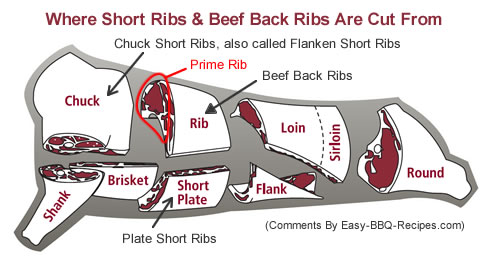
Cows have thirteen pairs of ribs and although some of the cuts can be tough, all of them can be turned into a delectable dish if cooked correctly.
Basically, there are two types of beef ribs, back ribs and short ribs. A steer has 13 ribs on each side. Starting at the front of the cow, the first 5 ribs are in the chuck cut. The next 7 ribs are part of the rib section and extend down into the short plate. The remaining rib is in the loin cut. As you might imagine, these cuts vary quite a bit from one end of the steer to the other. They vary not only in flavor, but in texture as well.
Back ribs and Plate short ribs (true short ribs) come from ribs 6 - 12. Chuck short ribs
Back Ribs
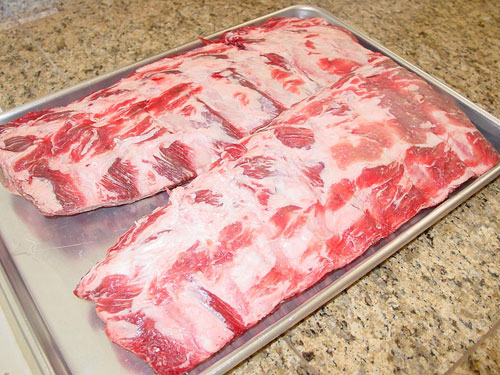
Beef Back Ribs
Back ribs, a.k.a. beef spareribs or Texas ribs, are very tender and are cut off from the prime rib. The top portion of ribs 6 through 12 is where the true beef ribs are. The long slender rack of ribs is what is left once the butcher removes the rib roast. Ribeye roasts are often sold boneless which leaves the back rib bones available for sale separately.
How big the butcher cut the rib roast will determine how much meat is left on the ribs, themselves. The bones usually are 6-8" long, slightly curved, with very little meat on top and a nice finger of meat between them. They are sold in racks, although some butchers sell individual bones. Typically a rack will feed two to three people.
Unfortunately, you rarely see good ones at your butcher counter or in your supermarket's meat department. You're more likely to find what competition barbecuers derisively call "shiners"—back ribs with so much of the meat removed that there's hardly anything left but shiny white bones with a few nuggets of protein connecting them. There's an economic explanation for this: Butchers can sell prime rib roasts and steaks at much higher prices than back ribs, so have little incentive to leave expensive meat on the bones.
Because they are so tender, back ribs are suited for grilling, but will shrink considerably during the cook—much more than pork ribs. They respond especially well to indirect grilling. When the meat is this good and the pit is hot and smoky, you can get by with seasoning the ribs like they do in Texas—with salt and pepper and nothing more. Cover the grill and cook the ribs until well browned, cooked through, and tender enough to pull apart with your fingers, 1-1/2 to 2 hours in all. When the ribs are done, the meat will have shrunk back from the ends of the bones by about 1/4 inch. Back ribs are also good for braising - the marrow is a stupendous source of flavor for stews.
Short Ribs
Short ribs are the meaty ends of beef ribs from the rib, chuck or brisket section. Short ribs have lots of meat and are very flavorful. They are also quite inexpensive. These ribs are approximately 2-inches long and are topped with a thick layer of well-marbled, tough meat. They are sold either as individual bones or in strips of three to four ribs. Many times you will find them without the bone When cooking them, calculate that each person you are feeding will eat approximately a pound of ribs each. Short ribs are best when braised as the long, slow process makes them specially tender and flavorful.
You can also cook short ribs using a hybrid method: smoke the ribs for an hour, then foil them tightly with beef broth or beer and aromatics like shallots and herbs, and continue cooking them at low heat (about 250 to 300 degrees) until nearly fall-off-the bone tender, 1-1/2 to 2 hours longer. This method is called smoke-braising, and it's a great technique to use for proteins that tend to be tough.
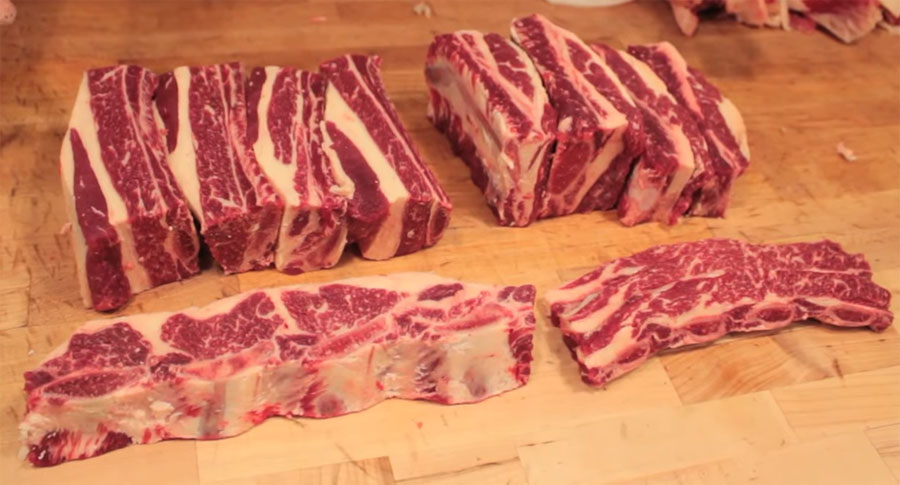
Top row: English cut, cut between the bones. The ones on the left have the "serratus ventraqlis" muscle in the center making them "meatier"
Front row, both cut across the bone: Franken cut on left and Kalbi cut on right (thinner Franken cut with the top strip of meat removed)
All cuts in this pictre come from the plate
Short Rib Cuts: Short ribs are cut either parallel to the bone (English-style) or across the bone (Flanken-style). Flanken-style is the preferred cut for the Korean dish, Kalbi. The English cut is the most common cut. There are usually 4 bones about 3" long, 7 to 8" wide, and about 1" to 2" thick. They can be sold as a rack or as a package of individual ribs. Short ribs often have a layer of fat on top, although some butchers remove it. Flanken cut rib bones are typically only 1/2" to 1" long and they are popular in Asian and Mexican groceries. There is a lot of hard fat but the meat absorbs marinades well and is tasty if grilled. This cut is also good braised.
Short Rib Riblets: Often shorties are sold in individual bone sections ranging from 1" to 6" long. Riblets are a section of a single bone about 2" long and 1.5" wide. These are very versatile and they're great for braising, for slow cookers, for barbecue, and for Korean Kalbi. Just try to select a package with meaty hunks. Butchers usually try to hide sections that are mostly fat among the good ones.
Plate short ribs: True short ribs come from the short plate, therefore the name. Don't let the name fool you, though. Short ribs are cut in various sizes and can actually be very large. They are a tougher cut of meat with a beefy flavor that is exquisite! A little tender-loving care is all that's needed. Plate short ribs are similar to brisket in that their meat is striated with flavorful fat and collagen. As a consequence, they need to be cooked to a temperature of at least 190 degrees for maximum succulence. Low and slow is the way to go. These ribs are particularly well suited to the pastrami treatment.
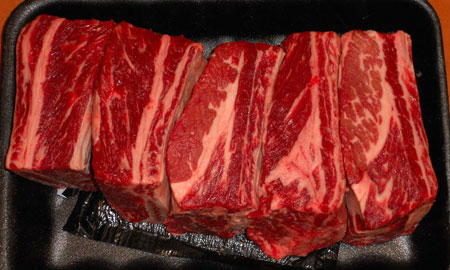
Chuck Short Ribs
Chuck short ribs: Enter the other short rib…the chuck short rib. Cut from the chuck section, they are a more tender cut of meat than its rib counterpart with a flavor that more resembles a pot roast. Chuck short ribs are generously marbled throughout, meaning they can be barbecued low and slow, indirect grilled, or even direct grilled. (The fat melts as they cook, keeping them tender and juicy.) Thanks to the growing popularity of Korean barbecue (kalbi), Korean-style crosscut short ribs have become more widely available, as has flanken and its Argentinean equivalent tira de asado. Marinate them first, then direct grill them over high heat until done. Snip into individual bones with kitchen scissors, as they do in Korea, then serve with grilled scallions and garlic, kimchi and other Korean condiments, plus lettuce leaves for wrapping.
Country-style Ribs
Other Beef Ribs that you may find from the chuck are country-style ribs. These may be boneless or bone in. The boneless are actually strips of meat sliced from the chuck roast and are an excellent choice for Asian stir-fry dishes or beef fajitas.
