Bistro Steaks
Steak eaters are slaves to fashion. While a tender piece of filet or New York strip is timeless, restaurant goers are flocking to lesser bistro steaks such as hanger, skirt and flank. Though fibrous and chewy, they are packed with flavor. The popularity of these steaks -- among Latin American and Asian as well as French bistro chefs -- has driven up the price, making these once lowly meats either hard to find or more expensive than their rough texture might merit.
Most people are familiar with the high-end steaks, the strip, the ribeye, the T-bone/Portehouse, and the tenderloin, but there are many inexpensive steaks that can be done on the grill - the butcher's cuts, sometimes called bistro steaks because they are often served in French bistros. These are the pieces of the steer that you won't find in steakhouses or most refrigerated cases in the supermarket (well, at least not most supermarkets). The pieces that chefs love to use because not only are they more inexpensive, but they've got character.
The high-end steaks are all cut from the same general region of the steer—along the ribs and spine on its back. Why? Because the muscles in that area—the Longissimus dorsi and the Psoas major do little to no work during the steer's lifetime. They are large, tender, and remarkably easy to cut into big, juicy, meaty steaks.
The butcher's steaks, on the other hand, come from all over the steer, and they're not quite as easy to extract. Many of them are whole muscles that must be trimmed by the butcher just-so if you want them to be tender and large enough to cook as steaks. There are also not many of them on a steer. For every 20 pounds of ribeyes and T-bones you can get off a steer, you'll get perhaps 1 or 2 pounds of these butcher's cuts. These butcher's cuts tend to be more packed with flavor because of the work they do, yet because they're not as marketable to the general public and require a bit more skill to cook and serve correctly, they remain much cheaper than their mainstream counterparts.
These bistro-style steaks all are wonderful grilled, stir-fried or pan- fried.
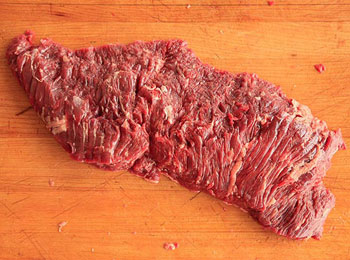
Flap steak, sirloin steak tips in New England
Note: There is also a roast called sirloin tip, which should not be confused with flap steak or New England steak tips. NE steak tips are cubes of flap meat, marinated and grilled to get a good char on them.
Also called flap meat, the unflatteringly named cut is similar to skirt and flank in that it comes from the less tender regions of the animal. Often cheaper than more popular cuts, this little underdog of the beef world has a wonderful meaty flavor and fine texture when prepared carefully. That's why it's starting to show up in more markets.
Called bavette d'aloyau, or "of the sirloin," in France, this fan-shaped cut is an extension of the T-bone and Porterhouse on the short loin. It's cut from the bottom sirloin butt—the same general region where the tri-tip comes from.When grilled right, it's tender, juicy, takes on marinades extremely well, and has a robust beefy flavor that a lot of other cuts lack.
Flap steak is generally a very thin steak, and thus, is sometimes confused with hanger steak which is also thin. The cut is also sometimes mistakenly sold as Skirt steak, which it resembles.
Like skirt or flank steak, flap meat benefits from marinating and being cooked on high, dry heat, whether grilled, broiled, pan-fried or stir-fried. It's vital to cut the meat very thinly across the grain, and it is at its best not too much past medium-rare. Flap meat is a great choice for Mexican grilled meats, bistro steaks and stir-fries -- some Asian meat markets simply call it "stir-fry meat." And if you can't find it, other long-fibered cuts such as flank steak and skirt steak also would be lovely in recipes, though cooking times might have to be adjusted.
Of all the inexpensive cuts of beef, it's one of the most versatile. It takes great to fast-cooking methods like grilling or searing. It's excellent cooked whole and sliced into thin strips. It can't be beat cubed and put on skewers. It has a coarse texture that grabs onto marinades and seasonings. It's even great as a slow-cooked braise, where if comes apart into tender shreds, like a Cuban ropa vieja.
Flap meat has an extremely coarse grain with an obvious direction. It runs all the way down the steak crosswise. This makes it hard to cut against the grain into thin, bite-sized pieces (you'd end up with strips sliced lengthwise from the meat). Instead, the best thing to do it first divide it into three or four pieces, slicing with the grain, then to rotate each of those pieces 90 degrees and slicing them thinly against the grain.
Since its shape, thickness, and proclivity for marinades makes it similar to flank steak, you can use it pretty much interchangeably. Think of it as flank steak's tastier, sexier cousin.
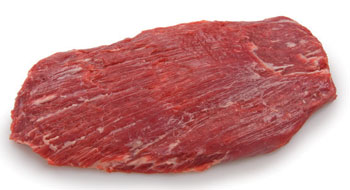
Flank
This is a large rectangular cut from the flank section with noticeable fibers running through it. Often used in stir-fries or for fajitas. At one time flank steak was a relatively hard cut to find, reserved for specialty butchers or saved for industrial uses. These days, consumers are wise to its benefits, and it has become as near-ubiquitous a cut as the standard high end steaks.
They're pretty diverse as far as cooking method goes, but the best way, by far, during the summer is on the grill. With their large surface area, they're made for picking up nice char, smoky flavors, and the types of dishes they transform into seem perfect for al fresco dining.
When shopping for flank steak, look for an even, deep red color with a fair amount of fine fat running along the length of the muscles. Poorly butchered flank steak will either have a thin membrane still attached to parts of it, or will have had that membrane removed so aggressively that its surface has been shredded. Look for smoothly textured pieces without nicks or gouges.
A standard whole flank steak can weigh anywhere between two and four pounds. Plan on cooking a pound of flank steak for every three diners, a pound and a half if your friends are hungry.
The key to perfectly grilled flank steak is to use a modified two-level fire—that's a fire where all the coals have been pushed over to one side, leaving the other empty (in a gas grill, just leave one bank of burners off). Doing this gives you more control over your cooking, allowing you to sear your meat over the crazy hot side, and finish cooking it through gently with the cover on on the cooler side of the grill. Without this option, there's a good chance that you'll end up incinerating the exterior of your meat before the center cooks through.
Like with all grilled, seared, or roasted meats, it's vital to allow the steaks to rest before slicing into them. As for slicing it, we're lucky on this front—a flank steak has a distinct grain, making it very easy for us to properly orient a knife for carving. You always want to cut perpendicular to the grain (cut across the grain) in order to minimize the length of each muscle fiber you have to chew.
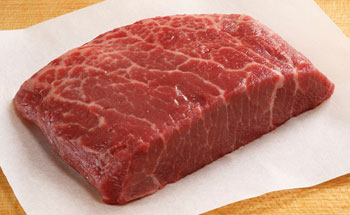
Flat iron steak
Flatiron
Flat iron steak is the American name for the cut known as butlers' steak in the U.K. and oyster blade steak in Australia and New Zealand. The Flat Iron (supposedly named because it looks like an old fashioned metal flat iron) is uniform in thickness and rectangular in shape. Not easy to find in markets, this popular restaurant steak is located on the chuck or shoulder. Flat iron steaks usually have a significant amount of marbling.
There is some confusion about the flat iron steak and the top blade steak, which are different. This confusion is not surprising considering that the traditional Top Blade steak and newfangled Flat Iron steak are indeed from the same muscle, the infraspinatus. Within that muscle, there are medial and lateral sections, separated by a relatively thick layer of connective tissue. That thick layer of connective tissue, or absence thereof, is what differentiates a regular Top Blade steak (with connective tissue seam) from the Flat Iron steak (without the connective tissue seam). But, because they originate from the same muscle, some folks (wrongly) use their fanciful names interchangeably.
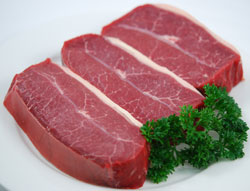
Top blade steak
To make it more marketable, the steak, which has the fascia dividing the infraspinatus within it, has increasingly been cut as two flatter steaks, each corresponding to one muscle, with the tough fascia removed. Steaks that are cross cut from this muscle are called top blade steaks or patio steaks. As a whole cut of meat, it usually weighs around two to three pounds; the entire top blade usually yields four steaks between eight and 12 ounces each.
Cutting a Flat Iron steak: Starting with the whole infraspinatus, the connective tissue seam can be filleted out, analogous to filleting a fish, resulting in two large portions of very tender steak, which is usually then portioned into attractive steaks.
Cutting a Top Blade steak: Starting with the whole infraspinatus, just cut across the width of the steak, leaving in the connective tissue seam and you have a Top Blade steak. This is a flavorful cut but is a bit tough because it contains a gristly connective tissue.
Like any non-loin steak, the Flat Iron benefits from marinating and is best if it isn't cooked too well beyond medium.
This steak has a deep, rich flavor which makes it perfect not only on its own, but also as meat for many dishes. The Flat Iron is very similar to any of the Flat Steaks so anything calling for Skirt or Flank Steak will benefit from a Flat Iron Steak. This cut is best grilled over a medium high heat. I don't suggest going as hot as possible unless you pick up a particularly thin cut.
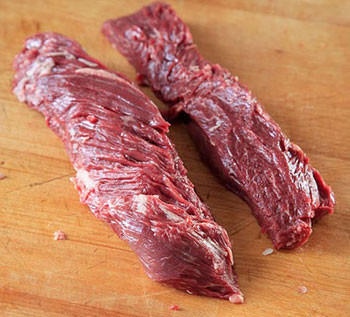
Hanger, hanging tender, butcher's steak, onglet in France, arrachera in Mexico
This long, narrow muscle comes from the plate section of the cow (the front of the belly), it "hangs" off of the cow's diaphragm, hence the name. Hanger steaks come in a few different forms in the market. Straight from the steer, it comes as two rather large, loose-grained muscles stuck together side to side with a tone of connective tissue and silverskin surrounding it. If you're lucky, you'll have a good butcher who knows how to break this down into two separate, well-trimmed steaks. Each one will be about a food long and weigh in at 8 to 12 ounces, with a triangular cross section. These individual steaks are sometimes butterflied into wider, thinner steaks supposedly to make for more even cooking. Really, a butterflied hanger steak is too thin to cook to medium rare while still developing a nice crust, so avoid buying them. Instead, stick to a regular trimmed steak, or buy it untrimmed and do it yourself.
For a long, long time hanger steak wasn't sold to the general public, reserved mostly for ground beef, or taken home by the butchers (earning it the nickname "butcher's steak"). If you lived in France, you would have seen it on bistro menus as onglet—a popular cut for steak frites. In the U.S., however, your chances of running into it were much slimmer.
Then, some time around the late 1990s, early aughts, chefs caught wind of it and it started appearing on menus of American bistros and fancy restaurants alike. They liked it because it offered the full, beefy flavor and richness of more expensive cuts of meat like ribeye or strip, without the hefty price tag. These days, it's become so popular that it's no longer as dirt cheap as it used to be (after all, there are only two on each steer, and they aren't particularly large), but it still comes in at around half to a third the price of a typical high-end steak at the supermarket.
Hanger steak, untrimmed
How To Trim It: You'll want to first start by removing all silverskin and excess fat from the exterior with a sharp, sharp boning knife. Slide the tip of the knife under the silverskin, grab the skin with your free hand, then carefully pull the knife under it, taking off as little meat as you can. Eventually, you'll end up with a piece of meat with two muscles attached by a thick sinew that runs down their center. Cut the steak in half along that sinew to separate it into two individual hanger steaks, then trim each one down, and you're ready to cook.
How To Cook It: There are a number of ways to cook hanger both indoors and out, but no matter where you cook it, you want to make sure that you cook it to medium-rare or medium, no more, no less. Unlike, say, a ribeye steak, which will still be pretty tender and juicy at medium or beyond, a hanger steak has a very coarse texture with a distinct grain running through it. Anywhere beyond medium, and it gets too rubbery to chew.
Undercook it, on the other hand, and you get meat that is mushy and slippery. Rare hanger steak is simply not the same as rare tenderloin, ribeye, or strip. Use a thermometer, and cook it to the sweet spot between 125° and 130° degrees (this gives it some leeway to rise in temperature as it rests).
Very high heat is essential as well. Hanger steaks are relatively thin, and you want to give them a nice char before they get a chance to start overcooking. In a pan, use cast iron and go for smoking hot high heat. Because of its loose texture, hanger takes well to marinating. Rub them with a mixture of olive oil with garlic, fresh herbs, and peppercorns for a day or so before wiping it dry and grilling with plenty of salt and pepper. The oil helps the seasonings spread their flavor earound the meat, as well as aiding in browning on the grill.
When serving, it is essential to slice the meat against the grain. This will shorten the long, grainy muscled fibers, making it easier to chew. When properly cooked and sliced, a hanger steak is every bit as tender as a ribeye.
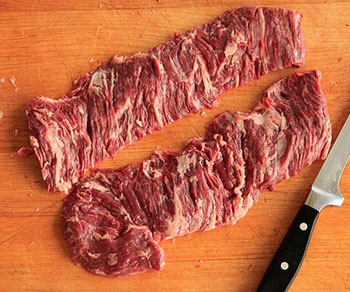
Skirt
This cut is also labeled as fajita meat in this country because of its common use in Tex-Mex cooking. There is an inside skirt and an outside skirt. The outside skirt is the diaphragm muscle.
Of all the inexpensive cuts on the cow, the skirt is probably the greatest dollar-to-flavor value out there. Riddled with plenty of buttery, beefy fat with a deep, rich flavor and a tender, juicy texture, it's a tough cut not to like, if, that is, you've had it cooked and sliced properly.
The outside skirt is the diaphragm muscle of the cow, cut from the plate. It is the traditional cut for fajitas, and is generally sold to restaurants. It comes with a tough membrane attached to it, which needs to be trimmed before it can be cooked.
Inside skirt is part of the flank, and is the more widely available form of skirt steak. Luckily for consumers, it generally comes with the membrane removed, making trimming an easy job at home. All you've got to do is remove some of the excess fat from the exterior, and you're good to go.
How To Cook It: There's a single rule when it comes to cooking skirt steak: intense, unrelenting, high heat. Forget low and slow. Skirt steak should be cooked over the highest possible heat from start to finish. It's so thin that unless you cook it over maximum heat, it'll be overcooked before you get a chance to develop a good sear on the exterior. Like hanger and other loosely-texture cuts, skirt takes well to rubs and marinades. At the very least, you should be using plenty of salt and pepper.
Like most of the inexpensive cuts, how you slice the meat is as important as how you cook it. The key, once again, is to let it rest for a few minutes after pulling it off the heat, then to slice thinly against the grain.
If you have a sharp knife and a bit of skill, you can do this pretty easily with a whole skirt. Take a look at the way the grain flows, then slice at a 45 to 60° angle from that grain. Alternatively, you can slice with the grain to divide the long steak into 2- to 3-inch wide segments, then rotate each one of those 90°F and slice into thin strips to achieve the same end result.
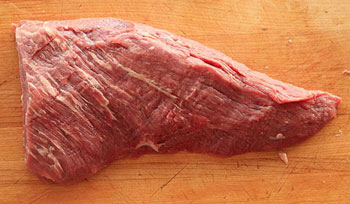
Tri-tip
Also sold as a roast, tri-tip is the large, tender, triangular muscle cut from the bottom sirloin of a steer. Also called: Santa Maria Steak, Newport Steak (when cut into individual steaks), aguillote baronne (France), punta de anca, punta de Solomo, or colita de cuadril (Latin America), maminha (Brazil).
It's a pretty lean cut. Texturally, it resembles a flat cut brisket, though it doesn't have nearly as much outside fat. Flavorwise, it's closer to a eye round roast. It's not huge on beef flavor or fat, so it's a generally good idea to season it generously and serve it with a flavorful sauce.
Because of its tapered shape, this is an ideal cut of meat if you want to serve a family that likes their meat cooked to different donenesses. The narrow tip will cook faster than the fatter butt-end, giving you a range of temperatures to choose from.
Just like when cooking a big fat steak, the key to even cooking, juicy meat, and a nice crust is to start the sucker over the cooler side of the grill with the lid on (you can add some soaked wood chunks to the coals—it takes well to smoke), and cook it to within 5 to 10°F of it's target pull temperature (which, in turn is 5°F lower than it's target final temperature). For medium-rare, that's about 115° to 120°F. After that, slide it on over to the hot side and cook it until nicely charred all around. Pull the sucker off, let him rest for about 10 minutes (it is, after all, a big cut of meat), then slice thinly against the grain with a sharp knife.
