Corned Beef Cuts
Where does corn beef come from? The answer is the brisket. The part of the cow brisket is located is in the front of the cow, toward the bottom, near the cow’s front legs. The whole brisket has a large amount of fat, part of it internal and the rest found as a layer on one side. Brisket also contains quite a bit of connective tissue because the two muscles of the brisket are worked as the steer stands or moves around in its daily routine. Since the cow uses that area a lot this is a tough cut of beef, so a slow cooking method must be used. Yet it is worth your time because it is a flavorful cut.
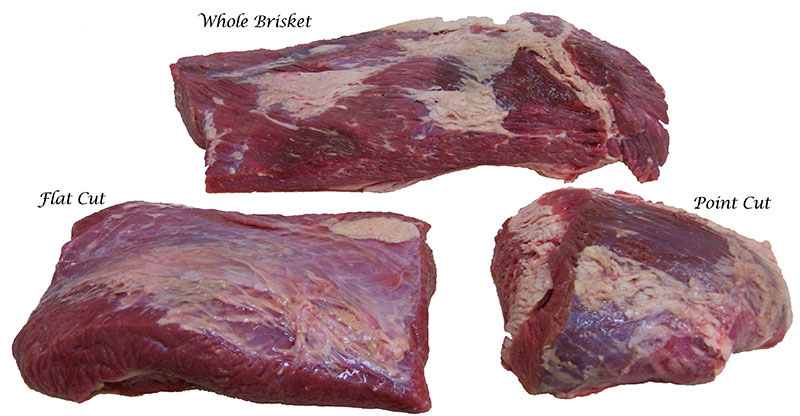
When choosing a brisket, unless you buy the entire brisket, you will have to choose between a Flat cut and a Point cut. It is very easy to tell the difference by just looking at the cuts.
There is also Corned Beef Round, which is normally made from the Bottom or Eye Round. This is very lean and it is what most deli's use for sandwiches and cold cuts. It is more expensive than the Corned Beef made from the Brisket.
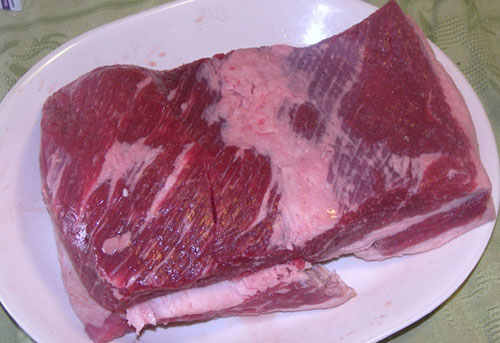
The brisket you see below shows of the flat and the point muscles, which are separated by a layer of fat. The dashed lines delineate the two muscles of the whole brisket. The layer of meat you see on top is the brisket flat. You can't see it in the picture on the left, but laying under the flat on the left side is the point, which is the second muscle of the brisket. In the second picture the point is a little easier to see.
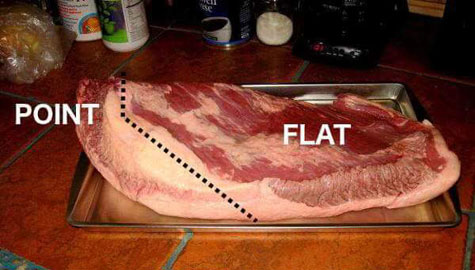
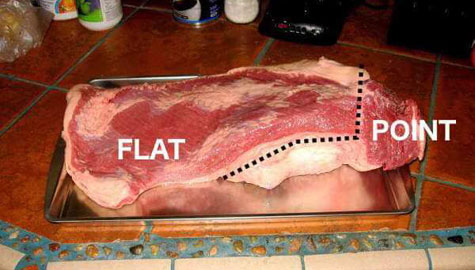
On the right end of the brisket you can see how the grain direction of the point is different than the grain of the flat. There's a narrow vertical line of fat separating the two muscles. The flat is a leaner muscle, and is usually less moist and a bit less tender than the fattier point. The brisket point is the more tender section of the whole beef brisket. It contains a bit more internal marbling than the flat, making it more juicy when cooked.
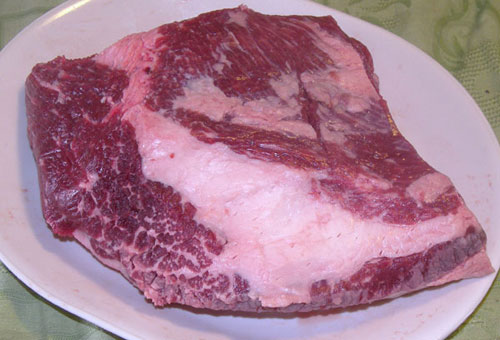
A point cut comes to a point at one end. The point cut has a lot of fat running through it, so when you cook it, it comes out nice and juicy. This is a good choice if you plan on shredding the meat when finished cooking. The Point is very fatty and sinewy, although it does pack a bunch of flavor.
The Point will be cheaper per pound to buy than the Flat cut, but will be more expensive in the long run to serve to a bunch of folks.
It may shrink up to 75% of the original weight. That's because in the modern processing, the producers pump the briskets full of brine, to speed up curing, When you cook the meat, that brine just oozes out.
The flat cut is a much leaner cut than the point. However it still has a layer of fat on one side, the bottom, that will keep the meat moist. It cooks uniformly and slices beautifully. This is the cut you will most often find in supermarkets, as it looks more appealing than the the point cut.
If you are looking for brisket that will slice up nicely, this is your best bet. It is also the cut used most often when you buy packaged corned beef.
The Flat is a tad more expensive per pound, but will shrink only 33-50% and is much more eye appealing and easier to work with.
Cooking Corned Beef
To cook corned beef on the stove, place the corned beef in a large pot. Add enough water to cover it by at least an inch or two. Bring it to a boil, cover the pot and reduce the heat to a simmer. A 2½- to 3-pound piece should cook for at least 2½ hours. The meat should be very tender throughout.
To cook corned beef in the oven, preheat the oven to 350 degrees. Season the corned beef as the recipe states and place in a baking dish, fat side up. If you’d like, place some carrots or potatoes around the brisket. Add water to cover two-thirds up the side of the brisket. Cover with foil, making sure the foil isn't touching the meat, and roast 2 to 2½ hours, or until tender. Add more water if the brisket begins to dry out. Remove foil the last 30 minutes of roasting. Remove from the oven and serve.
Testing for doneness: Many a recipe urges the cook to boil a corned beef until it's "fall-apart" or "fork" tender. Problem is, an overcooked corned beef borders on mushiness. Herskovitz recommends the same mandate for safely testing the proper doneness of any cut of meat: Use a quick-read meat thermometer. Pierce the flesh with the probe in the thickest part of the meat; when it registers 165, your brisket is done.
Kreiger uses the fork test. "The key to knowing when it's done, is to take a cook's fork, stick it in the thickest part of the meat, and when you tug it out there should be a little resistance, but it shouldn't cling to the fork," Kreiger says. "If it falls right off, you've overcooked it."
Be sure to slice it against the grain, otherwise you end up with shreds.
