How to Butterfly a Pork Loin for Stuffing
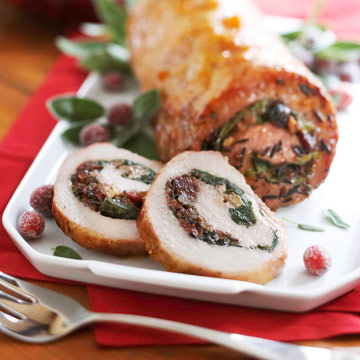
Stuffed pork loin is one of those meals that is elegant but also has a down home country feel. Surprisingly simple to make, a stuffed pork loin can be the centerpiece of a large family meal that fits perfectly for any holiday. There are any number of stuffings that could be used. See the recipes below to get some ideas.
To prepare a pork loin for stuffing you need to butterfly it. A butterflied pork loin is flat and allows the stuffing to be evenly spread across it and then rolled up, jelly roll style. You can do this in two ways.
Butterfly: First, the simplest method is to butterfly the roast. Using a sharp knife cut down through the center of the roast and fold it open like a book. Next, pound the meat into a uniform 1-inch thickness. This will allow you to roll the roast back up once it's stuffed. OR Using a sharp knife, cut along the long side of the pork loin. The cut should be about one third from the bottom/base of the pork loin. Cut evenly into the loin, stopping about 1/2 inch from the other side. Open up the loin. The left side should be much thicker than the right side. Now, carefully cut along the middle, cutting into the thicker, left half portion of the pork loin. Cut evenly, halfway through and open up the loin. You now have a butterflied pork loin that should be an even thickness all across the meat.
Butterfly Pork in a Spiral Cut (or) Roll Cut: The alternative is to cut the roast using roll cutting leaving you with a spiral cut. This technique takes a little more patience (and maybe some practice), but it provides more flexibility and doesn't require pounding to thin out the meat. Put loin, fat side down, on a cutting board lined with plastic wrap. Find beginning of a flap on 1 long side of loin (where bone was removed). Starting at inside edge of flap, make a long cut lengthwise down side of loin with a very sharp boning or paring knife, stopping 1 inch from bottom (this is beginning of spiral). Turn knife parallel to bottom of loin and begin to cut your way inward (parallel to the cutting board), keeping thickness of meat as even as possible. As you cut, "unroll" the roast. This is kind of like unrolling a roll of paper towels. The great advantage to this technique is that once you've really master it, you can cut a roast to 1/2 inch thickness or less.
Stuffing: At this point you're ready to spread the stuffing over the pork loin. You want to spread an even layer of stuffing, giving the finished product a nice spiral pattern when it is sliced. Roll the pork loin gently so as not to displace the stuffing. Tie it securely with kitchen twine, but not so tight that you squeeze out the filling. Now it is ready for the oven or grill.
Oven Roasting: Place the roasting pan in a 475 degree oven and cook for 10 to 15 minutes, until the top of the loin is lightly browned. Reduce the oven temperature to 325 degrees F and cook for 35 to 40 minutes, or until an instant-read thermometer registers 150 degrees F. Allow the roast to sit for 10 to 15 minutes before slicing.
Grilling: Generally, a stuffed pork loin is grilled over indirect heat. You need to let the inside cook before the outside gets burned and dried out. A medium heat will be perfect for this. You can place the pork loin over the direct heat to char and caramelize the surface but be careful not to over do it. The pork loin will be done when the pork reaches an internal temperature of 155 to 160 degrees F. (68 to 71 degrees C.). It is always best to let the roast rest before slicing it to let the juices flow back into the meat. About 5 minutes is adequate.
Doneness: One last challenge is checking for doneness. A meat thermometer will read different temperatures from the stuffing than it does from the meat. Your best bet is to check in several locations and take the lowest temperature as the most accurate.
Because pork loin is so lean, you might want to try a couple of tricks to add moisture. For grilling, of course, the best way is to use a marinade. One that has an oil base will hold in the moisture and keep the surface of the meat from drying out. Be careful not to let it burn. If oven roasting, you can baste with a liquid such as apple juice. Keeping a bit of liquid in the bottom of the roasting helps to keep it moist. Another way is the wrap strips of bacon around the outside of the roast. Since you are tying it up with string anyway, you could place some bacon strips under the strings. It will add flavor and protect the outside of the pork loin roast.
Recipes:
Raisin Challah & Apple Stuffed Pork Loin (boneless pork loin roll)
Braised Pork Roll: Braciolona
Caramelized Pork Loin
Cornbread Stuffed Pork Loin
