Pasta alla Carbonara
Recipe courtesy Emeril Lagasse, 2004, instructions modified
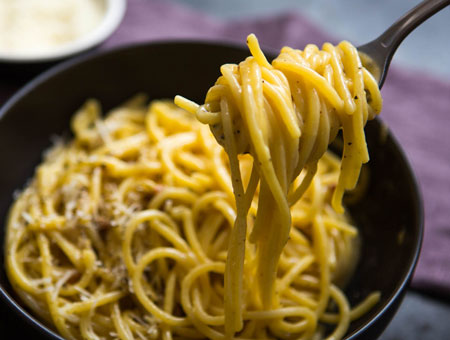
Pasta alla carbonara (cahr-boe-NAH-rah) is a recipe that evolved after World War II. Carbonara is the Italian word for charcoal. While the name’s origin can’t be traced, some believe that the dish was first made for Italian charcoal workers. The dish requires a long form of pasta—usually spaghetti, but also linguine or bucatini. A mixture of eggs and Parmigiano-Reggiano is combined with butter or olive oil to make a sauce; pancetta or guanciale (cured fatty pork) is added, along with and black pepper. In the U.S., heavy cream is added to the recipe as well.
The majority of chefs agree that "true" carbonara has guanciale (an Italian cured meat product prepared from pork jowl or cheeks - its name is derived from guancia, Italian for cheek) and not bacon or pancetta, although both make fine substitutions. If you can get your hands on guanciale, it will make a noticeable difference. Most chefs, although not all, say no cream, and just about everyone says that under no circumstances do peas belong in carbonara.
While it's fundamentally a simple dish, the challenge of carbonara is cooking the sauce just enough to form a thick, silky coating on the pasta without accidentally scrambling the eggs. You need enough heat to melt the cheese and thicken the egg but not enough that you scramble the egg, which will start to happen at 145°F. In general, scrambled egg in your carbonara means the heat is too high. Take the pan off the heat before adding the eggs.
This sauce is best when eaten immediately after it is made. Make only as much as you need for one meal. Reheating changes the texture. If you cannot find pancetta, crisp bacon is a good substitute.
Traditional Carbonara does not use cream. Pancetta, and maybe some garlic, is lightly browned in a frying pan. Cook pasta in salted water, drain and reserve some of the pasta water. In a separate bowl, whisk together eggs and an extra yolk with pecorino and some parmesan cheese, reserving some parmesan for garnish. Grind in plenty of black pepper. Add the drained pasta to the frying pan and coat with the fat from the pancetta. Off the heat, add the egg and cheese mixture to the pasta and quickly toss the pasta with the mixture. Once it has begun to thicken, add a little pasta cooking water to loosen the sauce. Toss again and serve.
Note: Carbonara does not reheat well. The eggs tend to scramble and the pasta can get dry and oily. Perhaps the best way is to use a bain marie (pot over hot water). Add a touch of milk or cream, if it looks like it needs it. Stir constantly and take it off heat if you even have the slightest inkling the eggs are going to curdle. The slow steady heat should not separate the butter, cheese, and egg.
The two time-honored methods of handling leftover pasta could also be applied. One of these is the frittata. It's a little redundant, what with there being egg already on the pasta, but at least there won't be any conflict. Beat the eggs in a bowl, mix in the pasta till it's well coated, and pour into a pan which you have been gently heating some oil. The other is ripassare in padella (sauteed in pan). Heat some oil in a pan (butter would be permissible with carbonara) and sauté the pasta until it's warm.
*Linguine alla Carbonara (made with cream)
Recipe courtesy Emeril Lagasse, 2004
FMM: This is the recipe we have always used.
1/4 cup extra-virgin olive oil
1 tablespoon unsalted butter
1 yellow onion, minced
4 ounces pancetta or prosciutto, diced [we use bacon which is cheaper]
1 pound fresh linguine
3 large egg yolks, at room temperature [or 2 eggs and 1 egg yolk]
1/2 cup heavy cream, at room temperature
3/4 cup finely grated Parmigiano-Reggiano, at room temperature
Freshly ground black pepper
Instructions modifed from Emeril's recipe
Bring your eggs to room temperature. This will help get your sauce smooth and light. In a bowl, whisk together the egg yolks, heavy cream, and Parmesan cheese until completely mixed. Set aside.
Heat oil and butter in a large saute pan over medium heat. Add the onion and pancetta and cook until the onions are translucent and the pancetta is beginning to crisp. Remove from the heat and set aside.
Bring a large pot of salted water to a boil and cook the linguine according to package directions until al dente, about 2 to 3 minutes.
You will need to work quickly now. Drain pasta in a colander (reserve a ladle or two of the cooking liquid in a small bowl) and add the pasta to the pan the bacon and onion was cooked in to pick up the fond in the bottom of the pan. Return the pot to the heat and stir until pasta is coated with the pancetta mixture and the pasta is heated through. Add a little pasta water if needed to keep pasta from sticking. You want the pasta to be as hot as possible, to cook the eggs and set the sauce.
Remove the pot from the heat (the gentle, residual heat from the noodles is what sets the eggs to create that velvety sauce, not the heat from the pan - if left on the burner, the eggs would scramble) and toss the pasta with some of the egg mixture until it is well-coated. You should add the sauce gradually, so it has a chance to thicken. Add the rest of the egg mixture a little at a time and toss well so all the pasta is covered. Season with salt and freshly ground black pepper, to taste. If needed, add a bit of the reserved pasta cooking liquid to help toss the pasta if it is dry. Much of the water will evaporate. Serve immediately. Do not cook any more at this point or you will scramble the eggs.
4 - 6 servings
Spaghettini Carbonara (made without cream)
from https://www.goodfood.com.au/
360g (.8 pound) spaghettini
2 large eggs
2 egg yolks
200g (.44 pound) of pancetta
60g (.13 pound) pecorino cheese
60g (.13 pound) parmigiano
Freshly cracked pepper
Bring to boil 5 litres of salted water and add a generous amount of salt. Add your spaghettini and allow to cook for about eight minutes. Strain the pasta and retain a glass of the cooking water.
Place a frying pan over a medium-high heat, add the pancetta and cook until crispy. While your pancetta is cooking add the eggs, pecorino and parmigiano to a small bowl and whisk until well combined. When the pancetta is golden, remove the frying pan from the heat.
Add the drained, cooked pasta to the crispy pancetta and return to the heat. Slowly add the cooking water and stir the pasta continuously to avoid sticking. This should only be done over a medium heat for a few seconds to remove excess water.
The next step is the most important part of the method and is where a lot of people make mistakes.
Remove your pan from the heat and add in the egg mixture and toss well until eggs have thickened; the residual heat will do most of the work. If the mixture is too thick you can add additional reserved water. Do not place the mixture over the heat, otherwise your eggs will scramble. Taste to see if your pasta needs additional salt, as some pancetta may not be overly salty. Add freshly cracked pepper and grated pecorino cheese and serve immediately.
[3 - 4 servings]
