Flavored, Colorful Pasta
from http://italianfood.about.com/
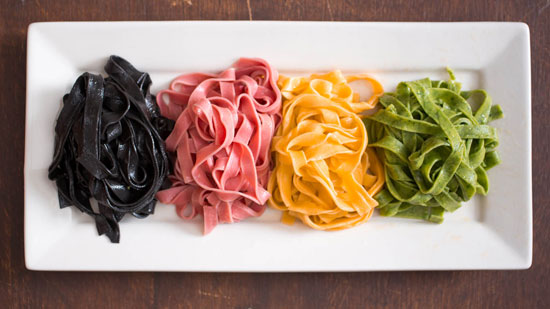
Squid ink, beet, carrot - tomato paste, and spinach colored pastas
Pasta need not be pale yellow or cream colored. If you add puréed vegetables, chocolate, or other ingredients to your dough you can obtain a wide range of delightful hues. One thing to keep in mind is that the addition of the vegetable will influence the texture of the dough, which will be less elastic and consequently more difficult to roll out. Also, that you may not succeed in getting the sheet quite as thin as you would a sheet made from just flour and eggs.
Colored pasta is only subtley flavored. Don't expect big, bold flavors.
Since the moisture content of the vegetables will vary from batch to batch, the quantity of flour is indicative. If the dough comes out overly moist and sticky, add more (you'll learn to judge how much you'll need with experience).
Green Pasta (spinach)
This is the most classic color, and gives rise to pasta paglia e fieno (straw and hay) -- a combination of green and yellow tagliatelle, which is often served with cream sauces or salsa ai funghi (mushroom sauce). Green pasta is also an excellent alternative if you're making lasagna or ravioli. To make it you'll need:
- 7/8 pound (400 g, or 3 1/3 cups) flour
- 8 ounces (220 g) raw spinach
- 3 eggs
- A pinch of salt
Wash the spinach well, shred it coarsely, and heat it in a pot with just the water that sticks to the leaves. Add a pinch of salt and stir it until it is completely wilted (5 minutes), then let it cool and squeeze it well to remove all the moisture you can. Blend the spinach and combine it with the other ingredients when you make the dough. As variations, you can also use wild greens, or nettles (use gloves when you pick and wash them).
Red Pasta (carrots, tomato paste)
The proportions are similar to those for green pasta:
- 7/8 pound (400 g, or 3 1/3 cups) flour
- 9 ounces (250 g) carrots
- 3 eggs
- A tablespoon of tomato paste
- A pinch of salt
Peel the carrots, dice them, and simmer them until soft in lightly salted water. Drain them well, blend them, add the tomato paste to the mixture, and heating it pot, stirring constantly, until it has become quite firm. Combine the mixture with the other ingredients when you make the dough. If you want the pasta really red you can dispense with the carrots and simply cook down a tube of tomato paste, though in this case the resulting pasta will be rather acidic and will require something along the lines of a cream sauce to balance it.
Brown Pasta (unsweetened baking chocolate)
This is a comparatively new addition to the pasta cornucopia, and is made with powdered baking (unsweetened) chocolate:
- 7/8 pound (400 g, or 3 1/3 cups) flour
- 3 ounces (80 g) powdered unsweetened baking chocolate
- 4 eggs
- A pinch of salt
Combine all the ingredients, and make pasta as you normally would. Contrary to what you might expect, it's not sweet because baking chocolate. It will work quite nicely with rich game-based pasta sauces.
Cheese Pasta (Parmigiano)
In terms of color this really isn't that different from regular, but it is a pleasant change of pace:
- 1/2 pound (225 g, or 1 4/5 cups) flour
- 1/2 pound (200 g) grated Parmigiano
- 3 eggs
You shouldn't need salt, due to the salt content of the Parmigiano. Combine the ingredients and proceed as normal, seasoning the finished pasta with unsalted butter and sage or a light tomato sauce. One warning: because of the cheese, this pasta doesn't keep well.
Orange Pasta (squash or pumpkin)
Not carrot this time, but squash: Pick one with orange flesh (pumpkin will also work)
- 7/8 pound (400 g, or 3 1/3 cups) flour
- 7/8 pound (400 g) squash
- 2 eggs
- A pinch of salt
Peel and dice the squash, discarding seeds and strings, and boil the pieces in lightly salted water for about a half hour. Drain the pieces well, blend them, and should the paste be too liquid, heat it again, stirring briskly, until it has thickened. Use the paste to make the pasta.
Speckled Pasta (fresh herbs)
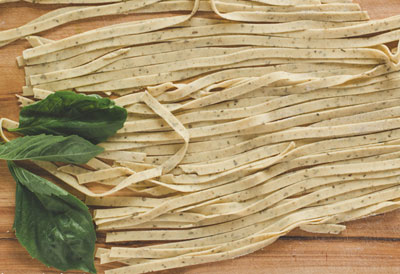
These are a surprising delight, and since the strengths of herbs vary from time to time, will never be quite the same from batch to batch.
- 7/8 pound (400 g, or 3 1/3 cups) flour
- 1/4 cup or to taste finely minced fresh herbs, for example sage, parsley, rosemary, thyme, or whatever else suits your fancy
- 4 eggs
- A pinch of salt
The exact volume of herbs will vary depending upon the herbs you chose and their potency. In any case, wash them well, pat them dry, strip the leaves from the stems, and mince the leaves. Combine the ingredients and make the pasta. The best sauce here will be unsalted butter, and a light dusting of grated Parmigiano.
Black Pasta (squid ink)
These are slightly unsettling the first time one sees them, but are perfect with creamy fish-based sauces.
- 7/8 pound (400 g, or 3 1/3 cups) flour
- 4 teaspoons squid ink (fresh will be best, from your fishmonger, but it is also available, in packets, in well-stocked delicatessens)
- 4 eggs
- A pinch of salt
Combine the ingredients and make the pasta as usual.
Dark Tan Pasta (dried mushroom)
Chestnut flour works quite well in pasta. The proportion you'll want is 1/3 chestnut flour and 2/3 white flour; figure the usual number of eggs.
Another option to make light brown pasta is a 50-50 mixture of whole wheat and regular flours.
A third, lavish option is to use dried porcini:
- 7/8 pound (400 g, or 3 1/3 cups) flour
- 60 g (about a packed cup) dried porcini
- 3 eggs
- A pinch of salt
Steep the porcini for 10 minutes in a small amount of boiling water, then drain them well, reserving the liquid. Blend the porcini. Strain the liquid, which may contain sand, into a pan, add the porcini, and heat, stirring constantly, until the mixture has thickened. Let the mushrooms cool, and combine them with the other ingredients when you make the pasta. This pasta will be delightful with unsalted butter and a dusting of cheese, or a simple cream sauce.
Purple Pasta (beets)
The perfect thing for tifosi Viola, fans of Florence's soccer team, which has worn purple ever since the laundry service made a mistake with their red jerseys in the 20s...
- 7/8 pound (400 g, or 3 1/3 cups) flour
- A fairly large beet (you can buy it ready cooked)
- 2 eggs
- A pinch of salt
Cook the beet if need be, skin it if need be, dice it, blend it, put the paste in a fine muslin bag, and squeeze out as much of the juice as you can. Combine the paste with the remaining ingredients and make the pasta. This pasta tends to crack as it dries, so use it as soon after you've rolled the sheet as possible.
Pasta Embossed with Leaves
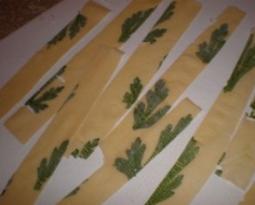
Gualtiero Marchesi, Italy's most respected chef, did these on a cooking show a number of years ago, and they are most impressive. Use them to make large ravioli, of the kind that are simple squares whose edges are tamped down around the filling, and serve them simply, with unsalted butter and grated cheese, lest the sauce cover the pattern. He used a hand-operated pasta machine to do the pressing.
Make pasta following the standard recipe given above and roll it out to the standard thickness. Next, take well washed sprigs of parsley or other leafy herbs and pinch away the stems so only the leafy crowns remain. Cut the pasta into strips about twice as wide as the leaves, brush one side of a strip with a little cold water, and lay down a row of leaves, separating them by about a half an inch. Cover with a second strip and run the sandwich through the pasta machine. The leaves will pattern the pasta.
Continue making strips and running them through the pasta machine until all is used up.
