Beef on Weck
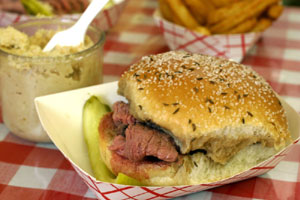
Beef on Weck is a sandwich, first made in Buffalo, New York, from thinly sliced rare roast beef served on a Kummelweck roll (a German kaiser-like roll with chunks of course salt and caraway seeds on the top) with the top bun getting a dip in au jus and spread with horseradish. Good served with German potato salad or stewed tomatoes.
History Beef on Weck Sandwich:
1901 – The following family history of the origin of the Beef on Weck sandwich was shared by John Guenther, great grandson of Joe Gohn, originator of the Beef on Weck Sandwich. Some of the information also comes from the Buffalo Courier Express newspaper, April 6, 1980:
Just before the start of the 1901 Pan American Exposition in Buffalo, NY, Joe Gohn (1862-1949) purchased a small saloon which he called the Delaware house, located at Delaware and Delavan Streets. The Delaware House was located on the northwest corner across the street from one of the exposition’s main entrances. He enlarged the house to offer hotel-style rooms for the exposition travelers. It was never called a hotel, but in order to have a whiskey license, he had to have ten bedrooms and provide sitting rooms for his customers.
According to family history, street trolleys loaded with people headed for the exposition were let off near the veranda of the John Gohn’s Delaware House. Since Joe had turned his house into a hotel and tavern to house and feed the hungry people, he decided that a roast beef sandwich and a cold beer would taste good to these travelers. Joe had a German baker working for him who was already making the rolls for the Delaware House. This baker, name unknown, suggested adding the caraway seeds and salt to the top of the rolls as they did in Germany. In Germany, this type of roll was called a kummelweck with nickname of weck. These sandwiches soon became very popular, and of course, the kummelweck helped to create extra thirsty patrons for selling a lot of beer.
The original Delaware House was purchased by the Standard Oil Company in 1931. It was later razed and a has a gas station on the site. Joe Gohn then purchased the building next door and converted it into a tavern, called Gohn’s Tavern. He continued serving his now famous Beef on Weck sandwiches. In later years, he sold the tavern and it became Meyer’s Tavern, which for many years continued selling the Beef on Weck sandwich with great popularity.
It is commonly believed by some historians that William Wahr, a German baker, brought the kummelweck to Buffalo from the Black Forest. There is no historical evidence to back this claim up, but could this be the name of the baker who worked for Joe Gohn at the Delaware House?
Note: If you prefer to cook a smaller roast, one option is to cut off slices and make Cube Steaks and the roast the rest. The cube steaks could be made and frozen for later.
Beef on Weck recipe
1 4-6 pound beef eye round roast (could also use sirloin tip or round rump roast)
1 cup au jus, reserved from roasting the beef
12 Kemmelweck rolls
3 ounces prepared horseradish
For the Kummelweck Rolls:
12 Kaiser or other hard rolls
2 tablespoons coarse salt
2 tablespoons caraway seed, whole
1/2 cup water
1/2 tablespoon cornstarch
1/4 cup water, warmed
To Cook the Roast:
Let meat stand at cool room temperature about 45 minutes before roasting. Pre-heat oven to 450 degrees. Put roast on a metal rack in a roasting pan (fat side up) and sprinkle generously with salt and pepper. Add about 1/4 inch water to bottom of pan and put roast in middle of oven. Replace the water as needed while the meat roasts. Immediately reduce temperature to 350 degrees and roast meat until an instant- read thermometer inserted in center registers 120 degrees. Cooking time will vary -- it will be anywhere from 10 to 20 minutes per pound -- depending on size of roast. At 120 degrees the beef will be rare, which is traditional for beef on weck. Internal temperature of meat will rise about 5 degrees as roast stands and if you dip the meat in the au jus it will cook more.
Let roast stand, loosely covered with foil, 10 to 15 minutes before slicing. Slice the roast thin, across the grain - this is the key to tenderness. Add enough water to the juices (about 1/2 to 1 cup depending on the size of the roast) to make the au jus, but do not thicken the juices with flour or corn starch. You could also use beef broth if water would thin the au jus too much. Use the pan juices to moisten the meat and the top of the kummelwecks (see below).
To Make the Weck Rolls:
To make the Weck rolls, heat 1 cup water to a boil. Dissolve cornstarch in 1/4 cup warm water and add to boiled water. Return to a boil and thicken until it coats a spoon. Cool.
Take 12 Kaiser rolls and place on baking sheet. Brush top of rolls with cornstarch solution and sprinkle with course salt and caraway seed.
When ready to eat, preheat oven to 350 degrees F. Place rolls in oven for 4 minutes or until kummelweck dries and the rolls are heated through and crispy on the outside. Make the sandwiches while the rolls are still warm.
To Assemble the Sandwiches:
To assemble the sandwiches, heat the au jus in saucepan until simmering. Quickly dip thinly sliced roast beef in hot au jus - you don't want to overcook it, just briefly heat it - and place on the bottom half of a warm kummelweck roll. Top with a dollop of horseradish. Dip the cut side of the top of the roll in the au jus and place on top. Cut in half if you like.
Makes 12 sandwiches
