Chicago Italian Beef Sandwich
from http://www.amazingribs.com
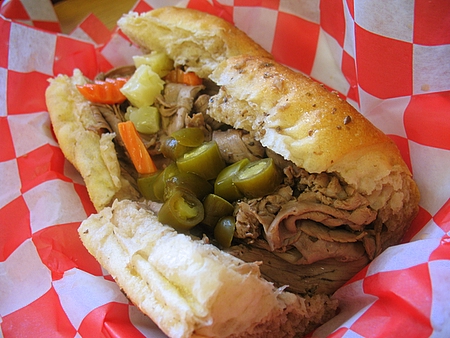 Created on the Sout Side of Chicago (no "h" used in South), in the Italian enclaves around the now defunct Stockyards, the classic Chicago Italian Beef Sandwich (pronounced sangwitch) is a unique, drippy, messy variation on the French Dip Sandwich. It is available in hundreds of joints around the city, and rarely found beyond its environs.
The exact origin is unknown, but the sandwich was probably created by Italian immigrants in the early 1900s as they rose from poverty and from ground meat into the middle class, where they were able to afford beef for roasting.
The recipe was popularized by Pasquale Scala, a South Side butcher and sausage maker. During the Depression, in the late 1920s, when food was scarce, Scala's thinly sliced roast beef on a bun with gravy and fried peppers took off. Today, beef sangwitches are a staple at Italian weddings, funerals, parties, political fundraisers, and lunches "wit my boyz". And Scala's Packing Company supplies hundreds of restaurants and Italian Beef Stands with the raw ingredients.
Italian Beef is made by slowly roasting lean beef on a rack above a pan filled with seasoned beef-based gravy. In many Chicago Italian households it is not called gravy, a term reserved for tomato sauces. Others call it au jus or "juice" for short, although it is often made with bouillon, and that is not technically au jus, which normally refers to natural cooking juices.
Then it is sliced paper thin, soaked in the juice for a few minutes, and layered generously, dripping wet, onto sections of Italian bread loaves, sliced lengthwise. This crust is typically tan, only slightly crumbly, fluffy and white in the center, and high in gluten. According to Allen Kelson, former restaurant critic for Chicago Magazine, and now a restaurant consultant, it is important that the bread has, what Bounty Towels calls "wet strength". This comes from long fermentations, he explains. The more accelerator (yeast), the worse the bread, as far as Italian beef goes. French breads just don't cut it, he says.
The meat is topped with sautéd green bell pepper slices and giardiniera, which is a spicy hot blend of chopped serrano peppers, carrots, cauliflower florets, celery, olives, and herbs packed in oil. Finally juice is spooned over the toppings, making the bread wet and chewy. You can ask for extra juice for dipping, but then everyone will know you ain't from around here.
Recipe
Makes about 10 sandwiches with about 1/4 pounds of meat each.
Cooking time: Allow about 2 hours to cook and another 3 hours to firm the meat for slicing in the refrigerator if you don't have a meat slicer. You need 90 minutes to cook a 3 pound roast, or about 30 minutes per pound. You can cook this well in advance and refrigerate the meat and juice and heat it up as needed. You can even freeze it. This is a great Sunday dish because the smell of the roasting beef and herbs fills the house. After you cook it, you need another 30 minutes to chill it before slicing.
The beef
1 boneless beef roast, about 3 pounds with most of the fat trimmed off (a rump roast with lots of marbling, or sirloin tip roast or top round roast with lots of fat - important for flavor development)
The rub
2 teaspoons garlic powder
1 teaspoon onion powder
1 teaspoon dried oregano
1 teaspoon dried basil
1 teaspoon ground black pepper
1/2 teaspoon crushed red pepper
The juice
6 cups of hot water
4 cubes of bouillon
The sandwich
10 soft, fluffy, high gluten rolls, sliced lengthwise but hinged on one side or Italian bread loaves cut widthwise into 10 portions (Gonnella, Turano, and D'Amato are the bakers of choice in Chicago)
3 medium sized green bell peppers
1 tablespoon olive oil, approximately
1 cup hot giardiniera
About the beef. Top sirloin butt, top round roast, or bottom round roast are preferred in that order. Scala's is the purveyor of choice in Chicago. For authenticity, do not use a fatty roast like the chuck or an expensive cut like the loin. For tenderness, especially if you cannot cut paper thin slices, try a chuck roast. Suggested to me by my friend David Rosengarten, the famous cookbook author and TV chef, chuck is a fattier cut, so the meat will be more tender and flavorful. "Luxurious" is the word he used. Problem is that you'll have to chill the pan drippings after cooking in order to skim off the fat.
About the garlic. Omit the garlic powder and stud the roast with fresh garlic.
About the bouillon. I have encountered lively debate on the makeup of the juice as I developed this recipe. Some insist you must use bouillon to be authentic, while others use beef stock, veal stock, or a soup base, and simmer real onions and garlic in it. The bouillon advocates have won me over on the authenticity argument, although I must confess, soup base is my favorite.
Serve with. A green salad with Italian dressing and French fries or tater tots.
Note. Kelson says "better to skip this and eat another sandwich."
Drinks. The traditional drink is diet cola because most beef stands don't have liquor licenses. Too bad, because this sandwich goes great with beer or red wine.
Do this:
1) If you wish, you can cut small slits in the surface of the meat every inch or so and stick slivers of fresh garlic into the meat. If you do this, leave the garlic out of the rub. Otherwise, mix the rub in a bowl. Sprinkle it generously on the meat and massage it in. There will be some left over. Do not discard it, we will use it in the juice. Let the meat sit at room temp for about 30 minutes. Meanwhile, preheat the grill or oven to 400°F. If you are cooking indoors, put a rack just below the center of the oven.
2) Pour the water into a 9 x 13" baking pan and heat it to a boil on the stove top. Dissolve the bouillon in the water. It may look thin, but it will cook down and concentrate during the roasting. Pour the remaining rub into the pan. Place a rack on top of the pan. Place the roast on top of the rack above the juice. Roast at 400°F until interior temperature is 140°F for medium rare, about 30 minutes per pound [I would cook to 120 - 125°F]. This may seem long, but you are cooking over water and that slows things down. The temp will rise about 5°F more as it rests. Don't worry if there are people who won't eat medium-rare meat. The meat will cook further in step 5, and you can just leave theirs in the juice until it turns to leather, if that's what they want. If you use a rotisserie on your grill, you can cut the cooking time in half because the spear and the forks holding it in place will conduct heat into the interior.
Beware. This recipe is designed for a 9 x 13" baking pan. If you use a larger pan, the water may evaporate and the juice will burn. If you have to use a larger pan, add more water. Regardless of pan size, keep an eye on the pan to make sure it doesn't dry out during cooking. Add more water if necessary.
Quick and easy shortcut. My wife makes a darn tasty Italian Beef Sangwitch by simply dusting the meat with unmeasured herbs, garlic, salt, pepper, and oregano, and then she browns it on all sides in a frying pan with some olive oil. She then deglazes the pan and that's her gravy. It goes in a pan under the meat in the oven during roasting. I love it (but not as much as mine - hope she doesn't read this).
3) While the meat is roasting (mmmmm, smells sooooo good), cut the bell peppers in half and remove the stems and seeds. Rinse, and cut into 1/4" strips (some like thick slices). Cook the peppers in a frying pan over a medium high heat with enough olive oil to coat the bottom, about 1 tablespoon. When they are getting limp and the skins begin to brown, about 15 minutes, they are done. Set aside at room temp.
4) Remove the roast and the juice pan. Let the meat sit for about 30 minutes for the juices to be reabsorbed into the meat fibers, and then place it in the coldest part of the refrigerator. Let it cool for about a few hours, long enough for the meat to firm up. This will make slicing easier. Slice the meat against the grain as thin as humanly possible, preferably with a meat slicer. My wife remembers that her family would cook the roast and take it to the butcher to slice on his machine. That's a good strategy if you don't have a meat slicer. This, of course, is against health codes today. If you don't have a slicer, use a thin blade and draw it along the red part of the meat. If you try to cut down through the crust you will be cutting it too thick.
5) Taste the juice. If you want you can thin it with more water, or make it richer by cooking it down on top of the stove. In Chicago beef stands it is rich, but not too concentrated. Then turn the heat to a gentle simmer. Soak the meat in the juice for about 1 minute at a low simmer. That's all. That warms the meat and makes it very wet. You can't leave the meat in the juice for more than 10 minutes or else it starts to curl up, squeezes out its natural moisture, and toughens. If you go to a beef stand and the meat is really curly, they have committed a mortal sin. At Mr. Beef, for example, I watched them take a handful of cooked beef and dump it into the juice every time they took out enough for a sandwich. This also enriches the juice with meat protein and seasoning from the crust.
6) To assemble the sandwich, start by spooning some juice directly onto the bun. Get it wet. Then lay on the beef generously. Spoon on more juice (don't burn your hand). Top it with bell pepper and, if you wish, giardiniera. If you want it "wet", dip the whole shootin' match in juice. Be sure to have plenty of napkins on hand.
Variations on the theme
The "Combo": Most Italian beef joints offer a "combo," which also has a grilled Italian sausage nestled in with the beef. These are thick, uncured, coarsely ground pork sausages in natural casings, flavored with fennel, paprika, black pepper, red or green bell peppers, onions, garlic, parsley, and crushed red chili peppers for some heat. Italian sausages are made in your choice of hot, medium, or mild (sometimes called sweet).
The "Cheef": Cover it with shredded mozzarella and/or provolone, broil for a few minutes, and you have a "cheesy beef" or "cheef". Not many stands offer this mutant strain. And if you're going to do that, you may as well put ketchup on your hot dog, too.
With "Gravy": An even rarer and more heretical variant, topped with marinara.
The "Soaker": Just dip the bread in the juice and you have the classic laborer's lunch, a soaker, a.k.a. "sugo pane", or gravy bread. Sugo pane is also commonly made with marinara sauce.
