Hoagie (Italian Sandwich)
Most of the early twentieth century Italian food in the United States came from the southern Italian immigrants who arrived during the great wave of immigration in the United States from the late 1800's to the early 1900's. Most of these immigrants settled into the large northeast cities of New York City, Boston, and Philadelphia.
Many Italians became fishermen, shoemakers, waiters, fruit and food peddlers, and tradesmen, though most were unskilled laborers working in mines, construction jobs, building roads, and as longshoreman on the waterfront.
The southern Italian immigrants from the Naples, Italy region (Neapolitan) brought with them the Italian sandwich, made with baked crusted bread with pointed ends stuffed with cured meats and cheese. Entrepreneurial immigrants seized on the opportunity to peddle the sandwich to the Italian immigrant workers on the docks at the waterfront, and to the laborers at construction sites.
How the Hoagie Got Its Name
The word hoagie first appears in print in 1945, with alternate spellings like hoogie and hoggie appearing as early as 1941. How it got its name is an often debated topic.
The most commonly touted explanation is that it comes from the name of Hog Island, Philadelphia. In the early part of the twentieth century there was a shipyard on Hog Island (now the site of the Philadelphia airport). During the First World War, Italian-American shipyard workers, or hoggies as they were known, would bring large sandwiches to work with them. The early spelling of hoggie makes this hypothesis attractive, but there is a gap between the shipyard’s years of operation and the earliest attestation of the sandwich name in 1941. The shipyard operated full-bore from 1917–20, after which production rapidly declined before it closed completely in 1925. That leaves only a handful of years for the name to catch on in the city’s consciousness and a gap of some fifteen years before the name is found in print. If the name can be antedated further, the Hog Island hypothesis will seem more likely, but for now this explanation seems doubtful.
The Philadelphia Almanac and Citizen's Manual offers a different explanation, that the sandwich was created by early-twentieth-century street vendors called "hokey-pokey men", who sold antipasto salad, meats, cookies and buns with a cut in it. When Gilbert and Sullivan's operetta H.M.S. Pinafore opened in Philadelphia in 1879, bakeries produced a long loaf called the pinafore. Entrepreneurial "hokey-pokey men" sliced the loaf in half, stuffed it with antipasto salad, and sold the world's first "hoagie".
A third and more likely explanation is that an enterprising restaurateur coined it. Al De Palma, the self-proclaimed “King of the Hoagies,” claims to have coined hoggie. In 1928, while working as a jazz musician, De Palma saw some fellow musicians eating a submarine. Impressed with the size of the sandwich, De Palma remarked that, “you had to be hog to eat one.” When the Depression hit, De Palma couldn’t find work as a musician and in 1936 opened up a sandwich shop. Recalling the sandwich and his remark from eight years before, he made and sold hoggies in the shop. He was quite successful, eventually opening a chain of hoagie shops and earning himself his sobriquet. De Palma’s claim and story is consistent with the date of the name’s appearance. He opened his sandwich shop in 1936 and the term (hoggie) appears in advertising copy by 1941.
Italian Hoagie (Italian Hero)
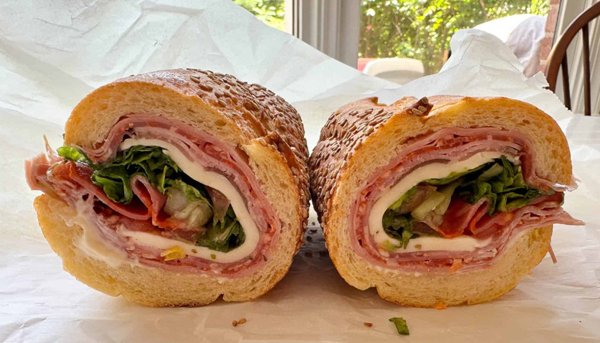
The true Italian hoagie basically packs an entire charcuterie board into every bite of a preferably crispy sub roll: cured meats (salami, soppressata, coppa, culatello, speck, bresaola…), semi-hard to hard cheeses (Provolone, Parm-Reggiano, but no mozz), Italianate condiments (pepperoncinis, sweet and hot pickled cherry peppers, etc), olive oil (mayo is for submarines), vinegar and oregano.
Note: Putting mayo on an Italian hoagie is like putting ketchup on a hot dog—you probably shouldn't. [I put ketchup on hot dogs and mayo on my hoagie.]
Dressing:
2 teaspoons red wine vinegar
1 tablespoon dried oregano
2 tablespoon olive oil
4 crispy Italian hoagie or sub rolls, split without cutting through to the other side (or Italian bread with sesame seeds)
Mayonnaise (optional)
1/4 pound prosciutto, thinly sliced
1/4 pound capicola, thinly sliced
1/4 pound mortadella, thinly sliced
1/4 pound Genoa salami, thinly sliced
1/4 pound provolone or Italian fontina cheese, thinly sliced
1 large tomato, thinly sliced [your tomatoes should not be real juicy or they make a mess of the sandwich]
1 small sweet onion, thinly sliced
3 or 4 romaine leaves, or iceberg lettuce, thinly sliced
Hot or medium pickled peppers or rings (optional) - hot cherry peppers (or pepperoncini)
Sweet pickled cherry peppers
Place the vinegar and oregano in a small bowl. Slowly whisk in the oil until emulsified.
Do not cut the roll totally in half. Notice in the picture that the meat and other ingredients are layered starting from the crease where the two halves meet. This builds structure and keeps the two roll halves together so the fillings do not all fall or squish out.
If you'd like, scoop out a bit of the crumb to create more room for the toppings.
Spread each half of roll with mayonnaise, if using. Place first the meats, then the cheese in layers piling them in the crease between the two halves of bread. Top with the tomatoes, onions, hot peppers, then the lettuce. Drizzle with the dressing, as desired. Close the two halves together. Optionally, you can wrap the hoagies in parchment paper to hold them together and make them easier to eat.
Serve immediately.
Serves 4
Other Popular Hoagies
All of these hoagies are made with lettuce, tomato, onion, oil, vinegar and oregano as for the Italian hoagie:
- Cheese
- Ham & Swiss or Provolone Cheese (American cheese is also good)
- Turkey & Cheese
- Roast Beef & Cheese
- Tunafish & Provolone Cheese
- Capicola & Provolone Cheese
Recipe for Homemade Italian Capicola - Fresh mozzarella & roasted peppers - use Balsamic vinegar
- Broccoli raab, sharp Provolone & roasted peppers
Follow the directions for Italian Hoagies to the left substituting any of the above meats and cheeses for the Italian meats and cheeses.
