Hard Sourdough Pretzel Rods
from https://sourdoughbrandon.com/
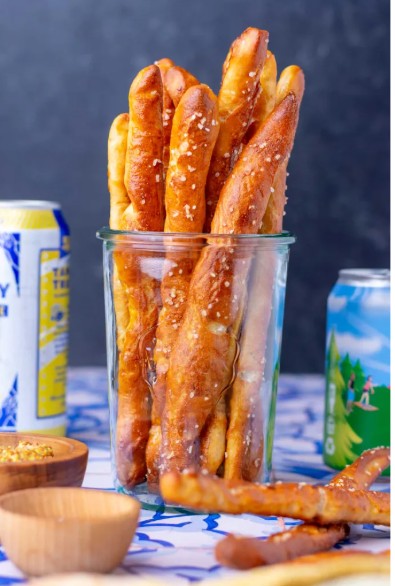
Hard Sourdough Pretzel Rods have a satisfying, salty crunch that can be paired with your favorite dip as an excellent snack or appetizer! To achieve their dark brown, glossy exterior, I make a baked baking soda bath, which is a little easier and less scary for most home bakers to use over lye. Then, they’re brushed with an egg wash and a sprinkle of crunchy pretzel salt. While the steps may seem a bit of a dance, the ingredients are very basic, and the process itself is quite forgiving. Plus, you can cut them to make smaller sourdough pretzel bites if you want to.
Shape the rods thin and as even as possible I recommend shaping the pretzel rods quite thin (about 1/2-inch) so there is more crust and the exterior remains crunchy. Depending on how crunchy you want your pretzels, you can extend the baking time at a lower temperature.
I think they look best served upright in a wide-mouth jar, like a mason jar or small vase, which makes them easy to grab for guests.
Active Sourdough Starter: The pretzels are leavened, so you’ll want to use an active sourdough starter (not sourdough discard) for this recipe.
Baked Baking Soda: To make baked baking soda, heat 1/2 cup of baking soda on an aluminum foil lined baking sheet at 250ºF (120ºC) for an hour. Baking the baking soda will transform the sodium bicarbonate to sodium carbonate and help you get dark brown pretzels. Feel free to make the baked baking soda ahead and store in it an airtight container. For a more straightforward and accessible substitute, you can boil your pretzels in a water bath with a few tablespoons of regular baking soda and 2 tablespoons of brown sugar or molasses. While this method won’t produce the same deep browning or chewy texture, it’s a quick and decent option for home bakers.
Hard Sourdough Pretzel Rods Recipe
Levain: Alternatively, skip this step and use enough starter for the recipe - 120g of active sourdough starter.
40 grams Sourdough Starter
40 grams Bread Flour
40 grams Water
Sourdough Pretzel Rods:
420 grams All-purpose Flour
25 grams Granulated Sugar
12 grams Kosher Salt
260 grams Warm Water
Levain, see above, or 120 grams of active sourdough starter
1 Egg, beaten for egg wash
Pretzel Salt, or another coarse salt for sprinkling
Baked Baking Soda Bath:
Water
1/2 cup Baking Soda, 130g for the baked baking soda, or use a substitute given in the detailed guide above
Make the Levain:
Mix the active sourdough starter, bread flour, and water for the levain in a jar.
Cover and set in a warm location for 4-5 hours until doubled in size and bubbly.
Alternatively, skip this step and mix 120g of active starter into your dough in the next step.
Mix the all-purpose flour, sugar, and salt in the bowl of a stand mixer fitted with the dough hook attachment. Then, pour all of the levain and water into the bowl and begin mixing for a couple of minutes on low speed until the dry ingredients are just mixed, but shaggy and stiff.
Cover with a towel for 10 minutes to rest and further hydrate.
Continue mixing for 7-10 minutes until the dough is smooth, tacky, and doesn't stick to the sides of the bowl.
Cover the bowl and place in a warm location to proof for 5-6 hours. Bulk fermentation is complete when the dough has doubled in size and feels full of air.
Refrigerate the dough overnight, or for up to 48 hours.
The next day, line two baking sheets with lightly floured parchment paper.
Punch down the cold dough and turn it out onto a clean work surface. Weigh the dough and divide that number by 20. Use a bench scraper or knife to divide the dough into 20 equal-sized portions. Mine are typically 38-40 grams each.
Use the palm of your hand and the friction of the work surface to roll each piece into a round ball (only flour the palm of your hands if there is sticking).
Then, roll the balls into long, slender pretzel rods about 9 inches long and an 1/2 inch thick with slightly tapered ends. Place them an inch apart on the prepared baking sheets.
Set aside to proof for 30 minutes to 1 hour until they've risen a bit and feel puffy.
Meanwhile, you can make the baked baking soda. To do so, preheat the oven to 250ºF (120ºC). Line a small baking sheet with aluminum foil and add the baking soda. Bake for an hour.
Arrange two oven racks in the upper and lower thirds of the oven and preheat to 425ºF (218ºC).
Fill a wide dutch oven or large pot over a stovetop with water and bring to a boil. Add all of the baked baking soda (it will bubble at first and turn cloudy).
Wearing safe kitchen gloves, gently drop one pretzel rod at a time into the bath for about 10 seconds. It's okay if they lose their shape or bend. Then, lift the rod out of the water with a spider strainer and place it back onto the prepared baking sheets. Arrange it so it's as straight as possible and bakes evenly. Repeat with the remaining pretzel rods.
If the dough is too sticky or difficult to handle, place the pan into the freezer for a few minutes to stiffen up.
Beat one egg in a small bowl and use a brush to apply a thin layer of egg wash to the pretzels rods, followed by a sprinkle of pretzel salt.
Bake the pretzels for 30 minutes, rotating the pans halfway through. When done, the pretzels should be dark brown and shiny.
Cool on wire racks and serve warm or at room temperature day-of.
For even harder and crunchier rods, turn the oven down to 200ºF and bake for at least another hour to further bake off any residual moisture or use a dehydrator.
