The Food Lab: How to Make Creamy Vegetable Soups Without a Recipe
http://www.seriouseats.com/, Jan 27, 2014, J. Kenji López-Alt, Managing Culinary Director
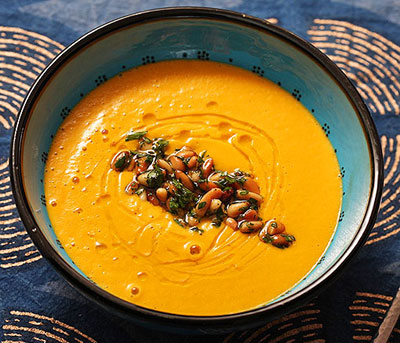
Spicy Carrot and Ginger Soup With Harissa
Harrissa is a North African pepper paste
Also see Creamed Vegetable Soups
Step 1: Prepare Your Main Ingredient
There are times when you may want to boost the flavor of a main ingredient by, say, roasting or browning it. This is an especially effective technique for sweet, dense vegetables like sweet potatoes and squashes, or brassicas like broccoli or cauliflower, all of which intensify in sweetness with some browning. To roast them, cut them into large chunks, toss with some olive oil, salt, and pepper, set them in a baking sheet lined with aluminum foil or parchment paper, and roast in a 375°F oven until tender, with their edges tinged brown.
If you want the clean flavor of fresh vegetables to come through, don't roast them.
Step 2: Choose Your Aromatics
Alliums—onions, leeks, shallots, garlic, and the like—are like the Best Supporting Actor of the soup pot. They're not there to steal the spotlight, but without them, your soup would be damn boring.
Other firm vegetables such as diced carrots, bell peppers, celery, thinly sliced fennel, or ginger can work well in certain situations, but they tend to have a stronger impact on the finished flavor of the dish, so make sure that you really want them there. Make a carrot soup with just onions and it'll taste like carrot soup. Make a carrot soup with fennel or ginger, and it will taste like carrot-and-fennel soup or carrot-and-ginger soup.
Step 3: Sweat or Brown Your Aromatics
Sweating is the process of slowly cooking chopped vegetables in a fat. You do it over moderate heat, and the goal is to get rid of some of the excess moisture within those vegetable, and to break down their cellular structure so that their flavor is released.
Browning starts out like sweating, but generally takes place over higher heat. Once excess liquid from vegetables has evaporated, the vegetables can begin to brown and caramelize, creating rich flavors, more sweet notes, and more complexity.
You might think that more flavor is always better, and thus you should always brown your vegetables, but more often than not, this browning can be overpowering, making soups too sweet or competing too much with the subtler flavors of your main vegetable.
Step 4: Add Second-Level Aromatics Like Spices and Pastes
After your aromatics have sweated or browned, the next phase is your secondary aromatics, and it's an optional stage that's often omitted. If you like very clean, pure-tasting soups, jump ahead. If you like playing with flavors and spices, then you'll have fun with this step.
These are things like ground spices (say, curry powder, ground cumin, or chili powder), and moist pastes (like tomato paste, harissa, or chopped chipotle peppers in adobo sauce). These types of ingredients benefit from a brief toasting or frying in hot oil, which alters some of their constituents into more complex, more aromatic products, as well as extracting fat-soluble flavors so that they disperse more evenly into the soup.
Because ground spices have such a high surface area-to-volume ratio and most pastes have already been cooked, the process only takes a few moments—just until the spices start smelling fragrant.
Step 5: Add Your Liquid
Your choice of liquid can have a big impact on the finished dish. Soups recipes will often combine liquids, such as chicken stock to simmer the soup ingredients in, then finished with a smaller amount of dairy (cream or half-and-half). See
• Chicken stock is an easy fallback and always a good choice. It has a neutral, mild flavor that adds meatiness and savoriness to a dish without overwhelming any flavors. Likewise vegetable stock can bring similar complexity, though buyer beware: unlike store-bought chicken broth, most store-bought vegetable broths are vile. You're better off making your own.
• Vegetable juice is what you want if you value intensity of vegetable flavor over balance. Carrots cooked and pureed in carrot juice will taste insanely carroty. You can buy many vegetable juices at the supermarket these days, or juice your own with a home juicer. Mixing and matching a main ingredient with a different vegetable juice (like Roasted Squash and Carrot Juice) can lead to great end results.
• Dairy such as milk or buttermilk is a good way to get yourself a heartier, creamier dish, though dairy fat does have the tendency to dull bright flavors. This is not necessarily a bad thing: dairy is the perfect foil for the intense flavor of broccoli in a creamy broccoli soup, or tomatoes in a cream of tomato soup, for instance.
• Water is a perfectly fine choice if the other options aren't available.
Whatever liquid you choose, don't use too much. Use just enough to cover your ingredients by an inch or so. You can always thin a thick soup out after blending, but reducing a puréed soup that's too thin is a much more difficult thing to do.
After adding your liquid and main ingredient bring it to a simmer, and let it cook until the vegetables are just cooked through; you want them to be just tender enough to pierce with a knife with no resistance. For things like carrots, parsnips, and other root vegetables, you have a bit of leeway here. Overcooking won't be the end of the world. But for bright green vegetables like broccoli, asparagus, peas, string beans, or leafy greens, you want to make sure to stop cooking them before they start turning a drab green color—if a brightly colored soup is something you care about, that is.
Step 6: Purée and Emulsify
Here's the fun part: puréeing. The smoothness of your final soup will depend on the tool you use. There is one exception to the general rules here: potatoes. Because of their high starch content, potatoes should never be puréed in a blender, unless thick, gluey soup is what you're after. For a potato soup, your best bet to smoothness is to cook the potatoes in liquid, then drain and press them through a ricer, food mill, or tamis, whisking the pressed potato back into the soup to thicken it.
• A blender will give you the absolute smoothest results, due to its high speed and vortex action. When blending hot liquids, always hold the lid down with a kitchen towel, start the blender on low, and slowly bring it up to high speed. Unless you enjoy wearing hot soup.
• An immersion blender can give you decently smooth results, depending on the power of your blender. It's by far the most convenient way to make soup, and it's a good choice if you're fine with a rustic, kind of chunky texture.
• A food processor should be your last choice. Because of their wide base and relatively low spinning rate, food processors do more chopping than puréeing.
Whatever method you choose to purée, I like to emulsify my soup with some fat during this stage—either butter or olive oil. This adds a rich texture to the soup.
If the ultimate in smoothness is your goal, finish off your puréed soup by using the bottom of a ladle to press it through a chinois or an ultra fine mesh strainer.
Step 7: Finish with Acid and Season
Seasoning is the final step just before plating and serving in any recipe. You can season as you go, but you never know if your soup has the right level of salt until you taste it in its final form. Now is the time to do that.
Equally important to bring out the best flavor in a recipe is acid. Because acidic ingredients quickly dull in flavor when cooked, it's best to add fresh acid right at the end, just before serving. For most vegetable-based dishes, lemon juice or lime juice is a great option, as their aroma complements vegetal flavors. Other good options would be a dash of cider vinegar, wine vinegar, or sherry vinegar. The latter goes particularly well with soups made with plenty of extra-virgin olive oil.
Step 8: Garnish and Serve
Your soup is essentially done at this stage, but a little garnish never hurt anybody.
Here are some options:
• Flavorful oils, like walnut, pistachio, squash seed, or argan.
• Chopped fresh herbs or tender alliums like parsley, tarragon, chives, or sliced scallions. [fried sage, dill]
• Sautéed vegetables like mushrooms, leeks, or garlic. [crispy fried onions]
• Nuts toasted in olive oil or butter, like almonds, hazelnuts, or pine nuts.
• Simple gremolata-style mixtures, like a blend of parsley, lemon zest, and grated garlic.
• Thinly sliced chilies.
• A drizzle of browned butter.
• Dairy products like sour cream, crème fraîche, or heavy cream; plain or flavored with spices or pastes.
• [Grated ginger, finely chopped orange zest]
• [A dusting of finely grated hard cheese such as Parmesan, Romano, or Emmenthaler]
Using a hint of the same spice you used earlier in step 4 can be a good way to boost flavor. Think of the garnish as a final step to layer flavor and/or texture into the bowl.
For further ideas, see: Soup Garnishes
