Boston Baked Beans
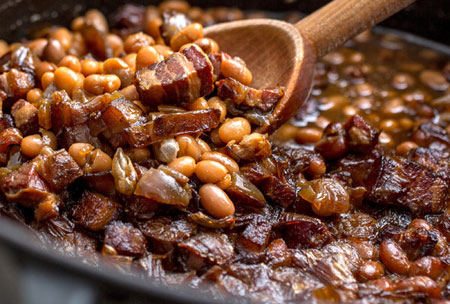
The official state bean of Massachusetts is the baked navy bean (also called pea bean, boston bean, or yankee bean), recognized in 1993 by the state legislature. The Old World was familiar with several kinds of beans, but the American common bean* and the lima bean were unknown. Scholars believe that the Pilgrims learned how to bake navy beans from native Indians, the Narragansett, Penobscot, and Iroquois Indians.
*The "American common bean" (Phaseolus vulgaris) includes all these native beans originating in the Americas: navy bean (so named because they sustained the seafaring branch of the military), red kidney, pinto, great northern, marrow, and yellow eye beans. It also includes all our edible-pod garden beans (string-less, snap, & string beans). The Fava Bean has been cultivated for centuries in Europe and is still considered a staple of the Mediterranean diet. Also known in English as the Broad Bean or Horse Bean, it was the only bean known to Europe before contact with the new world.
Beans were a staple food in the American Indian diet. The Indians wrapped the navy beans in deerskins (or placed them in earthenware pots) with venison, bear fat, and maple syrup, then baked them in pits lined with hot stones. The religious beliefs of the Pilgrims forbade cooking on the Sabbath (sundown Saturday to sundown Sunday), and these baked beans made a perfect Saturday night supper because the leftovers could be eaten, still warm, the next morning for breakfast.
Later, Boston became a major producer of rum. Molasses, the main ingredient for rum, was very plentiful and the recipe for baked beans was altered to include molasses in place of maple syrup. Salt pork was substituted for the bear fat and Boston Baked Beans were born. Boston became famous in colonial times for its baked beans, and to this day is called "Beantown."
What are Boston baked beans? They're small white beans (usually navy beans), slow-cooked in an oven, hearth, or ember-filled hole in the ground with molasses, salt pork, black pepper, and maybe a touch of mustard and onion until they form a thick stew, rich with a deep color and caramelized crust. Those are the ingredients a 1939 copy of The New England Yankee Cookbook calls for; it's what a 1914 copy of Household Discoveries & Mrs. Curtis's Cook Book describes; and it's what The Fannie Farmer Cookbook instructs as well (along with adding a couple of tablespoons of sugar).
Great served as a a main dish with corn bread, or as a side with pork or beef barbecued ribs, grilled ham steak, pork chops or roast, and of course, Boston Brown Bread.
Boston Baked Beans
from http://www.worldpath.net/~hiker/recipe.htm
FMM: I think this is the recipe I made once in an old bean pot I have and they were suprisingly good for such a simple recipe. I would have used bacon instead of salt pork which is not easily found.
1 pound (2 cups) dry navy beans
2 quarts cold water
1/2 teaspoon salt
1/2 cup molasses
1/3 cup brown sugar
1 teaspoon dry mustard
4 ounces salt pork [Use crisp and chopped bacon}
1 medium onion, chopped
Rinse beans; add to water in saucepan. Bring to boiling and simmer 2 minutes; remove from heat. Cover; let stand 1 hour. (Or add beans to cold water; soak overnight.)
[I would drain the soaking water and replace with fresh water.] Add salt to beans and water; cover and simmer till beans are tender, about 1 hour. Drain, reserving liquid. [Do not add the remaining ingredients until the beans are cooked or they may take forever to soften. Acid interfers with this.]
Measure 2 cups liquid, adding water if needed; mix with molasses, brown sugar, and mustard. Cut salt pork in half; score one half. Grind or thinly slice remainder. In 2-quart bean pot or casserole (some prefer the bean pot), combine beans, onion and ground salt pork [bacon]. Pour molasses mixture over. Top with scored pork.
Cover; bake in 300 oven for 5 to 7 hours. Add more liquid if needed.
Makes 8 servings.
Comments: This is a recipe to make while at home, as additional water will most likely need to be added - save your water from the boiling stage... And enjoy the smell of the baking beans.
Boston Baked Beans in Bean Pot
Recipe By Durgin-Park Restaurant, Boston, MA
2 1/2-quart bean pot or covered casserole
1 pound (2 cups) beans*
1/2 teaspoon baking soda
1/2 pound salt pork
1/2 medium onion -- peeled and uncut [I would chop this]
4 tablespoons sugar [1/4 cup, or brown sugar]
1/3 cup molasses
1 teaspoon dry mustard
1 teaspoon salt
1/4 teaspoon pepper
*Use California pea beans, York State beans or small white beans.
Soak beans overnight. In the morning, drain the beans and preheat oven to 325° F. Place the baking soda in a Dutch oven and fill half way with water. Bring to a boil and add the beans. Boil for 10 minutes. Drain beans in a colander and run cold water through them. Set aside.
Dice the salt pork (available in the bacon section of the grocery store) into 1-inch squares. Put half of the salt pork on the bottom of the bean pot, along with the onion. Put beans in the pot. Put the remaining salt pork on top of the beans.
Mix the sugar, molasses, mustard, salt and pepper with 3 cups of hot water and pour over the beans. Cover pot with lid and place the pot into the preheated oven. Bake for 6 hours [without stirring]. Check pot periodically to check the amount of liquid. Add water to the beans slowly as needed to keep them moist; do not flood them. Remove the pot from the oven and serve.
Makes about 7 cups.
NOTE: The Durgin-Park, a Boston restaurant whose origins date back to the American Revolution, is famous for its Boston baked beans, baked Indian pudding and apple pan dowdy. Durgin-Park cook Tommy Ryan has prepared this recipe at the restaurant for the past 37 years.
Durgin-Park serves 1,000 diners on an average Saturday evening. The waitresses have a reputation for their long memories: the second time you come in, you get the same thing you ordered the first time--unless you speak fast.
From The Sacramento Bee, September 2, 1998.
