Charcuterie & Cheese Boards
Charcuterie (shar-KOO-tuh-ree) is a French culinary art of preparing and serving cured, smoked, or salted meats like ham, salami, and pâté, originally for preservation before refrigeration; today, it's famously presented as a charcuterie board with meats, cheeses, crackers, fruits, nuts, and spreads as a popular appetizer. The word comes from French "chair" (flesh) and "cuit" (cooked).
A cheese board is a platter featuring a curated selection of cheeses, served with various accompaniments like crackers, breads, fruits, nuts, jams, and honey, designed to create a diverse tasting experience of flavors and textures, often presented beautifully on a wooden board or slate. While a traditional cheese board focuses solely on cheese, modern versions often blur lines with charcuterie boards (which highlight cured meats) by including both.
You can arrange things in whatever pattern you want them to be arranged. We just recommend that you put down larger items, like bowls with dips and spreads, and pieces of cheese first so that you can make sure you have room for them. Then, fill in with smaller things. And keep adding until the board is full. You want this to feel luscious and bountiful. If it looks a little thin, use a smaller board and compress the size.
Key Components of Cheese Boards:
- Cheeses: A mix of hard, soft, semi-soft, and aged cheeses (e.g., cheddar, brie, Swiss, Gruyère) for variety.
- Vessels (Carbs): Crackers, sliced baguette, breadsticks, or rye bread to carry the cheese.
- Sweet & Fruity: Fresh grapes, figs, berries, apples, pears, or dried fruits like apricots, plus honey or jams.
- Salty & Savory: Olives, pickles, nuts (almonds, pecans), or cured meats (on a mixed board).
- Spreads & Dips: Mustard, fig butter, or honeycomb.
What's on a Charcuterie Board:
- Meats (Charcuterie): Salami, prosciutto, sopressata, cured ham. Salami Cornicopias, also see Salami Roses below.
- Cheeses: A variety of hard, soft, and semi-soft cheeses like brie, cheddar, goat cheese, or blue cheese.
- Carbs/Starches: Crackers, baguette slices, rustic breads.
- Sweet Bites: Fruits (grapes, figs, berries), jams, honey, preserves.
- Savory/Briny Items: Olives, cornichons (small pickles), nuts (almonds, walnuts), mustard.
How to Style Charcuterie
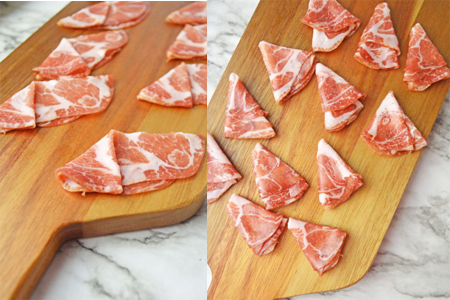
Charcuterie Folds: This fold works for many different types of meats of various sizes. Take a slice, fold it directly in half, then in half again to make a rough equilateral triangle with one rounded edge. With these quarters you can create a variety of textures on the cheese board.
The term “salami river,” which refers to a layer of salami snaking down the center of a cheese board. To do this, create multiple quarter folds and stack them in your hand. Add some pressure so they stick together, then lay them on the board in a line, stretching from one end to the other. Once the line is complete, you can gently create an S-curve in the line to make the river shape. You can create rivers with all types of charcuterie, but 3-inch-wide, 1/8-inch-thick sliced Genoa salami tends to work best for this. With larger slices of charcuterie, you can layer each quarter on the board, creating a river, or spread the slices throughout.
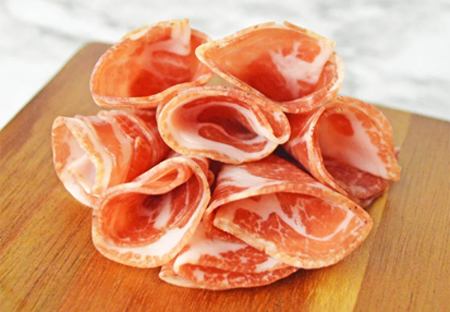
Charcuterie Cones: To fold together thinner meats, like capicola, you can fold them in half, and then roll them into cones for a fun presentation that you can build onto. These you can layer on top of each other to add some height to your board, and they start to resemble bouquets of little salty meats.
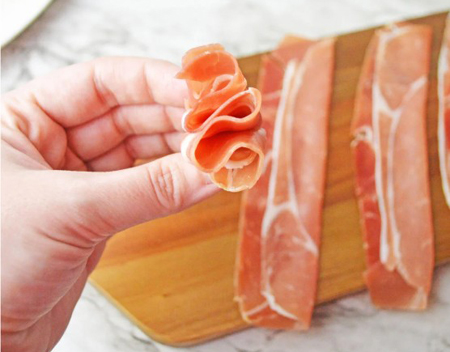
Charcuterie Ribbons (also called Fans or Accordians): To make these, start by laying out your pieces of charcuterie, prosciutto works well for this, and folding them about half or 3/4 of the way up, concentrating on folding up the side with more of the fat marbling so you have the meat side situated farther up. Press the folded edge so that it stays. Then, take the folded prosciutto and start folding it back and forth, continuing to pinch along that folded edge so that the ribbons stay folded together. It will end up looking like a handheld fan, sort of. You can then place those, by lying them down, and extend the ribbon with more pieces of prosciutto.
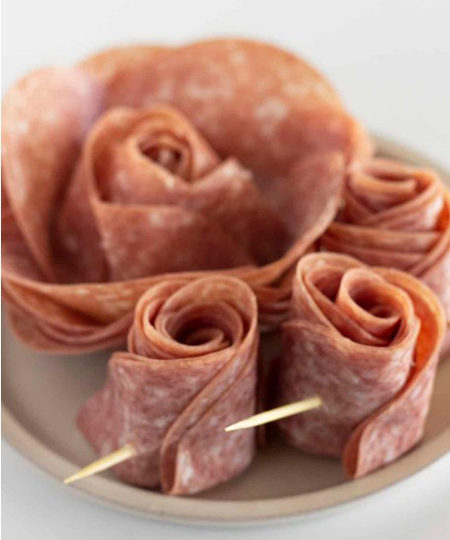
The Charcuterie Rose (also see below for larger roses made using a glass): Charcuterie roses are a great way to add a captivating detail to your board. To do this, layer 3 or 4 slices of a thinly sliced meat in a row, overlapping halfway across. Fold the row in half lengthwise. Starting on the right side, roll the fold to the left until completely wrapped.
How to make by rolling To make smaller meat roses, all you will need is a toothpick to keep the salami rosettes together. 1. Fold 5-10 slices of salami in half. Place the first one down and then add the others in a long line. Each piece of salami should be added to the middle of the one before. 2. Starting with the first salami slice that was laid down, begin to roll the line of meat tightly. Once you are at the end, use a toothpick to secure it.
Or, Start with one piece of salami and roll it up. Grab another piece of Salami and wrap it around the seam of the rolled-up salami. Continue to wrap around the seam with salami until it starts to take a rose shape and look like petals. Put in Bowl: Place in a small bowl to hold the shape and gently fan out the flower. Place the flower in the center of a round board.
Rollups: Simply Rolling up the charcuterie and stacking them makes a nice presentation. If the pieces are big, you can fold them in half before rolling.
Another way to style meat by rolling it. Make roll-ups by wrapping mozzarella with pepperoni. You can also wrap melon with prosciutto for a sweet-and-salty pairing. Also see Salami Cornicopias where salami is rolled up with cream cheese flavored with horseradish or other flavoring.
Salami Rose Focal Point
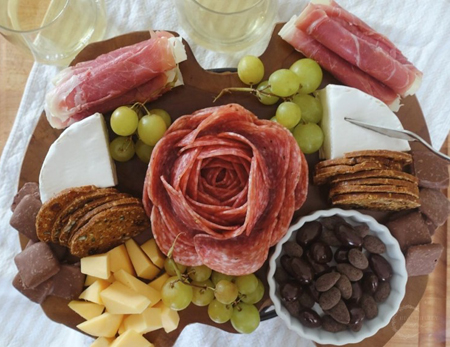
Another good starting point for making a Charcuterie Board is by making a Salami Rose to use as a starting point. This is also a great idea for a Sandwich-making platter.
You need to start with a glass - she likes to use a wine glass. Thinly sliced genoa salami is best. You should use about 20 pieces of salami to make a regular-sized, full-looking salami rose. Any less and you’ll sacrifice fullness.
Start by taking your salami and pinching it in the center so it’s folded in half in the middle. Lay it over the rim of the glass so that one half hangs over the edge while the other is in the glass.
Use that hand to hold it there as you do the same thing with another piece using your other hand. Place that second piece of salami slightly overtop the first one.
Continue doing this until you have a layer of salami that goes across the entire rim of the wine glass.
Continue layering your salami overtop each layer, overlapping the salami pieces even closer as you get closer to the center. After each layer, or as needed, use the palms of your hands to cusp the salami against the rim of the glass so it stays put.
After placing all the salami in layers on your glass, use one hand and place it on top of the salami and the other hand on the bottom of the glass. Flip the glass so the salami is resting in the palm of your hand.
Use the hand holding the bottom of the glass to gently twist the glass to remove it from the salami rose. Place the salami rose wherever you’d like!
Making Ahead: You can make salami roses ahead of time! Simply place your salami rose in an airtight container and store it in the refrigerator for up to 3 days.
Tips:
- Change the size of your rose by changing the size of your glass.
- Use more meat to make a fuller-looking rose. Save any extras and use them for sandwiches the next day!
- Any meat you use for salami roses should be round in shape so they can imitate the petals of a rose.
Ina Garten's Cheese Board
I like this cheese board because it is simple. So many of them are so cluttered you have no idea what is on them. I don't find them inviting.
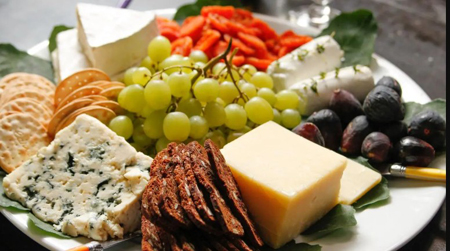
8 fig leaves
1 to 2 bunches green grapes
1/2 round of Brie, such a Tremblaye
Wedge of aged sharp Cheddar
8 ounces goat cheese, at room temperature
Fresh thyme sprigs
Good olive oil
1 wedge blue cheese, such as Roquefort
Dried apricots
Fresh figs
1 package of dried fruit crackers, such as Rustic Bakery
1 package water biscuit, such as Carr's
Arrange the fig leaves on a round platter. Place the grapes in the middle and the Brie, Cheddar and goat cheese around the grapes. Sprinkle thyme leaves and place a sprig of thyme on top of the goat cheese and drizzle with olive oil. Add the blue cheese to the cheese arrangement and artfully arrange the apricots, figs and crackers among the cheeses.
Christmas Charcuterie Boad
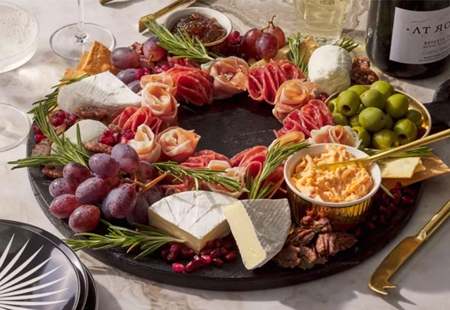
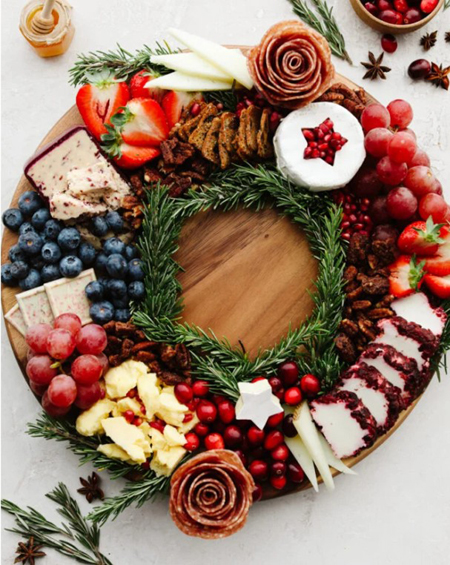
Place a small bowl in center of a circular cheese board. This helps to create the shape.
Roll prosciutto into flowers, if desired (Fold in half lengthwise and roll up); fold salami pieces like an accordion to create ruffles; secure with wooden picks. Arrange around bowl on cheese board.
Arrange Brie, goat cheese, Basic Pimiento Cheese, olives, fig jam, pomegranate arils, grapes, around bowl in shape of a wreath.
Fill in remaining space on board with Rosemary-Browned Butter Pecans and crackers.
Fill in for dramatic effect. Arrange rosemary sprigs on the inside and outside of the “wreath” for the green effect.
Remove the center bowl.
A Christmas Wreath Cheese Board
This wreath uses rosemary to look like Christmas greenery. Add the rosemary in the center to outline the wreath. Then, add some sprigs in the outside edges.
She use Garlic Herb Brie, English Cheddar Cheese, Cranberry Cheese, Cranberry Cinnamon Goat’s Milk Cheese for the cheeses and just two salami roses for the charcuterie, so this is primarily a cheese board.
If you want to add in more meats and less cheese and fruits then she suggests using some pepperoni, prosciutto, Spanish chorizo, or capocollo!
She especially likes to add fruit to a charcuterie board not only because it’s a classic ingredient but because of the great taste and texture. It’s nice to have some juicy, fresh taste to complement all of the savory meats and cheeses! She added fresh cranberries, which I am sure no one will eat - too sour.
Here are the nuts, crackers, and sweets that she used: Pistachios Candied pecans Baked crackers Ghiradelli peppermint bark squares, for a mixture of salty and sweet.
