Pâté, Terrines and Galantines
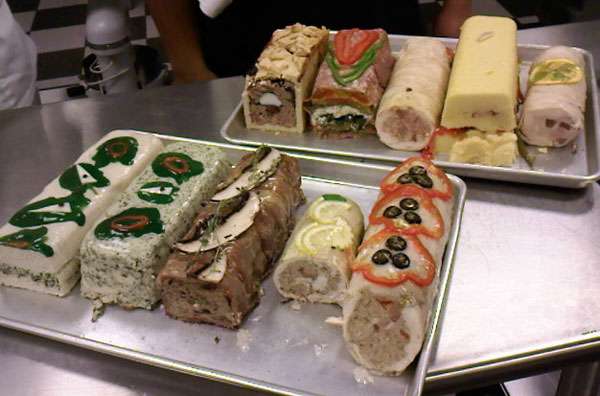
Pâté, Terrines and Galantines
Pates, terrines, and timbales have existed since the early history of the Francs and Gaules and of the Roman Empire. It was in the thirteenth century that the wealth of buffets and tables of entremets began in earnest. In these particular times, not only were chefs involved in the creations, but sculptors, painters, and architects were also part of the formation of these extravagant banquets.
These forcemeat (called farce by the French) products were made of finely ground or coarsely chopped meat, poultry, or fish. They were seasoned and then bound with a combination of egg, cream, and bread stuffing. As the skills of chefs advanced and consumers had more money, forcemeats were layered with strips of meat, sweetbreads, liver, truffles, and mushrooms to vary their tastes and textures. The edible wrappings of pastry, caul fat, salt pork, grape leaves, and poultry skins encased the meats. The bundles were then placed on hot stones near the fires to slowly bake, or they were roasted on spits above the open flames. Eventually, earthenware crocks were also used as vessels for baking.
Charcuterie has been considered a French culinary art at least since the 15th century. Pâté and terrines are both a form of charcuterie, a way to cook and preserve meat prior to the development of the refrigerator in France. Chefs continue to use the method because of the rich flavors produced by the preservation process. Charcuterie includes a number of other meats in addition to pate and terrine, such as confit and galantine. Pâté and terrines can be unpretentious and simple, or fancifully adorned.
Charcuterie production typically involves forcemeats, which are ground lean meats emulsified with fat. Forcemeats are made from various meats, including
Pork and pork liver
Seafood and fish
Game meat and game birds
Veal
Poultry
Pork fatback is often used in the emulsifying process because of its neutral flavor. In the United States, four different types of forcemeats are used: Straight, country-style, gratin and mousseline. The differences in the forcemeats relate specifically to the portions of emulsifier and the process by which the forcemeat is created.
Pâtés and Terrines
Pâté is a smooth form of charcuterie that is cooked in a dish called a terrine. Pâté is often made of pig meat and parts, but wild game like snipe, partridge, venison or wild boar can be cooked into a pâté, as can farm-raised duck, rabbit or pheasant. Even vegetables can be made into pâté. Lean meats might require the addition of some pork fat to keep the pâté from drying out in the oven. Often, pâté is cooked in a crust or pie, in which case it is called pâté en croûte—meaning "in a crust." In England, a workaday version of this pâté is found in every pub—but they call it pork pie. More often pâté is cooked in a special metal or porcelain loaf pan, and this mold is called a terrine. You might hear pâté referred to as terrine; if it's cooked in a terrine, it can correctly be called a terrine.
However, a terrine is a different type of charcuterie that are chunky but are also baked in a terrine dish. The term pâté often suggests a finer-textured forcemeat using liver, while terrines are more often made of a coarser forcemeat.
The meat is chopped or ground, along with heavy seasoning, which may include fat and aromatics. The seasoning is important, as they will generally be served cold, which mutes the flavors. The mixture is placed into a lined mold, covered, and cooked in a water bath to control the temperature, which will keep the forcemeat from separating, as the water bath slows the heating process of the terrine. Pâté and terrine are generally cooked to 160°F (71°C), while terrine made of foie gras are generally cooked to an internal temperature of 120°F (59°C). After the proper temperature is reached, the terrine is removed from the oven and placed into a cooling unit topped with a weight to compact the contents of the terrine. Then it is allowed to rest for several days to allow the flavors to blend.
Galantines and Roulade
Galantine is a chilled poultry product created after the French Revolution by the chef to the Marquis de Brancas. Galantines consist of finely ground poultry or feathered game, herbs, spices, wines or spirits. The finely blended mixture is pleased into a special forms or stuffed into the skin of the bird, tightly trussed, and poached in an appropriately flavoured stock. Galantines may be studded with pistachios for additional visual effect and a pleasant taste dimension. They are thinly sliced and attractively arranged on presentation mirrors for buffet tables. Duck, wild duck, turkey, chicken, geese and pheasants are frequently used for galantines.
The galantine is prepared by skinning and boning a chicken or other poultry. The skin is laid flat, with the pounded breast laid on top. A forcemeat is then placed on top of the pounded breast. The galantine is then rolled with the ends of the breast meeting one another. The galantine is then wrapped in cheesecloth and poached in poultry stock until the proper internal temperature is reached. Galantines are served cold, often coated in aspic.
Roulade is similar to a galantine. The two major differences are instead of rolling the poultry evenly for the ends of the breasts to meet, the bird is rolled into a pinwheel shape, and the roulade is cooled by chilling it after it has been removed from the poaching liquid.
Ballotine
A ballotine is traditionally a boned thigh part of the chicken, duck or other poultry stuffed with forcemeat and other ingredients. It is tied to hold its shape and sometimes stitched up with a trussing needle. A ballotine is cooked by roasting, braising or poaching. A ballotine is often shaped like a sausage or re-formed to look like the leg, often with a cleaned piece of bone left in the end.
In today's commercial kitchens a ballotine is often made from other parts of poultry like the leg meat, also today's ballotine may be made using many types of meat and not always poultry. Although ballotines are related to galantines they are distinctive by being single-serve items classified as entrées as opposed to relevés. They are also served hot or cold, whereas a galantine will be served cold.
