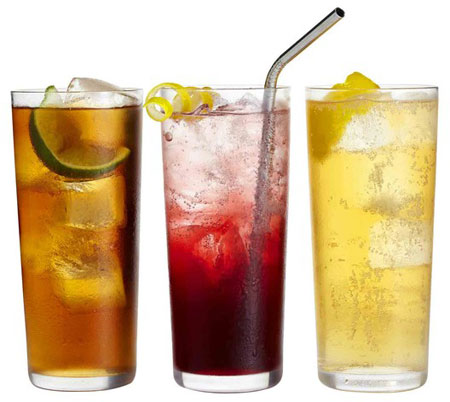
The Highball
Any liquor served with ice, soda, plain water, ginger-ale or other carbonated beverages.
Highball is the name for a family of refreshing mixed drinks that are composed of an alcoholic base spirit and a larger proportion of a carbonated mixer. Initially, the most common highball was made with Scotch whisky and carbonated water, known where it originated in the UK as a "Scotch and Soda". Other well-known examples of highballs include the Gin and Tonic, Seven and Seven (Seagram's 7 whiskey and 7-up soda), and Cuba Libre (rum and coke). A highball is typically served over ice in a large straight-sided highball glass or Collins glass. Unlike Rickeys, Collinses, and Fizzes, highballs do not contain citrus fruit juice.
Origin
The highball started life, not with whiskey, but with brandy, thanks to the invention of Joseph Priestley in 1767 of carbonated water. It became a highly acceptable drink for Victorian gentlemen. It was then given even more pep with the invention of the soda syphon. Cognac was the first great aged spirit to be mixed, but when a grape vine pest devastated the region's vineyards, a substitute was needed. In stepped whiskey. As squirt of soda made blended whiskey made an acceptable middle-class drink.
Esquire Magazine's 1949 Handbook for Hosts claimed that the Highball was invented back in 1890 or so by Patrick Gavin Duffy, the bartender at Manhattan's Ashland House on Fourth Avenue at Twenty-fourth Street. At that time, the word, "ball" was slang for a "drink of whiskey" (Irish in origin) and high meant "served in a tall glass." This is all speculation of course, but it could account for how the simple cocktail got its name. Carbonated water changed the way people drank. The Highball was created during a period of American beverage history when bar patrons were looking for a way to enjoy the favors of whiskey without belting it down in one "knuckle dusting slug." They wanted to sip a tall, harder drink while they socialized in much the same way they used beer and wine. Instead of drinking liquor straight/neat (without a mixer), soda water and carbonated soft drinks helped dilute alcohol, and made having a drink more socially acceptable.
In his 1934 'The Official Mixer's Guide', Patrick Gavin Duffy writes, "It is one of my fondest hopes that the highball will again take its place as the leading American Drink. I admit to being prejudiced about this - it was I who first brought the highball to America, in 1895. Although the distinction is claimed by the Parker House in Boston, I was finally given due credit for this innovation in the New York Times of not many years ago."
That New York Times reference appears to be a letter written by Duffy on 22 October 1927 to the Editor in response to an editorial piece in the paper. He starts, "An editorial in The Times says that the Adams House, Boston, claims to have served the first Scotch highball in this country. This claim is unfounded." He goes on to tell of how in 1894 he opened a little café next the old Lyceum in New York City and that in the Spring of that year, an English actor and regular patron, E. J. Ratcliffe, one day asked for a Scotch and soda. At that time Duffy did not carry Scotch but this request and the growing number of English actors frequenting his bar led Duffy to order five cases of Usher's from Park & Tilford. Duffy claims that when the shipment arrived he "sold little but Scotch highballs", consisting of 'Scotch, a lump of ice and a bottle of club soda'. His letter finishes, "Shortly afterward every actor along Broadway, and consequently every New Yorker who frequented the popular bars, was drinking Scotch highballs. In a few years other Scotch distillers introduced their brands and many were enriched by the quantity consumed in this country. Actors on tour, and members of the Ancient and Honorable Artillery of Boston, who came here annually to attend the Old Guard Ball, brought the new drink to the Adams House.
Duffy's letter to The New York Times mentions Adam House in Boston while the reference in his subsequent book talks of 'Parker House'. Both are plausible Boston locations but does this confusion mean we should not take any of Duffy's claims for being the first to make Scotch Highballs in America seriously? The Times merely published Duffy's letter to the editor, the paper did not substantiate or even 'give credit' to his claims.
In his 2003 'The Joy of Mixology', Gary Regan explains that "Highball is an old railroad term for the ball indicator connected to a float inside a steam train's water tank which told the conductor that there was enough water in the tank and so the train could proceed. Apparently when the train was set to depart, the conductor would give the highball - two short whistle blows and one long". Gary explains that this term was apt as the drinks consist of 2 shots of liquor and a long pour of mixer.
Cocktail historian David Wondrich has uncovered an 1884 reference to a rye and ginger ale Highball with the spendid name of Splificator, which predates Duffy's claim. Splificators were the most popular drink during Prohibition times, and in the 1950s the Scotch Highball ruled. So closely associated with the "dash and a splash" with Scotch, that when it began to struggle in the 1970s, the Highball went with it. It's no surprise that drinkers are reviving this drink again.
Some Highballs
Scotch and Soda
Gin and Tonic
Seven and Seven - Seagram's 7 whiskey and 7-up soda
Cuba Libre - rum and coke
Dark 'N' Stormy - rum and ginger beer
Greyhound - traditionally gin, now often vodka, and grapefruit juice
Salty Dog - a Greyhound (gin and grapefruit juice) with a salted rim
Long drink (Finland) - gin and grapefruit soda or grapefruit juice
Also see Refreshing Summer Drinks, many of which are highballs.
