What is Vermouth?
Types of Vermouths
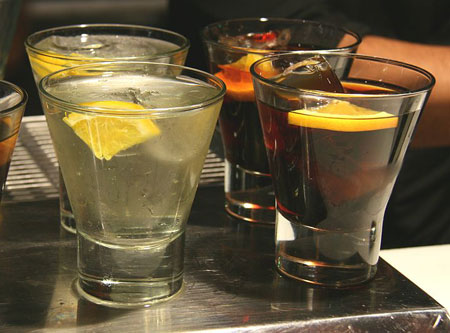
Vermouth is a fortified wine that is aromatized with a variety of herbs and spices. Grape wine is used as the base ingredient for vermouth. Each manufacturer adds additional alcohol and a proprietary mixture of dry ingredients, consisting of aromatic herbs, roots, and barks, to the base wine, which is then bottled and sold. There are a few varieties of vermouth available, the most common are dry or white vermouth and sweet or red vermouth. French and Italian companies produce most of the vermouth consumed throughout the world.
Consumption of wines fortified with herbs and/or roots is believed to have begun in ancient Greece around 400 BC. The extra ingredients were added to wine to make it a medicinal drink, but may have also had the purpose of masking foul odors and flavors as the wine spoiled over time.
Though the product is mostly an Italian/French undertaking, the word comes to us from the German Vermutwein, meaning wormwood wine (from the German word for wormwood, wermut). Wormwood was the chief flavoring ingredient for vermouth until the herb was found to be poisonous. The modern versions of the beverage were first produced around the late 18th and early 19th centuries in Italy and France. In 1786, Antonio Benedetto Carpano of Turin, Italy made the first sweet vermouth and dry vermouth came along in 1800, created by Joseph Noilly of France. There are many producers of vermouth, each using their own, often secret, recipe of herbs and botanicals.
While wormwood is indeed one of the many botanicals that go into its manufacture, vermouth has escaped the stigma that has followed absinthe. Actually, vermouth is a highly sophisticated product of a great many botanical flavorings such as cloves, nutmeg, seeds, marjoram, angelica root, gentian, nutmeg, linden, elder flower, iris root, citrus peels, and over a hundred others. The French (dry) make it by selecting and combining their botanicals, then pouring mixture of fortified wine and mistelles over them. The brew is allowed to steep for a few weeks; the wine is then drawn off and the process repeated until all the flavor has been extracted from the botanicals. A selection of these flavored wines are blended together and then mixed with unflavored wines, Brandy is added to raise the alcohol level, and the vermouth is chilled almost to the freezing point to eliminate any sediment. The Italian (sweet) vermouth is red, richer in flavor and more syrupy.
The First Cocktails
Although French vermouth first arrived in the US in 1844 and Italian vermouth in New York in 1853, vermouth was not a cocktail ingredient until the 1870s. There wasn't a single cocktail with vermouth in the 1862 edition of Jerry Thomas's Bar-Tender's Guide or in Willliam Terrington's 1869 Cooling Cups and Dainty Drinks.
Vermouth was consumed as a medicinal libation until the later 19th century when people found that vermouth was the ideal mixer and it became an important ingredient in many of the first classic cocktails, most notably, sweet vermouth in a Manhattan (beginning around 1874) and dry vermouth in a Martini (beginning in the 1860s). In addition, the popular Vermouth Cocktail, first appearing in 1869, consisted of chilled vermouth and a twist of lemon peel with the occasional addition of small amounts of bitters or maraschino. Those drinks that use an equal amount of sweet and dry vermouth are referred to as perfect.
Harry "The Dean" Johnson was the first mixologist to publish an amazing 11 cocktails with vermouth in his 1880 Bartenders' Manual. The Vermouth Cocktail, the Manhattan, the Trilby, the Morning Cocktail, Bijou Cocktail, Silver Cocktail, Turf Cocktail, Tuxedo Cocktail, Marguerite (the true mother of the Dry Martini), the Martini, and Bradford a la Martini were testaments to vermouth's popularity in cocktails. Johnson originated most of these cocktails himself, save for the Manhattan.
The popularity of vermouth-heavy cocktails, often using twice as much vermouth as gin or whiskey, continued through the 1880s and 1890s. Although the amount of vermouth used in cocktail recipes has somewhat declined, it is still used today as an ingredient in many popular cocktails, and for that reason demand for the beverage has remained fairly steady through the 20th and into the 21st centuries.
Most cocktails using vermouth, and when drinking vermouth by itself, are apéritifs, although sometimes drunk as a digestif. Vermouth is used as an ingredient in many different cocktails, as people found it ideal for lowering the alcohol content of cocktails with strong spirits as their base, for providing a pleasant herbal flavor and aroma, and for accentuating the flavors in the base liquor. At first, martinis used sweet vermouth. Around 1904, however, dryer French vermouths began to be used in the cocktail. The term "dry martini" originally meant using a dryer vermouth as a mixer, not using less vermouth, as the term is used today.
The popularity of vermouth in the United States and Great Britain has declined since the mid-20th century, but is still used in those countries in many classic cocktails such as the Manhattan, albeit in smaller amounts. The drink is more popular in other parts of Europe, such as Italy and France, where it is often consumed by itself as an apéritif.
Cooking
Vermouth can be used as a substitute for white wine in food recipes. The herbs in dry vermouth reportedly make it an attractive ingredient in sauces for fish dishes or as a marinade for other meats, including pork and chicken.
Because vermouth is fortified, an opened bottle will not sour as quickly as white wine. Opened vermouth, however, will gradually deteriorate over time. Gourmands recommend that opened bottles of vermouth be consumed within one to three months and should be kept refrigerated to slow oxidation.
