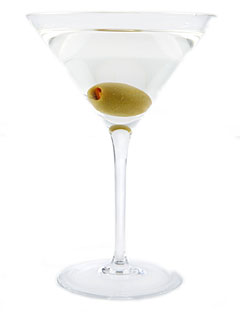
Dry Martini
"Originally (before Prohibition, anyway - the drink probably dates to the 1870s, but nobody's really sure), it went something like this: two parts, or even one part, gin to one part red vermouth (the sweet kind), with an extra dash of sugar syrup and maybe some orange bitters. Garnish: twist of lemon peel.
For at least the first five decades of its circulation, ever since a drink with that name and this general description first appeared around 1900, a martini required vermouth—a lot of it, none of this atomizer business or that stale "glance in the direction of a vermouth bottle" hokum. And early on, much of the vermouth making its way into martinis was of the sweet Italian variety rather than French dry—hence, a "dry martini" was a drink made with dry vermouth, not one with as little vermouth as possible. The dry martini (dry, white vermouth and no syrup) was a critter of the Gilded Age, coming in around 1900. "Dry" or "French" vermouth gained popularity just after the turn of the 20th century, resulting in bar-goers ordering "dry" or "perfect" cocktails, perfect meaning the drink held a blend of dry and sweet vermouths.
By the '30s, though, you find the Stork Club pouring 'em at an entirely reasonable five parts gin to one vermouth. At the height of the martini's powers, in the gray-flannel-suit years, the "see-through" went something like eight parts gin to no parts vermouth, with an olive."
For more information on vermouth and the history of cocktails, see What is Vermouth?
The key to a great Martini is to begin with great ingredients. Start off with a top-shelf gin and a decent vermouth. This is not a cocktail that you want to be cheap with because there are only two ingredients and if one is inferior, it will bring down the entire drink. See A Guide to Popular Gin Brands
2 oz. Gin (Tanqueray, Bombay Sapphire, Beefeater - you want it around 94-proof)
1 oz. Dry Vermouth
1 dash orange bitters, optional but recommended
Garnish with olive or lemon twist
Combine ingredients in a mixing glass and fill with ice. Stir well to chill* and strain into a chilled cocktail glass. Twist a piece of lemon peel over the drink and use as garnish, or toss in an olive.
*Water is added to a Martini from the ice that is used to mix it with. The role of the water in any cocktail is to calm down the flavors all around and to reduce the "burn" of the alcohol. This is extremely important for creating a cocktail that is smooth and relaxing.
Vodka Martini - substitute vodka for the gin.
