Peter Reinhart’s Homemade Bagels
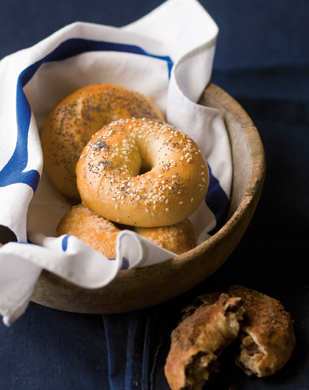
from Peter Reinhart:
“New York City isn’t the only place in the world to get decent, authentic bagels. The truth is, you can make bagels that are just as good at home, no matter where you live. They’re one of the simplest breads to make, requiring only flour, water, salt, yeast, and malt—and one secret ingredient: time (in the form of long, slow, cold fermentation).
Any decent bagel shop knows this and uses an overnight method to stretch out the fermentation process, releasing all sorts of subtle flavors trapped in the flour. Fermentation is also what creates those tiny little micro-blisters on the surface of a bagel. You have to ferment bagels for much longer than you might think. To get more bubbles, we let bagels sit in the fridge for two days instead of just one. The longer you leave it, the more bubbles you'll get.
While bagel shops often use a type of high-protein flour not available to home cooks to achieve that distinctively chewy texture, regular, unbleached bread flour can also do the trick. The real key is to use a much lower percentage of water than is used for baguettes and other European hearth breads, producing a stiff dough that can stand up to a dunking in boiling water before going into the oven.
Having said that, don’t get all crazy and make a super stiff dough or your bagels will start to resemble doorstops or hockey pucks more than bagels. And that’s definitely not what we are going for. The best bagel dough is still soft enough to manipulate easily, but stiff enough to not leave much residue on your fingers after doing so. The dough needs to be just a bit stiffer and tackier than a roll dough.
More than any ingredient or other aspect of the method, this boiling step is what defines the uniqueness of the bagel. That said, bagels do usually feature one other distinctive ingredient: barley malt. While this may seem like an exotic, hard-to-find product, it’s actually commonly available at most supermarkets, usually labeled “barley malt syrup.” If you can’t find it, simply substitute an equal amount of honey. Your bagels might not have that malty flavor, but they’ll still be better than almost any bagel you can buy.”
A typical bagel is about 4 ounces or 113 grams before baking, but you can make them smaller.
Cinnamon Raisin Bagels: For cinnamon raisin bagels, increase the yeast in the final dough to 1 teaspoon, and add 1 tablespoon of ground cinnamon and 5 tablespoons of granulated sugar to the final dough. Rinse 1 1/2 - 2 cups of loosely packed raisins with warm water to wash off surface sugar, acid, and natural wild yeast. Add the raisins during the final 2 minutes of mixing. Proceed as directed, but do not top the bagels with any garnishes. When they come out of the oven and are still hot, you can brush the tops with melted butter and dip them in cinnamon sugar to create a cinnamon-sugar crust, if desired.
Blueberry Bagels: use about the same amount of dried blueberries as raisins that is in the cinnamon raisin version (1 ½ to 2 cups), and again like the cinnamon raisin bagels, increase the yeast in the final dough from ½ teaspoon to 1 teaspoon to compensate for the dead weight of the dried fruit. Since the dried blueberries are pretty sweet, no additional sugar needs to be added to the dough.
Rye or Whole Grain Bagels: You can replace any amount of the bread flour with an equal amount of whole grain flour (by weight), such as wheat or rye. If you do so, increase the water in the dough by 1 tablespoon (0.5 oz / 14 g) for every 2 ounces (56.5 g) of whole grain flour you substitute. Other Ideas: Oat - Wheat dough with oat flour, for those who like their oats. Seven Grain - Wheat, rye, cracked corn, oats, millet, barley, rice and flaxseed, all in a wheat bagel. Top Pumpernickel bagels with caraway seeds.
Egg Bagels: add 1 egg (or just 1 yolk for a richer egg bagel) per 1 cup of flour. Since eggs have water content, there needs to be an adjustment of the water that goes into the recipe. As a general rule of thumb, each whole egg contains 1.5 ounces of water, while yolks contain about 0.5 ounce of water.
Bagel Toppings: Top your bagels with any combination of the following garnishes: poppy seeds, sesame seeds, coarse salt, or rehydrated dried onions or garlic - or chopped fresh onions or garlic that have been tossed in oil. (Soak dried onions or garlic in water to cover for at least 1 hour before applying. Then drain well.) The toppings will stick even better if you first brush the top of each bagel with an egg white wash made by whisking 1 egg white with 1 tablespoon (0.5 oz / 14 g) of water. If using coarse salt as a garnish, remember that a little goes a long way.
Everything Bagel Topping
4 teaspoons poppy seeds
4 teaspoons sesame seeds
4 teaspoons dried garlic (minced or flaked)
4 teaspoons dried onion (minced or chopped)
2 teaspoons kosher salt (or other coarse salt)
*Peter Reinhart’s Bagels
From https://smittenkitchen.com/
Adpated from The Bread Baker’s Apprentice
"These are utterly glorious as-is, chewy with a crispy and tough exterior and a soft, flavorful interior. I have it on good authority that these are as good as, if not better, than the Old School variety."
Also see my revised instructions for this recipe with tips I have picked up along the way: Homemade Bagels
Sponge
1 teaspoon instant yeast
4 cups unbleached high-gluten or bread flour
2 1/2 cups water, room temperature
Dough
1/2 teaspoon instant yeast
3 3/4 cups unbleached high-gluten or bread flour (FMM: I only used 2 cups)
2 3/4 teaspoons kosher salt (or 1 1/2 tsp. table salt)
2 teaspoons diastatic malt powder or 1 tablespoon dark or light malt syrup, honey, or brown sugar
To Finish
1 tablespoon baking soda
Cornmeal or semolina flour for dusting
1. Day one: To make the sponge, stir the yeast into the flour in a 4-quart mixing bowl. Add the water, whisking or stirring only until it forms a smooth, sticky batter (like pancake batter). Cover the bowl with plastic wrap and leave at room temperature for approximately 2 hours, or until the mixture becomes very foamy and bubbly. It should swell to nearly double in size and collapse when the bowl is tapped on the countertop.
2. To make the dough, in the same mixing bowl (or in the bowl of an electric mixer), add the additional yeast to the sponge and stir. Then add 3 cups of the flour and all of the salt and malt. Stir (or mix on low speed with the dough hook) until the ingredients form a ball, slowly working in the remaining 3/4 cup flour to stiffen the dough.
3. Transfer the dough to the counter and knead for at least 10 minutes (or for 6 minutes by machine). The dough should be firm, stiffer than French bread dough, but still pliable and smooth. There should be no raw flour – all ingredients should be hydrated. The stiffness of the dough allows the bagels to be boiled without deflating or losing shape. The dough should pass the windowpane test and register 77 to 71 degrees F. If the dough seems too dry and rips, add a few drops of water and continue kneading. If the dough seems tacky or sticky, add more flour to achieve the stiffness required. The kneaded dough should feel satiny and pliable but not be tacky.
4. Immediately divide the dough into 4 1/2 ounce pieces for standard bagels, or smaller if desired (Deb note: I used 2.25 ounce pieces, and yes, I weighed them because I wanted them to bake evenly). Form the pieces into rolls.
5. Cover the rolls with a damp towel and allow them to rest for approximately 20 minutes.
6. Line 2 sheet pans with baking parchment and mist lightly with spray oil. Proceed with one of the following shaping methods:
Method 1: Poke a hole in a ball of bagel dough and gently rotate your thumb around the inside of the hole to widen it to approximately 2 1/2 inches in diameter (half of this for a mini-bagel). The dough should be as evenly stretched as possible (try to avoid thick and thin spots.)
Method 2: Roll out the dough into an 8-inch long rope. (This may require rolling part of the way and resting if the pieces are too elastic and snap back, in which case, allow them to rest for 3 minutes and then extend them again to bring to full length. Wrap the dough around the palm and back of your hand, between the thumb and forefinger, overlapping the ends by several inches. Press the overlapping ends on the counter with the palm of your hand, rocking back and forth to seal.
7. Place each of the shaped pieces 2 inches apart on the pans (Deb note: I got away with 1-inch space for the minis). Mist the bagels very lightly with the spray oil and slip each pan into a food-grade plastic bag, or cover loosely with plastic wrap. Let the pans sit at room temperature for about 20 minutes.
8. Check to see if the bagels are ready to be retarded in the refrigerator by using the “float test”. Fill a small bowl with cool or room-temperature water. The bagels are ready to be retarded when they float within 10 seconds of being dropped into the water. Take one bagel and test it. If it floats, immediately return the tester bagel to the pan, pat it dry, cover the pan, and place it in the refrigerator overnight (it can stay in the refrigerator for up to 2 days). If the bagel does not float, return it to the pan and continue to proof the dough at room temperature, checking back every 10 to 20 minutes or so until a tester floats. The time needed to accomplish the float will vary, depending on the ambient temperature and the stiffness of the dough.
9. The following day (or when you are ready to bake the bagels), preheat the oven to 500 degrees F with the two racks set in the middle of the oven. Bring a large pot of water to a boil (the wider the pot the better), and add the baking soda (and optionally, a few tablespoons of barley syrup). Have a slotted spoon or skimmer nearby.
10. Remove the bagels from the refrigerator and gently drop them into the water, boiling only as many as comfortably fit (they should float within 10 seconds). After 1 minutes flip them over and boil for another minute. If you like very chewy bagels, you can extend the boiling to 2 minutes per side. While the bagels are boiling, sprinkle the same parchment-lined sheet pans with cornmeal or semolina flour. If you want to top the bagels, do so as soon as they come out of the water. You can use any of the suggestions in the ingredients list or a combination.
11. When all the bagels have been boiled, place the pans on the 2 middle shelves in the oven. Bake for approximately 5 minutes, then rotate the pans, switching shelves and giving the pans a 180-degree rotation. (If you are baking only 1 pan, keep it on the center shelf but still rotate 180 degrees.) After the rotation, lower the oven setting to 450 degrees F and continue baking for about 5 minutes, or until the bagels turn light golden brown.
You may bake them darker if you prefer.
12. Remove the pans from the oven and let the bagels cool on a rack for 15 minutes or longer before serving.
Yield: 12 extremely large, 16 regularly large or 24 miniature bagels
Peter Reinhart's Bagels
Epicurious | August 2011 by Peter Reinhart
Peter Reinhart's Artisan Breads Every Day
Dough
1 tablespoon (0.75 oz / 21 g) barley malt syrup, honey, or rice syrup, or 1 teaspoon (0.25 oz / 7 g) diastatic malt powder
1 teaspoon (0.11 oz / 3 g) instant yeast
1 1/2 teaspoons (0.37 oz / 10.5 g) salt, or 2 1/2 teaspoons coarse kosher salt
1 cup plus 2 tablespoons (9 oz / 255 g) lukewarm water (about 95°F or 35°C)
3 1/2 cups (16 oz / 454 g) unbleached bread flour
Poaching liquid
2 to 3 quarts (64 to 96 oz / 181 to 272 g) water
1 1/2 tablespoons (1 oz / 28.5 g) barley malt syrup or honey (optional)
1 tablespoon (0.5 oz / 14 g) baking soda [skip - don’t like the taste on the bagels]
1 teaspoon (0.25 oz / 7 g) salt, or 1 1/2 teaspoons coarse kosher salt
Do ahead
To make the dough, stir the malt syrup, yeast, and salt into the lukewarm water. Place the flour into a mixing bowl and pour in the malt syrup mixture. If using a mixer, use the dough hook and mix on the lowest speed for 3 minutes. If mixing by hand, use a large, sturdy spoon and stir for about 3 minutes, until well blended. The dough should form a stiff, coarse ball, and the flour should be fully hydrated; if it isn’t, stir in a little more water. Let the dough rest for 5 minutes.
Resume mixing with the dough hook on the lowest speed for another 3 minutes or transfer to a very lightly floured work surface and knead by hand for about 3 minutes to smooth out the dough and develop the gluten. The dough should be stiff yet supple, with a satiny, barely tacky feel. If the dough seems too soft or overly tacky, mix or knead in a little more flour.
Place the dough in a clean, lightly oiled bowl, cover the bowl tightly with plastic wrap, and let the dough rise at room temperature for 1 hour.
When you’re ready to shape the bagels, prepare a sheet pan by lining it with parchment paper or a silicone mat, then misting it with spray oil or lightly coating it with oil. Divide the dough into 6 to 8 equal pieces. (A typical bagel is about 4 ounces or 113 grams before baking, but you can make them smaller. If you make more than 6 bagels, you may need to prepare 2 sheet pans.) Form each piece into a loose ball by rolling it on a clean, dry work surface with a cupped hand. (Don’t use any flour on the work surface. If the dough slides around and won’t ball up, wipe the surface with a damp paper towel and try again; the slight bit of moisture will provide enough traction for the dough to form into a ball.) There are two methods to shape the balls into bagels.
The first method is to poke a hole through the center of the ball to create a donut shape. Holding the dough with both thumbs in the hole, rotate the dough with your hands, gradually stretching it to create a hole about 2 inches in diameter.
The second method, preferred by professional bagel makers, is to use both hands (and a fair amount of pressure) to roll the ball into a rope about 8 inches long on a clean, dry work surface. (Again, wipe the surface with a damp towel, if necessary, to create sufficient friction on the work surface.) Taper the rope slightly at each end and moisten the last inch or so of the ends. Place one end of the dough in the palm of your hand and wrap the rope around your hand to complete the circle, going between your thumb and forefinger and then all the way around. The ends should overlap by about 2 inches. Squeeze the overlapping ends together by closing your hand, then press the seam into the work surface, rolling it back and forth a few times to seal. Remove the dough from your hand, squeezing it to even out the thickness if need be and creating a hole of about 2 inches in diameter.
Place each shaped bagel on the prepared sheet pan, then mist with spray oil or brush with a light coating of oil. Cover the entire pan with plastic wrap and refrigerate overnight or for up to 2 days. (You can also proof the full piece of dough in the oiled bowl overnight and then shape the bagels on baking day, 60 to 90 minutes before boiling and baking them, or as soon as they pass the float test.)
On baking day
Remove the bagels from the refrigerator 60 to 90 minutes before you plan to bake them, and if you plan to top them with dried onion or garlic, rehydrate those ingredients (see the variations). Immediately check whether the bagels are ready for baking using the “float test”: Place one of the bagels in a small bowl of cold water. If it sinks and doesn’t float back to the surface, shake it off, return it to the pan, and wait for another 15 to 20 minutes, then test it again. When one bagel passes the float test, they’re all ready to be boiled. If they pass the float test before you are ready to boil and bake them, return them to the refrigerator so they don’t overproof. About 30 minutes before baking, preheat the oven to 500°F (260°C) and gather and prepare your garnishes (seeds, onions, garlic, and so on).
To make the poaching liquid, fill a pot with 2 to 3 quarts (64 to 96 oz / 181 to 272 g) of water, making sure the water is at least 4 inches deep. Cover, bring to a boil, then lower the heat to maintain at a simmer. Stir in the malt syrup, baking soda [don't use any baking soda], and salt.
Gently lower each bagel into the simmering poaching liquid, adding as many as will comfortably fit in the pot. They should all float to the surface within 15 seconds. After 1 minute, use a slotted spoon to turn each bagel over. Poach for another 30 to 60 seconds, then use the slotted spoon to transfer it back to the pan, domed side up. (It’s important that the parchment paper be lightly oiled, or the paper will glue itself to the dough as the bagels bake.) Sprinkle on a generous amount of whatever toppings you like as soon as the bagels come out of the water (except cinnamon sugar; see the variation for details).
Transfer the pan of bagels to the oven, then lower the oven heat to 450°F (232°C).
Bake for 8 minutes, then rotate the pan and check the underside of the bagels. If they’re getting too dark, place another pan under the baking sheet. (Doubling the pan will insulate the first baking sheet.) Bake for another 8 to 12 minutes, until the bagels are a golden brown.
Cool on a wire rack for at least 30 minutes before slicing or serving.
Makes 6 to 8 bagels
