Bakers Math (Dough Hydration)
Bakers Math is based on the total weight of flour in a recipe. Flour weight is always 100%.
Common formulations for bread include 100% flour, 60% water/liquid, 1% yeast, 2% salt and 1% oil, lard or butter. The amount of water, expressed as a percentage of the weight of flour, is referred to as the "hydration" and is indicative of the stickiness of the dough and the "crumb", or internal texture, of the bread.
If you are baking a 2 pound loaf of bread it typically contains approximately 17.5 ounces, or 500 grams, of flour. A bread dough at 60% hydration contains about 10.5 ounces, or 300 grams, of water (500 grams*60% = 300 grams). Bakers measure in grams for accuracy. In this case, the hydration of the dough is 60% since that's the percentage of water in the formula. Please note that that’s water content. Oil or other fats don’t count towards hydration.
To calculate the hydration level of a conventional recipe, first weigh the flour and water or other liquid (milk, etc.). Divide the weight of the water by the weight of the flour and then multiply the result by 100. For example, a recipe containing 1 1/4 cups of water (10 ounces) and 3 cups of all-purpose flour (15 ounces) will have a 67 percent (10/15 x 100 = 67) hydration level, indicating a moderately airy crumb.
When calculating hydration of sourdough breads, include the flour and in the starter, the leaven and the recipe.
Higher hydration levels produce more and larger holes, as is common in artisan breads such as baguettes or Ciabatta.
- American style breads usually are about 60 to 62% hydration, French style breads between 62 to 65%, and Italian style (ciabatta) breads upwards of a 68% range.
- A typical french bread formula looks like this: flour 100%, water 65%, salt 2%, yeast 2%
- Pizza Dough: flour 100%, salt 1.74%, sugar 2%, olive oil 3%, instant dry yeast 0.5%, water 58%
- I calculated Peter Reinhart’s bagel recipe – converted to grams, so there may be rounding differences – to be around 52% hydration. In kneading it, it required zero added flour and did not stick to anything – not my counter, not my hands, nothing. I knew this was likely the case walking in because I’d calculated the hydration levels first.
Bagel dough is much denser than bread dough, with a much lower hydration percentage, approximately 52%. This would mean that 500 grams of flour would only get 260 grams, or slightly over 9 ounces of water. I start with a sponge at 100% hydration, meaning an equal weight of flour and water and 1% yeast. This would equate to 500 grams of water plus 500 grams of flour and 5 grams of yeast. I let the sponge rest anywhere from 4-10 hours. Much more than that and I feel it affects the end product adversely. The gluten structure in the sponge begins to break down and the dough becomes slack. After the sponge has risen sufficiently, 4-12 hours, I mix the dough with enough additional flour to bring it down to a 52-53% hydration, adding salt, honey, and malt, each at about 2% of the total flour weight.
Hydration affects the process of bread building and the nature of the final result. Generally speaking, the more water in the dough, the more open the final bread's crumb. Note also that different types of flour absorb water differently because of their gluten protein percents. You may need to adjust dough consistencies; hydration with one flour at 75% may need to be adjusted to 73% or 77% when using a different brand or type. Bread dough can be classified according to three other categories based on hydration: stiff, standard or rustic.
Dough Texture |
% Hydration |
Bread Type & Crumb |
|
Stiff: |
50 to 57 |
Yields dense crumb in breads such as bagels, pretzels, breadsticks Bagels (50 to 57% hydration) are one of the least hydrated doughs and are extremely stiff. This means that they need a ton of kneading to get all the flour incorporated and gluten developed; it also means that they are not sticky at all in dough form. |
|
Standard:
|
58 to 65 |
Yields a denser, closed crumb, in breads such as sandwich bread, rolls, French and other European breads, such as Pane di Casa (Italian bread) Many formulas, such as white sandwich bread, French bread, and challah, use around 57 to 65% hydration. The dough starts to be a bit more tacky, but also more extensible. These doughs can hold their shape well, but also allow for a greater volume in proofing (rising). Be careful not to add too much flour, a little sticky is good, you do not usually want it to be completely non-sticky. That would mean your dough is too dry. As the dough rests, the flour will absorb more liquid. |
|
Rustic:
|
65 to 80 or more |
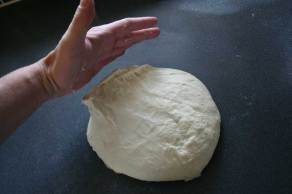
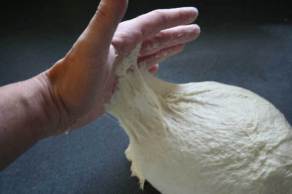
Yields an airy crumb and large, irregular holes, in breads such as ciabatta, focaccia, pizza dough, Country style, Rustic breads, Artisan Bakers baguette are around 65 to 70%. On the higher end of the spectrum you have breads like focaccia and ciabatta, which could be 65 to 80% or more hydrated. These doughs are extremely sticky. Kneading does not usually work on these doughs, and instead techniques used are turning (folding) or just letting the dough develop the gluten over a long period of time on its own (no kneading). Usually, 80% hydration is most appropriate for flatter or roughly shaped breads: ciabatta, focaccia, pizza dough, rustic baguettes, etc. These doughs need careful shaping. They might need a bit more bake time than usual to prevent the inside from being gummy. |
|
Crumb
Crumb is a term that bakers use to define the inside of the bread. By looking at the way the cell structure of the crumb is formed, and the shape and size and color of the cells, a baker can analyze the hydration, flour types, and yeast amounts as well as how the dough was mixed and shaped. By looking at the shape and crust a baker can see how the bread was baked, flour types, fermentation balance, and moulding techniques.
The amount of water in a dough defines the type of bread it will make.The next four examples show how the difference in hydration changes the size of the hole structure and creates an open crumb. Although differences in shaping and baking techniques account for the differences in appearance and crust, the basic ingredients of flour, water, salt, and yeast are always the same, so it is the hydration that gives the dough its defining quality. A dough with a 70% hydration that was shaped and baked like a bagel would never be a bagel.
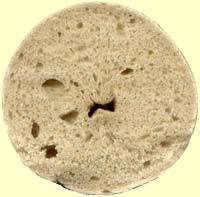
50% Hydration
Bagels traditional have a dense tight crumb creating a chewy texture. They are made with the same ingredients as crusty loaves of artisan bread but a different baking process and the low hydration give bagels their distinct texture and appearance.
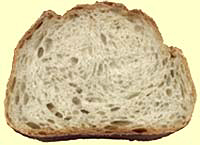
60% Hydration
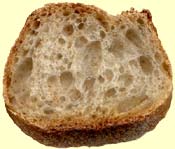
As hydration increases, the hole structure of the crumb gets larger and more irregular. Artisan breads generally have at least a 60% hydration level. You will notice that with the lower hydrations it is easier to see the swirl formed from the shaping process.
70% Hydration
This example of an Artisan Bakers baguette has 70% hydration. (A typical formula for a French baguette dough would be 60% water. This is due to the difference in the rate of water absorbtion between French and American flours.) In comparing the color of this example with that of the ciabatta below you will notice the brown flecks indicating that this baguette has some whole wheat flour in it and that the ciabatta does not.
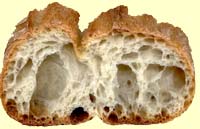
85% Hydration
The extra large hole structure of this ciabatta is caused by very high hydration levels and long fermentation times. Holes this large are considered difficult to achieve in the craft of baking. Mistakenly, a bread with holes this big is not considered a good sandwich bread because the filling might leak out the holes and be messy. But if the bread is sliced lengthwise, the large cells fill up with juices and the top and botton crusts keep the juices in. There is not a better bread for making a sandwich.
Bread Mixing Tips
Learning how to mix the dough so you get its "right consistency" or what is specified in the recipe, is the most important aspect of bread baking, can mean success or failure. For example, the objective in mixing MODERATELY STIFF DOUGH is to end up with dough that is tacky, not sticky or wet. It should also be pliable, soft and moist. By sticky, dough will stick to your finger as you pull it from the dough and some may stick to your finger. If that happens, the dough is too wet. By tacky, it mean when you touch the dough, it feels like the glue on the back of a "Post-it-Note" - your finger will stick to the dough when you pull it away, but it will come off easily and not take dough with it.
The most common reason for dense breads is the addition of too much flour; most of us add flour to get a smooth feel. You must learn to work with slacker (wetter) dough, which is somewhat sticky. It's the moisture content in the dough that turns to steam in the oven that helps to give it the oven rise, creating an open, light and airy texture and crumb, and more flavors.
When mixing dough, always start with a minimum amount of flour until dough reaches desired consistency (soft, tacky or firm). Most doughs (Standard type) require the addition of more flour if they fail to clear the sides of the bowl in their kneading time. To ensure you get the proper dough consistency and bread texture, mix in additional flour slowly, 1 tablespoon at a time. And never add more than 1⁄4 cup of extra flour to a recipe and give the flour time to absorb the liquid.
Knead dough only until it does not tear easily when stretched. Over-kneading dough is a common bread making mistake, which makes gluten too tight for bread to rise, resulting in chewy bread instead of fluffy.
Let the dough rise in a warm (80° F to 85° F), draft-free area. Proper rising helps in the development of the bread texture.
