Yorkshire Pudding (also Popovers - see below)
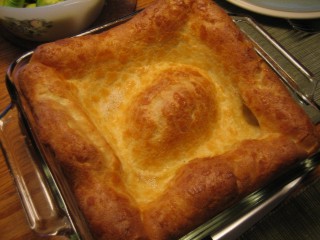
Yorkshire pudding is a staple of the British Sunday dinner and is the traditional accompaniment for Prime Rib. It is delicious used as a bread to sop up the juices on your plate.
Yorkshire pudding was originally poor man's fare that made a virtue out of a necessity – the necessity here being to stretch the meat as far as possible. It was also economical, using a little flour, an egg, salt and some milk. The original version was doubly economical, cooking beneath the spit-roasting meat, catching dripping juices and making best use of the roasting fire.
Historically it was served as a first course with the gravy from the roasting beef as well as the fat and juices that had dripped into it. For the children of poor families the Yorkshire pudding was the meal, the beef reserved for father. In Yorkshire it's still frequently served with onion gravy as a starter. Today the pudding is usually part of a roast beef main course, generally in bun sized versions, though the dinner-plate size cut into slices is more traditional.
Note: The batter needs to rest before baking at 1 hour to overnight.
4 Tbsp. beef drippings (from beef roast)
2 eggs
1 c. milk
1 c. flour (J. Kenji López-Alt uses all-purpose, others use bread flour)
1 tsp. salt
Beat the eggs. Beat in the milk. Add the flour and salt, all at once, and beat until smooth. Let the batter stand at room temperature to rest. or place the batter in a container and refrigerate for an overnight rest. Take the batter out 1/2 to 1 hour before baking so that it warms up.
Key to good Yorkshire Pudding: According to J. Kenji Lopez-Alt writing for The Food Lab at http://www.seriouseats.com/, "Resting the batter overnight is key for developing better flavor. Forget about cold batter: letting it rest at room temperature helps it rise taller as it bakes." He writes, "Not only do they come out taller, they also come out much tastier, with a more complex, toasty flavor. Non-rested-batter puddings taste positively flat (literally and figuratively) next to rested-batter puddings. . . Resting makes a big difference in the interior texture as well. With little gluten development, the interior of a Yorkshire pudding baked right after forming the batter is almost cake-like, with small bubbles and not much stretchiness. A pudding baked after an overnight rest has a stretchy texture with large bubbles inside."
Bring ingredients to room temperature. Divide the beef drippings between 2 - 8" round tins or 6 - 6 oz. cups. When ready to bake, place the baking pans with the drippings in the oven and preheat the oven to 450 degrees. Kenji says, "until the fat is smoking hot, about 10 minutes." A large cast iron pan will take more time to heat than popover tins.
Once heated, pour the batter into the heated pans or cups and bake for 15 minutes, then at 350 degrees for 15 - 20 more or until the puddings are puffed and brown. If baking in cups, the time will be less. Do not open the oven door while the pudding is cooking. (J. Kenji López-Alt tested this and concluded opening the oven door has no affect on the puddings.)
Serve with standing rib roast or other roast beef.
Popovers
When baked in muffin cups or popover pans, use butter to grease the cups instead of the the meat drippings, these are called Popovers. Served warm with butter and jam for breakfast or snack, or as a bread with dinner.
The popover is an American version of Yorkshire pudding and similar batter puddings made in England since the 17th century. The oldest known reference to popovers is in a letter of E. E. Stuart's in 1850. The first cookbook to print a recipe for popovers was Mary Newton Henderson, Practical Cooking and Dinner Giving, 1876.
Here is the recipe:
Breakfast Puffs, or Pop-overs (Mrs. Hopkins)
Ingredients: Two cupfuls of milk, two cupfuls of flour, two eggs, and an even tea-spoonful of salt. Beat the eggs separately and well, and the whites last, and then beat well together. They may be baked in roll-pans, or deep gem-pans, which should be heated on the range, and greased before the batter is put in: they should be filled half full with the batter. Or they may be baked in tea-cups, of which eight would be required for this quantity of batter. When baked, serve immediately. For Graham gems use half Graham flour.
