Danish Rye Bread (Rugbrød)
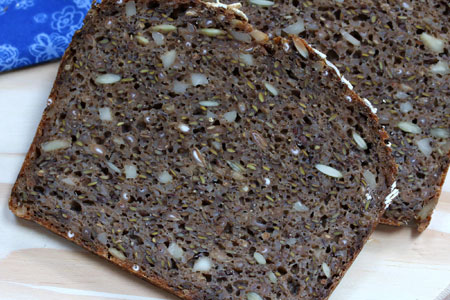
Scandinavian rye breads look nothing like the slices that clamp together the sandwiches at your neighborhood deli in New York. Made from whole grains and naturally risen, they are chewy, fragrant and deliciously dark. With butter and cheese, or as the base for avocado toast, they are amazingly satisfying. The taste and texture are addictive, and many enthusiasts also appreciate that rye bread contains more fiber and less gluten than wheat.
In Germany and throughout Scandinavia dense whole grain breads are particularly popular. You’ll see them served cut up in squares for a variety of hors d’oeuvres (for example, topped with gravlax/smoked salmon, a dollop of crème fraîche or hard-boiled eggs and a sprig of dill), served for breakfast with a tray of sliced cheeses and cold cuts, enjoyed for open-faced sandwiches or simply slathered down with good butter and jam. In Denmark this rye bread (Rugbrød) serves as the basis for their smørrebrød (ie, smorgasbord) wherein it is served buffet style with any number of fine toppings and is also a common accompaniment for many meals.
Traditional recipes start by makeing a rye sour starter that take at least three days. These recipes mix the bread dough to begin with and let the dough sit for 12 to 24 hours to sour. Both recipes use beer as a liquid.
Easy Danish Rye Bread (Rugbrød)
from http://www.daringgourmet.com/
Danish rye bread is a sourdough bread that traditionally takes 2-3 days to make. Here is a super simple version that cuts the fermentation time down to as a little as 24 hours without the need to tend and feed it. This version calls for a yeasty beer. Beer and bread are cousins, both traditionally made from the same two ingredients, water and grains. The alcohol in this bread is burned off during the long baking process while the beer contributes to a fabulous texture and consistency (and flavor, depending on which beer you use).
The bread dough is allowed to ferment for 24 hours at room temperature (or 48 hours depending on how sour you like the bread). This fermentation process neutralizes the phytic acid in the grains, a naturally occurring substance that binds nutrients so that the body cannot properly absorb them. Not only does phytic acid acid bind the nutrients of the grains themselves, it binds the nutrients of anything else you eat with the grains. Fermenting the bread dough increases its nutrients and makes the bread easier to digest. And even after sourdough is baked it continues to sour and only gets better in flavor over time.
2 cups lukewarm water
2 teaspoons dry active yeast
2 tablespoons sugar
2½ cups dark rye flour
¾ cup all-purpose flour
1¾ cup cracked rye berries
½ cup whole rye berries
1¼ cup whole flaxseeds
1⅓ cup sunflower seeds or combination of sunflower seeds, pumpkin seeds and/or chopped almonds
3 teaspoons salt
1 cup dark yeasty beer
1 cup buttermilk or kefir (vegan: 1 cup almond milk mixed with 2 tablespoons cider vinegar) (I often use homemade kefir in place of buttermilk)
Traditional rolled oats for sprinkling
Stir the yeast and sugar into the lukewarm water and let sit for 10 minutes until the yeast is frothy.
Combine all the dry ingredients in the bowl of a stand mixer. Add the yeast mixture, beer and buttermilk. Stir to combine.
Fit the stand mixer with a dough hook and knead on the bread setting ("2") for 10 minutes. The dough will be very sticky and not remotely malleable.
Scoop the dough into a very large non-metallic bowl with plenty of head space (the dough will bubble up). Cover loosely with plastic wrap and let it rest in a warm place (room temperature) for 24-48 hours, depending on how sour you want the bread to be.
Line a 9x5x3 inch bread loaf pan with parchment paper (SEE NOTE).
reheat the oven to 350 degrees F.
Scoop all of the dough into the lined bread pan, pressing down as needed. (It's a lot of dough but it will fit.) Brush the top with water and sprinkle over evenly with the rolled oats.
Bake on the middle rack for 90 minutes.
Let the loaf cool for 5 minutes before removing it from the pan. Let the loaf cool completely before slicing. Keep stored in an airtight container. To prolong its shelf life I recommend storing it in the refrigerator or freeze part of it if you know it will take you a while to go through it.
Notes
A couple of our readers have mentioned having difficulty peeling the parchment paper from the baked bread. I have never had to do this, but you can lightly spray the paper with some oil.
Makes 1 loaf
Claus Meyer's Easy Seeded Rye Bread
This dense, extra-seedy rye bread from Danish chef Claus Meyer is incredibly moist. It sits beautifully at room temperature for a few days and is the perfect thick, crusty piece of bread to use for your avocado toast.
3 cups rye flour, preferably organic
2 cups whole-wheat flour
1 3/4 cups cracked rye (see Note)
1 1/2 cups flaxseeds
1 cup roasted salted sunflower seeds
3/4 cup toasted sesame seeds
2 1/2 cups cold water
1 cup buttermilk
2/3 cup dubbel-style Belgian beer, such as Chimay Première
1 tablespoon flaky sea salt
1 1/2 teaspoon active dry yeast
Canola oil or nonstick cooking spray, for greasing
In a large bowl, whisk both of the flours with the cracked rye and the flax, sunflower and sesame seeds.
In the bowl of a stand mixer fitted with the dough hook, mix the water with the buttermilk, beer, salt and yeast at low speed until combined. Add the dry ingredients and mix at medium-low speed until incorporated and the dough is the consistency of a thick cake batter, about 10 minutes.
Lightly grease two 9-by-4-inch loaf pans and divide the dough between the pans; smooth the top of the dough with a spatula. Each loaf pan will have about 2 1/2 pounds of dough. Cover loosely with plastic wrap and refrigerate overnight, at least 12 hours or up to 6 days.
Remove the loaf pans from the refrigerator and let stand at room temperature in a warm place until an instant-read thermometer inserted in the center of the dough reads 73°, about 3 hours. Preheat the oven to 350°. Unwrap the dough and bake for 2 hours, until the crust is a deep brown and an instant-read thermometer inserted in the center reads 200°.
Transfer the loaf pans to a wire rack and let cool for 30 minutes. Carefully remove the bread from the pans and let cool completely, about 2 hours.
MAKE AHEAD
The rye bread can be wrapped in foil and kept at room temperature for up to 1 week.
Makes 2 9x4 inch loaves
