Jewish Sour Rye
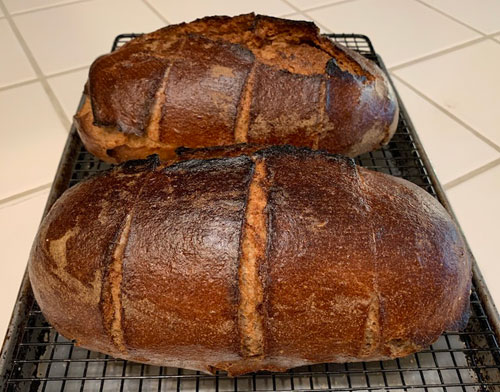
Photo from the Fresh Loaf
This recipe is from Secrets of a Jewish Baker, by George Greenstein. He says this is “real Jewish rye bread.” The process starts with the development of a rye sour over several stages before progressing to the actual bread creation. You may interrupt the development at any stage by putting the sour in the refrigerator overnight.
"This is real Jewish rye bread, written by a Jewish baker, made for the most demanding audience in the world, the New York consumer. This bread transcends its ethnic boundaries due to its universal appeal. To my knowledge an authentic version of this recipe has never been published. Bakers, like chefs, are reluctant to part with their recipes and invariably try to hold something back. Few breads offer such a distinct flavor coupled with a unique crust. The secret of great rye bread is the sour, or ferment, that give the bread its outstanding qualities. Sour is the product of the controlled fermentation of rye flour and water. Once it is begun, the baker always saves a small amount of sour each time he or she bakes. This becomes the starter to begin the next batch.
Sour Rye Bread is made up of water, flour, yeast, and salt. There is no sugar or fat added to this pure bread. Rye bread is ideal for deli sandwiches and as an accompaniment to meat dishes. It is excellent with cheese. A favorite of mine is cream cheese and olives on rye toast. A real Jewish treat (high in cholesterol) used to be a roast beef sandwich on rye with Bermuda onion and chicken fat (shmaltz). My grandmother would take afternoon tea with toasted rye that had the crust rubbed with garlic while still warm. She lived well into her nineties and I always attributed it to the tea and garlic, but now I firmly believe that it was the rye bread."
- from Secrets of a Jewish Baker, by George Greenstein
1 cup warm water
1 package active dry yeast
3 cups Rye Sour
1/2 cup altus (optional, see *Notes - bread saved and used from previous batch)
4 to 5 cups common (first clear) flour (see *Notes)
1 tablespoon salt
1/2 tablespoon caraway seeds, or more to taste (optional)
Rye flour, for dusting work top
Oil, for greasing bowl
Cornstarch solution (see *Note) or water, for brushing leaves
In a large bowl dissolve the yeast in the warm water and add the sour. Add the altus, if desired. Without stirring add 3 cups of the flour and salt. Gently stir the dry ingredients with your fingertips to incorporate, then stir with a wooden spoon, adding more flour as necessary until the dough comes away from the sides of the bowl.
Turn out the dough onto a floured work surface and knead. If the dough is moist and sticky, add more flour 1/4 cup at a time. Knead until the dough feels soft and silky (5 to 8 minutes). Rye dough will be softer than usual and tend to feel sticky. Transfer the dough to an oiled bowl and turn several times to coat. Cover and allow to rest for 15 to 20 minutes. Punch down, sprinkle with the caraway seeds (if desired).
Shaping: Shape the balls into 2 free-standing pan loaves. Place on a rye flour- or commeal-dusted baking sheet. In the bakery we proof the leaves and bake them on the oven hearth using a wooden peel. Cover and allow to rise until doubled in size. Brush with the cornstarch solution, then cut 3 horizontal slashes on the top of each loaf.
Baking: Bake with steam in a preheated 375 degree F oven until tapping the bottom with your fingertips produces a hollow sound (35 to 45 minutes). The top and sides should feel hard to the touch. Brush again with the cornstarch solution, then let cool on a wire rack.
Yield Makes 2 loaves.
*Notes:
Altus -- is European in origin, and little known outside of the bakery establishment. Newcomers to the bakery think of it as a method of using up stale bread. However, as with many old-fashioned techniques, bakers find that it enhances the desirable qualities of certain breads. It's use seems to have begun in the making of pumpernickel doughs, and the best of these breads often contain altus. Altus is a mash made by slicing and trimming the crusts from leftover sour rye bread, soaking the trimmed bread in water for several hours or overnight under refrigeration, squeezing it dry, and adding small amounts to the bread dough. Altus intensifies the distinctive flavor of pumpernickel and rye bread and helps them retain moisture. When using altus, all for a little extra flour in the recipe. The mash keeps well, covered, in the refrigerator.
Common flour -- called first clear or clear flour, must be obtained from a bakery. [It is a high gluten wheat flour.] You can substitute 3 1/4 cups all-purpose flour plus 3/4 cup cake flour, but the bread won't taste as good. 2 cups Rye Sour can be used instead of 3 cups for a milder taste.
Cornstarch solution is used before slashing the top of the bread and placing it in the oven. Bring 1 cup water to boil dissolve 2 tablespoons cornstarch in 1/4 cup cold water; then whisk into the boiling water until it thickens. This solution may be kept for several days. For a high shine, brush a second time as soon as the bread emereges from the oven.
Variations:
Onion Rye -- Omit the caraway seeds. Knead Onion Filling and Topping into the dough immediately after mixing. The top of the shaped loaves should be rolled in additional onion topping before the final rise.
Marble Rye -- 1/2 recipe Sour Rye Bread, unbaked +1/2 recipe Pumpernickel Bread, unbaked. Cut each dough in half. Flatten out with your hands or a small rolling pin. Place one pumpernickel half on top of a rye half. Shape jelly roll fashion into a short loaf. For further variety, shape the second loaf with the pumpernickel on the bottom. This will yield 2 combination breads, 1 rye with pumpernickel swirled inside and the other a brown bread with the rye inside.
Cocktail Rye -- This can be served plain or with either or both of the fillings and toppings below.
Fillings: Caraway seeds, Onion Filling and Topping
Knead one of the fillings into the dough after mixing. Roll the dough into thin baguette shapes about 1 inch in diameter and 12 inches long. Roll the tops in fillings before the final rise.
Toppings: Caraway seeds with Kosher salt, Onion Filling and Topping or Kosher salt
In the bakery we use pretzel salt; coarser than Kosher salt, it does not dissolve into the crust when baked. If pretzel salt cannot be found through your usual sources, try a bagel shop.
