Vienna Bread
from Peter Reinhart's book The Bread Baker's Apprentice
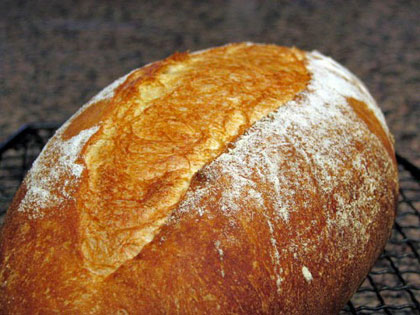
"With all the emphasis on French and Italian rustic breads these days, it is easy to overlook the fact that the real center of the bread and pastry universe for hundreds of years was Vienna. Most of the great French breads that we love today, including baguettes, croissants, and even puff pastry, came to France a couple hundred years ago via the Austro-Hungarian empire, where they found a hungry audience willing to support these Austrian (which included Polish) bakers.
"Nowadays, the main distinction in American (and even European) bakeries between French, Italian and Vienna breads, is the presence of a few enrichments in the latter. A little added sugar and malt causes the crust to brown faster, and a small amount of butter or shortening tenderizes the dough by coating and "shortening" the gluten strands.
"The shape, as with all culturally based bread, is determined by the baker based on function, but we usually think of Vienna bread as typically 12 inches long and weighing one pound. It is often scored down the middle to make a nice "ear", but does not have quite as hard a crust nor open a crumb as a French bread. This dough makes exceptional pistolets (torpedo rolls) and it can be baked in loaf pans for sandwich loaves."
Pâte Fermentée
Makes 16 to 17 ounces (enough for one batch of Vienna bread)
- 1 1/8 cups unbleached all-purpose flour
- 1 1/8 cups unbleached bread flour
- 3/4 teaspoons salt
- 1/2 teaspoon instant yeast
- 3/4 cup to 3/4 cup plus 2 tablespoons water, at room temperature
Stir together the flours, salt and yeast in a 4 quart bowl or in the bowl of an electric mixer. Add 3/4 cup of the water, stirring until everything comes together and makes a coarse ball (or mix on low speed for one minute with the paddle attachment). Adjust the flour and water according to need, so that the dough is neither too sticky nor too stiff. (It is better to err on the sticky side, as you can adjust during kneading).
Sprinkle some flour on the counter and transfer the dough to the counter. Knead 4 to 6 minutes or mix on medium speed with dough hook for 4 minutes, or until dough is soft and pliable, tacky...but not sticky.
Lightly oil a bowl and transfer the dough to the bowl, rolling it around to coat it with oil. Cover the bowl with plastic wrap and ferment at room temperature for 1 hour, or until it becomes 1-1/2 times it's size.
Remove the dough from the bowl and knead lightly to degas, and return to bowl, covering with plastic wrap. Place the bowl in the refrigerator overnight. You can keep this in the refrigerator for up to 3 days, or freeze it in an airtight plastic bag for up to three months.
Vienna Bread
Makes two 1- pound loaves or 9-12 pistolets (torpedo rolls)
- 2 1/3 cups (13 ounces) pâte fermentée (recipe above)
- 2 2/3 cups (12 ounces) unbleached bread flour
- 1 Tablespoon (.5 ounces) granulated sugar
- 1 teaspoon (.25 ounces) diastatic barley malt powder
- 1 teaspoon salt
- 1 teaspoon instant yeast
- 1 large egg, slightly beaten
- 1 Tablespoon (.5 ounces) unsalted butter or shortening at room temperature or melted
- 3/4 cup plus 2 Tablespoons (6 to 7 ounces) water, lukewarm 90° to 100°F
- Cornmeal for dusting
Remove the pâte fermentée from the refrigerator 1 hour before making the dough. Cut it into ten small pieces with a pastry scraper or serrated knife. Cover with a towel or plastic wrap and let it sit for 1 hour to take the chill off.
Stir together the flour, sugar, malt powder, salt and yeast in a 4 quart bowl (or the bowl of an electric mixer). Add pâte fermentée pieces, egg, butter and 3/4 cup water. Stir together with spoon or mix on low speed with paddle attachment until the ingredients form a ball. If not all the ingredients are absorbed, add the remaining 2 Tbsp water or as much as needed to make the dough soft and supple.
Sprinkle flour on the counter and transfer dough to counter. Knead for about ten minutes, or mix on medium speed with dough hook for about 6 minutes, adding flour if needed to make a firm, but supple dough, slightly tacky but not sticky. The dough should pass the windowpane test and register 77° to 81°F. Lightly oil a bowl and transfer the dough to the bowl, rolling it to coat with oil. Cover the bowl with plastic wrap.
Ferment at room temperature for 2 hours. If the dough doubles in size before then, remove it from the bowl and knead for a few seconds to degas it and then return to bowl to continue fermenting until the dough doubles in size again.
Remove the dough from the bowl and divide it into 2 equal pieces for loaves, or into 9 to 12 pieces for pistolets. Shape larger pieces into boules or smaller pieces into rolls. Mist the dough lightly with spray oil, cover with a towel or plastic wrap and let rest for 20 minutes.
Shape the larger boules into batards, or the smaller pieces into pistolets. Line a sheet pan with baking parchment, dust with semolina or corn meal, and transfer the dough to the pan. Mist the dough lightly with spray oil, and cover the pan loosely with plastic.
Proof at room temperature for 60 to 90 minutes, or until the loaves have risen to 1-3/4 times their original size.
Prepare the oven for hearth baking making sure to have an empty steam pan in place. Heat the oven to 450°F. Just prior to baking, mist the loaves with water and dust lightly with bread flour by tapping some through a sieve. Score the loaves down the center.
Slide the loaves directly onto the baking stone, parchment and all, or place the sheet pan with the loaves in the oven. Pour 1 cup hot water into the steam pan and close the oven door. After 30 seconds, open the door, spray the oven walls with water and close the door. Repeat twice more at 30 second intervals. After the final spray, lower the oven heat to 400°F and bake for 10 minutes. Rotate the breads 180 degrees if necessary, for even baking and continue baking until they are a golden brown and register at least 200°F on instant read thermometer at the center. This should take anywhere from 5 additional minutes for rolls to 20 minutes for loaves.
Remove loaves from oven and transfer to a cooling rack. Cool for at least 45 minutes before slicing or serving.
Makes 2 loaves or 9 - 12 pistolets (rolls)
