Differences Between Vienna, French and Italian Breads
"With all the emphasis on French and Italian rustic breads these days, it is easy to overlook the fact that the real center of the bread and pastry universe for hundreds of years was Vienna. Most of the great French breads that we love today, including baguettes, croissants and puff pastry, came to France a couple hundred years ago via the Austro-Hungarian empire, where they found a hungry audience willing to support these Austrian (which included Polish) bakers." (from Peter Reinhart's book The Bread Baker's Apprentice)
Formulation of Vienna, French, and Italian breads are very similar. True French and Italian breads are made from only the four basic ingredients, flour, water, yeast and salt. To extend the shelf life of the bread some bakers use a small amount of shortening and sugar. After proofing and prior to baking all three types of bread are cut in the top crust to to prevent wild breaks, although the design of the slashes differ for each. All of these breads are baked directly on the hearth of the oven or in perforated pans.
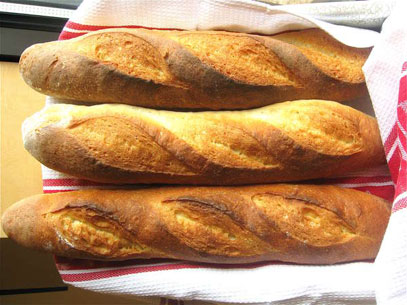
French Bread
French bread is generally shaped into long and narrow loaves (baguettes) which are are cut four times diagonally across the loaf after proofing. Its crust is crunchy and light and the crumb inside is light and airy. It has a light tart taste. When shaping French bread you should not knead out all of the gas bubbles and it should proof until very light; French bread has many large holes in its crumb.
For eating, French bread is often broken or cut diagonally into pieces rather than sliced. Its shelf life is very short because it is made with just flour, water, yeast and salt.
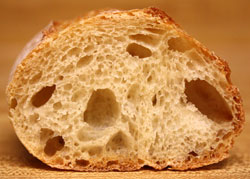
French bread - crispy, thin crust and
soft crumb with many large holes
Recipe for French Bread
Recipe for French Presidential Baguette
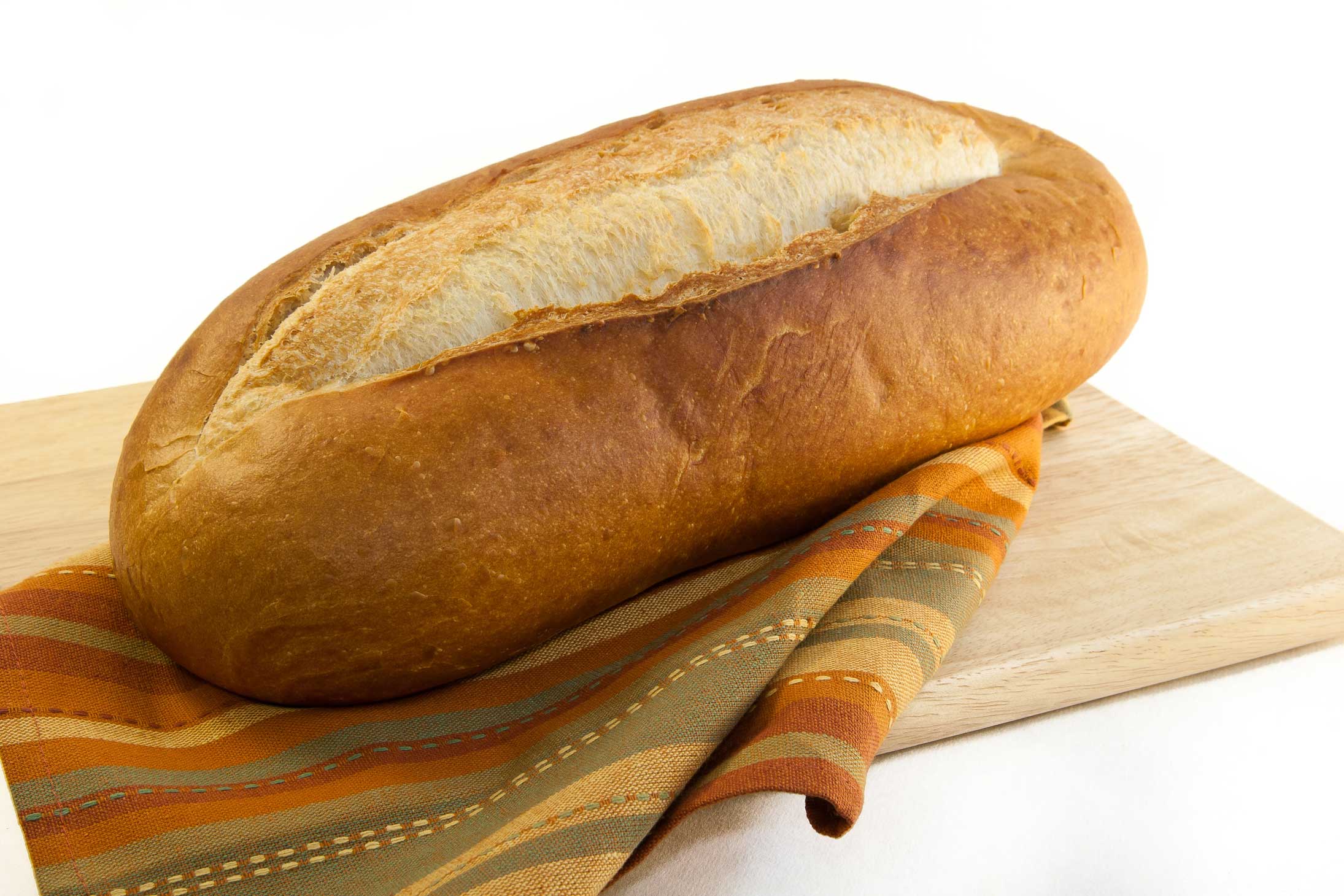
Italian Bread
Italian bread is usually made either as a round or as an oblong loaf with pointed ends called a batard. This type of bread yields larger slices and makes this bread, when sliced, suitable for sandwiches although lengths of French bread can used for sandwiches similar to using a hoagie roll.
The round Italian loaves receive two parallel cuts in one direction and two more cuts across the first two cuts. The oblong Italian loaves are either cut three or four times straight across or once lengthwise and slightly off-center. These long cuts will generally open wide during baking. Italian breads are sometimes baked without steam to produce a thick dull crust. This thick crust contributes to the good taste of the bread.
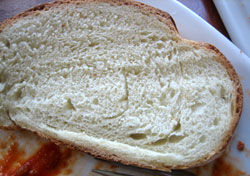
Italian bread - thick, chewy crust and
denser crumb than French bread
Italian bread has a thicker, chewier crust than French bread and its crumb is somewhat denser. Italian bread is made using only as much yeast as salt and is left to rise overnight.
What is commonly known as Italian Bread in the states is something like French Bread but often softer. The dough typically contains some olive oil and dairy to soften things up. Instead of steaming the oven to maximize crust, the crust is brushed with water before placing it in the oven which keeps it softer and chewier. It is the perfect spongy bread for soaking up pasta sauces and quite good on its own.
Recipe for Rustic Italian Bread
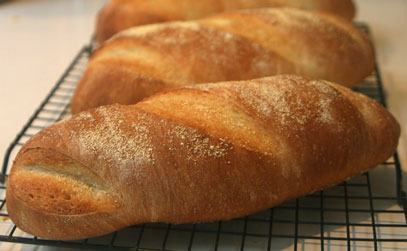
Vienna Bread
The make-up of Vienna bread is usually in the oblong shape similar to Italian bread. Vienna breads sometimes contain some shortening, milk and eggs. Some bakers add a small amount of potato flour in their Vienna breads which soften and tenderize the bread crumb.
The almost fully proofed loaves are either cut three or four times diagonally across the top or they are topped with a thin moist strip of dough placed lengthwise across the loaf. This dough strip will cause the loaf to form a wide break along one of its sides. Vienna bread may also be topped with poppy or sesame seed or covered with a Dutch Crunch Topping (A mixture of white rice flour, salt, sugar, yeast, oil and water that is painted on the bread after it has proofed about 60%. The paste dries and cracks during the baking process). These Dutch Crunch loaves are not generally cut prior to baking. See Dutch Crunch Bread.
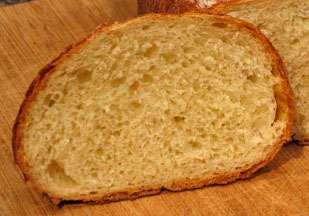
Vienna bread crust and crumb
For good appearance, Vienna bread is baked, like French bread, with a good amount of low pressure steam. This will assure that the bread has a crispy crust with a nice sheen, or bloom, and a soft crumb. While it is closely identified with France, the prototype for French bread was developed in Vienna in the mid-19th century, when the first steam ovens made possible the crisp crust and the porous (with holes) white crumb.
Recipe for Vienna Bread
Recipe for
Vienna Bread - Peter Reinhart's
History of Vienna Bread
Vienna bread is a type of bread that is produced from a process developed in Vienna, Austria, in the 19th century. The Vienna process in part used high milling of Hungarian grain, cereal press-yeast for leavening, and care and thought in the production process.
In the 19th century, for the first time, bread was made only from beer yeast and new dough (no old dough). The first noted or applauded example of this was the sweet-fermented Imperial "Kaiser-Semmel" roll, also called Imperial roll, of the Vienna bakery at the Paris Exposition of 1867. These sweet-fermented rolls lacked the acid sourness typical of lactobacillus, and were said to be popular and in high demand.
Prior to this time, bakers had been using old-dough leavens (sourdouch starters), and they discovered that accelerating the latter refreshments' rest intervals promoted yeast growth in a race against time and what would later be learned were overwhelming lactobacillus numbers. At some point bakers began to add brewer's or beer yeast or barm to the latter refreshments, which produced a whiter, sweeter-tasting bread. However, beer brewers slowly switched from top-fermenting to bottom-fermenting yeast, creating a shortage of yeast for making sweet-fermented breads, so the Vienna Process was developed by 1846.
In 1845 the Association of Vienna Bakers announced a contest for the production of a sweet-fermenting yeast, this prize was awarded in 1850 to Adolph Ignaz Mautner. In 1867 the Paris Exposition was said to recognize the Vienna Bakery as, "First in the world."
Vienna yeast was propagated utilizing a mash of malted corn, barley, and rye. After pitching a small amount of yeast into the cooled wort, and introducing some air, the propagated yeast floated to the surface. The krausen was collected with some care by skimming, and it may have been washed lightly with distilled water. It was then drained and compressed with the aid of a hydraulic press. Press-yeast was one forerunner to our modern, commercial Baker's yeast.
Other remarkable aspects of the report included procedures for high milling of grains, cracking them incrementally instead of mashing them with one pass. The Imperial rolls were made with the finer grades of flour, milk and water in a 50:50 ratio, beer yeast, and salt.
Steam baking: The Vienna bread-production process innovations are often popularly credited for baking with steam leading to different crust characteristics. The dough is placed into the oven under a ceiling of steam or, alternatively, the oven is injected with steam as soon as the loaf is loaded. This adds moisture to the body, the crumb, of the bread which delays establishment of the crust and tends to prevent cracking, resulting in a more evenly risen and thinner crust as well as a light and airy crumb. When the steam is gone (sometimes today, withdrawn), the dry heat of the oven bakes the crust, producing its characteristically slightly crisp and flaky texture.
In 1837, August Zang, a native of Austria, opened a Bakery in Paris called the "Boulangerie Viennoise" which first introduced steam baking to France, and whose process was described in detail in an entry on Viennese Bread in an 1849 French Industrial Chemistry book: "the crust of these breads glazes while baking in an atmosphere of steam, to which effect, one places on the floor of the oven a pile of wet hay, well washed in advance, which produces a cloud of steam." Decades later, another Viennese bakery in Paris introduced the mechanical steam oven, eliminating the need for wet hay.
