History of Candy
Candy is made by dissolving sugar in water or milk to form syrup. The final texture of candy depends on the different levels of temperatures and sugar concentrations. Hot temperatures make hard candy, medium heat make soft candy and cool temperatures make chewy candy. The English word ''candy'' is in use since the late 13th century and it derives from Arabic qandi, meaning ''made of sugar''.
Early Candy
The history of candy dates back to ancient peoples who must have snacked on sweet honey straight from bee hives. The first candy confections were fruits and nuts rolled in honey. Before sugar was readily available, candy was based on honey. Honey was used in Ancient China, Middle East, Egypt, Greece and the Roman Empire to coat nuts, seeds, fruits and flowers to preserve them or to create forms of candy. Candy is still served in this form today, though now it is more typically seen as a type of garnish. Conserves and preserves (fruit preserved in sugar) eventually became their own type of food; typically paired with toast or spread between cookies and cakes.
Between the 6th and 4th centuries BCE, the Persians, followed by the Greeks, discovered the people in India and their "reeds that produce honey without bees". They adopted and then spread sugar and sugarcane agriculture. Sugarcane is indigenous to tropical South and Southeast Asia, while the word sugar is derived from the Sanskrit word Sharkara. Pieces of sugar were produced by boiling sugarcane juice in ancient India and consumed as Khanda, dubbed as the original candy.
Middle Ages
The manufacturing of sugar began during the middle ages and at that time sugar was so expensive that only the rich could afford candy made from sugar. Before the Industrial Revolution, candy was often considered a form of medicine, either used to calm the digestive system or cool a sore throat. Today's cough drops and peppermint sticks descend from this tradition. In the Middle Ages candy appeared on the tables of only the most wealthy at first. At that time it began as a combination of spices and sugar that was used as an aid to digestive problems. Digestive problems were very common during this time due to the constant consumption of food that was neither fresh nor well balanced. Banquet hosts would typically serve these types of 'candies' at banquets for their guests. One of these candies, sometimes referred to as a 'chamber spice', was made with cloves, ginger, aniseed, juniper berries, almonds and pine kernels dipped in melted sugar. The Middle English word candy began to be used in the late 13th century.
Why are confections sometimes called "sweetmeats?" Laura Mason, British confectionery history expert, explains: "The anomalies in our own language are due to the origin of sweets or sweeties...as diminutives of sweetmeat. This word, still not entirely obsolete, was in common use for over 400 years to the end of the nineteenth century. The suffix-meat has an archaic meaning of food in the widest sense (surviving in the phrase 'meat and drink'), so sweetmeat simply means a sweet food...To the inhabitants of Tudor and Stuart England, sweetmeats were sugary foods in general, including pieces of flavoured candy and sugar-covered nuts and spices, products of medieval theories on the medicinal value of sugar, as well as dishes which used sugar as one ingredient amongst many, for structure, sweetness and an air of the exotic...Medieval feasts had provided several roles for sweetmeats."
See Martha Washington's Booke of Sweetmeats, circa mid 18th century. This comprehensive catalog with instructions exemplifies the time when British and American confectionery were one in the same.
The Oxford English Dictionary dates first the print reference to sweetmeats to the 16th century and defines it thusly:
"1. collect. pl. (and †sing.) †Sweet food, as sugared cakes or pastry, confectionery (obs.); preserved or candied fruits, sugared nuts, etc.; also, globules, lozenges, ‘drops,’ or ‘sticks’ made of sugar with fruit or other flavouring or filling; sing. one of these.
Medieval Sweetmeats:
- Sucket - candied and preserved citrus fruit, one of the first European candies
- Manus Christi, which means Hand of Christ. It was a stick or tablet of hard candy, flavored with rose or violet water, and blended with flecks of gold or ground up gemstones. Rich people, like Henry the Eighth, took it like a vitamin (along with Rhubarb pills).
- Candied fruits - oranges, lemons, limes and tamarinds were boiled in water, then preserved in sugar by repeatedly bathing them in syrup until the fruit is entirely infused. It is then basted with sparkling sugar to dry. Technique of candying soon spread to other fruits. Example: early 17th century recipe called Clusters of Grapes Kept Until Easter. These are like the candied fruits we make fruitcake from.
- Portuguese marmelada (marmelo meaning quince) - stiff fruit pastes cut into slices, shaped with moulds, or impressed with a design. The term came to refer to any candied fruit. (Spreadable marmalade was devised in the 18th century, probably in Scotland, and is something different.) Paste of Genoa became a generic term applied to any high quality paste, no matter where made.
- early medieval Arabic sweet called faludhaj, which sounds like a chewier version of Turkish Delight, made from sugar, honey, nuts, oil, starch and gum arabic dissolved in rosewater. It was divided into squares when cooled. This does not seem to be known in medival England.
- medieval pharmacy - preparations containing sugar and bound in gum, called electuaries or lozenges, were common in the medieval pharmacy, after the Arabic model. Fruit pastilles based on these crossed over into confectionary by the 17th century. The sweet dissolves slowly so the herb or drug has time to do its work
- Comfits - traditionally a spice or nut covered in a layer of hard sugar - fennel, coriander, cloves, ginger, cinnamon, juniper, berries, almonds, dates, pine kernels, caraway. Musk comfits were also known as kissing comfits because of the allure of musk. Caraway seeds were also used for kissing comfits. By the 16th century, French confectioners were using panning techniques to build up the sugar layers and giving them a rounder texture. See Sugar-Plums & Comfits. Comfit coatings were dyed using beets, saffron (yellow). In France the larger comfits (almonds for example) were called dragées.
Medieval & Renaisance European Sweets:
- Liquorice
- Marshmallows
- Marzipan
- Pralines
- Sugar plums & comfits
The Tudors (16th century) were also fond of sweet foods (if they could afford them), which they called sweetmeats. The rich ate preserved fruit, gingerbread, sugared almonds and jelly. Marzipan was introduced into England in the late Middle Ages. It is a paste made of almonds and sugar. The Tudors used marzipan to make edible sculptures of animals, castles, trees and people called subtleties. Furthermore people have eaten barley sugar since the 17th century.
17th Century
The price of manufacturing sugar was much lower by the seventeenth century when hard candy became popular. In medieval times the growing of sugar had gradually spread westwards. By the year 1000 it had reached the Middle East and the coast of east Africa. Around 1500, sugar plantations were begin in the new colonies, notably in the Canaries and the West Indies. Thus, from the sixteenth century onwards, we can read first-hand descriptions by Europeans of how to grow the cane and how to refine the sugar cane...Investment in the planting and manufacture of sugar continued unchecked until, in the seventeenth century, the world market collapsed. The price of sugar dropped like a stone. In the West Indies, around 1700, there were far too many sugar plantations and far foo much sugar being produced...This low price was a good reason to experiment with sugar confectionery, which had already become complicated, varied, multi-flavoured and much loved in seventeenth-century Europe.
"Large and prosperous households bought their white sugar in tall, conical loaves, from which pieces were broken off with special iron sugar-cutters. Shaped something like very large heavy pliers with sharp blades attached to the cutting sides, these cutters had to be strong and tough, because the loaves were large, about 14 inches in diameter at the base, and 3 feet high [15th century]...In those days, sugar was used with great care, and one loaf lasted a long time. The weight would probably have been about 30 lb. Later, the weight of a loaf varied from 5 lb to 35 lb, according to the moulds used by any one refinery. A common size was 14 lb, but the finest sugar from Madeira came in small loaves of only 3 or 4 lb in weight...Up till late Victorian times household sugar remained very little changed and sugar loaves were still common and continued so until well into the twentieth century..."
---English Bread and Yeast Cookery, Elizabeth David [Penguin:Middlesex] 1977 (p. 139)
As a sugar syrup is cooked, water boils away, the sugar concentration increases, and the temperature rises. The highest temperature that the sugar syrup reaches tells you what the syrup will be like when it cools. Most candy recipes will tell you to boil your sugar mixture until it reaches one of the stages Today we use these terms to describe the different stages: thread, soft-ball, firm-ball, hard-ball, soft crack, and hard crack. In the 18th and 19th century they used different terms.
."The five terms--lisse or smooth, pearl, blow, feather, and casse or break--remained standard [confectionery terms] during the eighteenth and nineteenth centuries. They were split into lower' and higher', which then became regarded as degrees in their own right. The term caramel was added. Confusingly for the modern reader, this indicated the degree just before the sugar begins to colour. It is now regarded as the hard crack stage. Such attention to detail implies that confectionery became very accomplished during the eighteenth century, but, despite this, written instructions were often inconsistent and blase...Confectioners remained circumspect about boiling sugar higher than feather...Higher degrees came into use gradually. In the sixteenth century, only apothecaries were confident with them. . . . In the eighteenth, sugar boiled to the highest degree, grand casse, or caramel, had a limited use. Massailot said that caramel was proper for Barley-sugar and certain small Sugar-works call'd by that name.' His compatriot J. Gilliers, writing in 1751, described caramel as sugar boiled to casse. It was coloured, and used for figures to decorate the table. Other confectioners used caramel for decorative purposes and do not seem to have made many boiled-sugar sweets of the type now familiar."
---Sugar-plums and Sherbet: The Prehistory of Sweets, Laura Mason [Prospect Books:Devon] 2004 (p. 57-60)
The problem in candy-making is that once syrup has been heated higher than about 250 degrees, its natural inclination is to "seize up" as it cools, turning into rock-hard crystals rather than brittle, glassy candy. In the 17th century, French candy-makers had discovered that fat has the handy property of getting in the way of crystallization.
Acid ingredients accomplish much the same thing--in the 18th century, adding an acid such as cream of tartar to sugar syrup was called "greasing" it--by breaking some of the sucrose molecules into glucose and fructose sugar, thereby cluttering up the solution for would-be crystals. This is one reason for all the many sweet-sour hard candies, such as lemon drops and Life Savers. Probably it also explains why a lot of old-time butterscotch recipes call for a little vinegar or lemon juice, and maybe even how a bit of lemon peel flavor came to be traditional in English butterscotch candies.
Molasses retards crystallization too, by altering the ratio of glucose to fructose. Conveniently for butterscotch makers, molasses contains caramel and even some roasted Maillard-reaction flavors of its own, because it's the byproduct of the repeated boiling by which sugar is refined; in effect, it's a very dark caramel with a distinct burnt edge and a bit of sharpness. Because molasses is so strongly flavored, butterscotch recipes rarely use it straight, only in the diluted form of brown sugar, which is basically refined sugar crystals thinly coated with molasses.
So a really cautious, or insecure, candy-maker might throw all these things into the mix: butter, an acid ingredient and molasses. As it happens, until highly refined sugar became inexpensive in the middle of the 19th century, most sugar--certainly the sort of sugar ordinary people had access to--was more or less brown, so the molasses issue pretty much took care of itself.
18th Century
peppermint drops, "horehound" drops, crystallized ginger, and lemon- and orange-flavored candy in rocks and sticks.
The marshmallow, among the oldest candies ever, contained the marsh mallow plant. In the mid-1800s, cooks replaced the plant with instant gelatin, making it easier to use, more readily available, and an immediate American favorite.
The first cookbooks in English that relied on sugar were addressed to those who cooked for great households, for instance François Massialot’s Court and Country Cook of 1702, which included a translation of his Nouvelle instruction pour les confitures from 1692. But sugar was rapidly ceasing to be the province of the wealthy, and sometime around 1760 Hannah Glasse published her Complete Confectioner OR, THE Whole Art of Confectionary Made Plain and Easy, and in 1789 Frederick Nutt (who had apprenticed with Domenico Negri, the reigning confectioner of his age) published his Complete confectioner or, The whole art of confectionary: forming a ready assistant to all genteel families, both directed at households of the middling sort.
Nutt’s work was reprinted in America by 1807, and in 1828 Eliza Leslie published her Seventy-five Receipts for Pastry, Cakes, and Sweetmeats, of which she has this to say… “The receipts in this little book are, in every sense of the word, American; but the writer flatters herself that (if exactly followed) the articles produced from them will not be found inferior to any of a similar description made in the European manner.”
Industrial Revolution
In the middle years if the 19th century, technology was not standing still, and neither was the confectionery trade. When sugar was a luxury, professional confectioners catered to the well-to-do, providing sweetmeats, ice creams, and elaborate sugar and pastry sculptures to grace the table at grand meals, but as sugar dropped in price, confectioners’ goodies came within reach of more and more consumers.
The candy business underwent a drastic change in the 1830s when technological advances and the availability of sugar opened up the market. The new market was not only for the enjoyment of the rich but also for the pleasure of the working class as well. There was also an increasing market for children. Confectioners were no longer the venue for the wealthy and high class but for children as well. While some fine confectioners remained, the candy store became a staple of the child of the American working class. Penny candies epitomized this transformation of candy. Penny candy became the first material good that children spent their own money on. For this reason candy store-owners relied almost entirely on the business of children to keep them running. Even penny candies were directly descended from medicated lozenges that held bitter medicine in a hard sugar coating.
In 1847, the invention of the candy press (also known as a toy machine) made it possible to produce multiple shapes and sizes of candy at once. In 1851, confectioners began to use a revolving steam pan to assist in boiling sugar. This transformation meant that the candy maker was no longer required to continuously stir the boiling sugar. The heat from the surface of the pan was also much more evenly distributed and made it less likely the sugar would burn. These innovations made it possible for only one or two people to successfully run a candy business.
Cacao, from which chocolate is made, was re-discovered in 1519 by Spanish explorers in Mexico, but wasn't used to make chocolate until 1875.
Candy Storage: 'Jar glasses' (small, cylindrical glass containers) were in use by the seventeenth century but they are rarely mentioned. They were expensive, limited to wealthy households or enterprises. Glass jars probably did not become common until the late eighteenth century when, though used as storage containers, their emphasis had switched to a means of display. They include straight jars presumably for conserves or jams, small, stemmed glasses for jellies and larger ones with lids for sweets and comfits. Tall straight-sided and later ones with lids are also shown. Glass was used more and more to show off the bright colours and clarity of newly fashionable, transparent acid and fruit drops to brilliant advantage in the 1830s and '40s...Another important innovation, from the 1850s onwards, was the airtight tin--especially for toffee. Functional yet decorative, these became coveted in their own right. Commemorative versions were produced for national events, or the patterns designed so that a set of tins with themed pictures was available. Transparent wrapping is a product of our own age. Cellophane was introduced in the 1920s and plastics followed later."
America
The most important contribution of the Northeast Indians to American cooking is perhaps that which falls in the category of sweetening....Maple syrup was the great sweetener, and much more than that: it was also the all-purpose seasoner, which for the Northeast Indians took the place of salt. It impressed Europeans enormously, since the sugar maple did not exist in the Old World. Father Nouvel, a French Jesuit priest, wrote in 1671 of "a liquor that runs from the trees toward the end of winter and is known as maple-water." Indian women boiled it down to sugar, adding it to porridges made of ground corn; mixing it into cold water, they drank it as a tonic in hot weather. The Indians also used crystallized maple syrup as a seasoning for meat and fish dishes, a flavoring they much preferred to the Europeans use of salt. Sap that was allowed to become sour made a vinegar to be used in cooking venison which was afterwards sweetened with maple sugar. And there is an echo of this when some Americans add maple syrup to the water in which country hams are boiled. The sugar season among the Indians is a sport of carnival, and boiling candy and pouring it out on the snow to cook is a pastime of the children.
The first candy came to America in the early 18th century from Britain and France. Only a few of the early colonists were proficient in sugar work and were able to provide the sugary treats for the very wealthy. Rock candy, made from crystallized sugar, was the simplest form of candy, but even this basic form of sugar was considered a luxury and was only attainable by the rich.
Boiled "sugar plums were known in the seventeenth-century England and soon were to appear in the American colonies where maple-syrup candy was popular in the North and benne-seed [sesame seed] confections were just as tempting in the South. In New Amersterdam one could enjoy "marchpane," or "marzipan," which is very old decorative candy made from almonds ground into a sweet paste. While the British called such confections, "sweetmeats," Americans came to call "candy," from the Arabic qandi, "made of sugar," although one finds "candy" in English as early as the fifteenth century...Toffees were known in the early eighteenth century and lollipops by the 1780s..."Hard candies" made from lemon or peppermint flavors were popular in the early nineteenth century...A significant moment in candy history occurred at the 1851 Great Exhibition in London, where "French-style" candies with rich cream centers were first displayed...But it was the discovery of milk chocolate in Switzerland in 1875 that made the American candy bar such a phenomenon of the late nineteenth century."
"...it would not be Columbus of the Spanish but rather the British who would succeed in realizing this [establishing sugar cane in the New World] goal, and in spectacular fashion. British colonies established on Barbados in 1627 and on Jamaica in 1655 came to be devoted almost exclusively to sugar production, with the requisite labor provided by slaves imported from Africa. For centuries sugar had been made by pressing short lengths of sugarcane stalks through a roller mechanism until syrup was exuded. The syrup was then evaporated by boiling--one, two, or several times depending on the degree of refinement desired--and pourd into loaf-shaped vessels to cool and harden. During the cooling stage, 'the emerging 'raw sugar' [would leave] behind it molasses, or treacle, which [could not] be crystallized further by conventional methods," but which could be consumed. Proving to be a great deal cheaper than crystallized sugar, molasses was in fact consumed in vast quantities...In New England sugar appears in the records from an early date...In the eighteenth century sugar was regularly advertised in Boston newspapers, and it was on sale in other communities as diverse as coastal and mercantile Portsmouth, New Hampshire, and interior and agricultural Deerfield, Massachusetts... Seventeenth-century immigrants to the colonies "were advised to defer their sugar purchases" until reaching their destinations, because sugar would be cheaper there than it had been at home."
---America's Founding Food: The Story of New England Cooking, Keith Stavely & Kathleen Fitzgerald [University of North Carolina Press:Chapel Hill] 2004(p. 214-216)"Sugar finally came to the sixteenth- and seventeeth-century consumer in blocks or cones, in varying degrees of refinement. This accounts for the elaborate directions for clarifying sugar, and the reiterated instructions to searce (sift) or powder it. (Powdered sugar was only finely sifted sugar, not confectioners' sugar). Block sugar also accounts for the strewing of scraped sugar that made for a charming textural and taste contrast that we have all but forgotten.The presence of sugar in so many of our meat recipes, almost in conjunction with fruits and spices...is part of our heritage from medieval cooking, which, in turn, had come from the Arabs. It is virtually impossible to give precise amounts of sugar required..."
---Martha Washington's Booke of Cookery and Booke of Sweetmeats, Transcribed by Karen Hess [Columbia University Press:New York] 1995 (p. 11)The primary forms in which sugar was sold during the Colonial period were white refined sugar in loaves; soft, brown sugar; and molasses.
Molasses: A popular, economical 17th/18th century substitute for refined white sugar. Well known by period cooks in England and America. Molasses became the most common American sweetener in the eighteenth century because it was much cheaper than sugar and was part of the triangular trade route. In the early 1700s rum made in New England became an essential element in a highly profitable triangular trade across the Atlantic. The colonists exported rum to West Africa in trade for slaves; the ships brought the slaves from Africa to the French West Indies, trading them for more molasses and sugar; these products were then shipped to New England to make more rum. ...By the end of the [19th] century molasses vied with maple syrup and sugar as the sweetener of choice, but when sugar prices dropped after World War I, both molasses and maple fell in popularity, so that today both are used as sweeteners in confections only when their specific taste is desirable, as in Boston baked beans."
Penny candies, the first goods children spent their own money on, were also the first confections to reach a mass audience in America. By the late 1830s sugar's increasing availability and decreasing price enabled confectioners to profitabaly produce sugary drops without the medicine typically found in druggists' stocks. Unlike exclusive confections marketed to elite adults, these "penny candies," often sold ten to a dozen for a penny, were aimed at the palates of working-class children, for whom a penny was in reach.
By the mid-1800s, there were over four hundred factories in the United States producing candy.
Candy Pulls
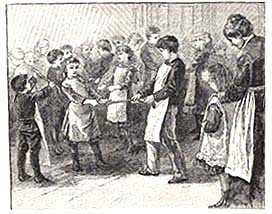
Candy Pull
Candy pulls or candy stews were popular in the 19th century America. One definition, from A Dictionary of Slang...1897:
"Candy-pull (American), a candypull is a party of both sexes at which molasses or sugar is boiled and pulled by two persons (whose hands are buttered) to give it proper consistency, and then mixed and pulled again, till it becomes true candy."
As described puckishly in Puck,
"The necessary materials and plant are a goodsized warm kitchen, a number of active young women, aged from fifteen upward, several dudes and non-dudes—none over twenty-five — a large supply of white aprons, a larger supply of table-napkins, a well-heated cooking-range, two or three copper stew-pans." [Puck. NYC: March 6, 1884]
As for the type of candies for a candy pull, Table Talk, vol. 6, 1891 recommended plain molasses candy, yellow jack, and cream candy. The article's recipe to make Molasses Taffy/yellow jack included boiling New Orleans molasses, then ..."turn into greased, shallow pans to cool. When partly cold mark into squares, or it may be pulled until a light yellow, and then it is 'yellow jack.' ... The 'yellow jack' may be twisted into thick sticks; it may be braided, or it may be pulled out in long, rope-like pieces, and cut with an old pair of scissors into little drops."
In 1847, Mrs. Webster's Improved Housewife had a recipe for Molasses Candy which included: "If you wish to make it yellow, take some out of the tin pan while it is yet warm, and pull it out into a thick string... it will gradually become of a light yellow color, and of a spongy consistency. When it is quite yellow, roll it into sticks, twist two sticks together, and cut them off smoothly at both ends. Or you may variegate it by twisting together a stick that is quite yellow and one that remains brown."
Groups of friends would gather around a pot of boiling molasses or other concoction and wait until it formed threads when a spoonful was dripped in cold water. They would keep stirring until the liquid formed a soft ball when a spoonful was placed in cold water. Finally, they waited until the liquid formed a stiff ball when placed in cold water. This meant it was ready.
The liquid was poured into buttered pans to cool and once there, the party began. Each member of the group would cover their hands in butter and begin to pull on a ball of candy. Pulling and folding, the group joked and gossiped until their balls of candy grew lighter in color. It was now time to form it into its final shape. It could be rolled into ropes and cut with scissors or twisted or braided, or molded into any number of shapes, but many young women preferred to make chain necklaces out of it. Seating around a warm fire with friends and the gingerbread like smell of molasses cooking wafting in the air, a candy pull was a nice break from an otherwise bleak and monotonous winter.
The majority of recipes from this time period include only molasses, flavoring and bicarbonate of soda, known now as baking soda as the main ingredients and some recipes suggested that peanuts or blanched almonds might be added. However, The Cook's Own Book (1854) includes the addition of brown sugar and lemon juice which is more similar to recipes today. The recipe did not vary much and was a favorite in shops for those who did not want to make it themselves.
Molasses Candy, from Miss Beecher’s Domestic Receipt-book, 1871.
Timeline:
Also see History of American Candy
500 BC – Indian manufacturers started making cooled sugar syrup, which was molded in large flat bowls. This new form of sugar made it not only easier for transport, but its name managed to live until today. It was called khanda, or on modern day, candy.
300 BC – First European contact with the sugar came during the reign of famous Alexander the Great, when his returning troops from India brought back home mysterious "honey powder". Even with this discovery, Europe embraced sugar more than 1 thousand years later after the end of the Crusades.
1st century AD - Columella recipe for fig sweetmeats: mash figs to a pulp, mix this with toasted sesame, anise seed, fennel seed and cumin, form into little balls and wrap in fig leaves.
1st century AD - Apicius lists several types of Roman sweet: dates stuffed with nuts, pine kernels or pepper, rolled in salt and fried in honey.
There are records of knowledge of sugar among the ancient Greeks and Romans, but only as an imported medicine, and not as a food. For example Dioscorides in Greek in the 1st century (AD) wrote: "There is a kind of coalesced honey called sakcharon [i.e. sugar] found in reeds in India and Arabia Felix [i.e. Yemen] similar in consistency to salt and brittle enough to be broken between the teeth like salt. It is good dissolved in water for the intestines and stomach, and taken as a drink to help a painful bladder and kidneys."
350 AD - Originally, people chewed sugarcane raw to extract its sweetness. Indians discovered how to crystallize sugar during the Gupta dynasty, around 350 AD. The earliest method method of processing sugar was developed there: beating the cane to release the sweet liquid inside, then evaporating the water to produce crystallized sugar. This primitive processing method produces jaggary, a brown sugar that still contain molasses. It is still eaten in India, other parts of Asia, and the Caribbean.
7th century AD - It was the major expansion of the Arab peoples in the seventh century AD that led to a breaking of the secret. When they invaded Persia in 642 AD they found sugar cane being grown and learnt how sugar was made. As their expansion continued they established sugar production in other lands that they conquered including North Africa and Spain.
9th and 10th century – Arab Agricultural Revolution represents a key point in the history of sugar. It was then when Muslim countries in Middle East and Asia adopted sugar production of India, and enabled European countries to come in contact with this incredible food substance.
9th century - Rock Candy - Candied sugar has its origins in Iran. Arabic writers in the first half of the 9th century described the production of candy sugar, where crystals were grown as a result of cooling supersaturated sugar solutions. In order to accelerate crystallization, confectioners later learned to immerse small twigs in the solution for the crystals to grow on. The sugar solution was colored with cochineal and indigo and scented with ambergris or flower essence. To make it, sugar is dissolved in water, and then allowed to recrystallize. It was flavored with rose or violet. The name comes from the medieval era, and in turn lends its name to a British candy called rock.
11th - 12th century - Crusaders brought sugar home with them to Europe after their campaigns in the Holy Land, where they encountered caravans carrying "sweet salt". Early in the 12th century, Venice acquired some villages near Tyre and set up estates to produce sugar for export to Europe, where it supplemented honey as the only other available sweetener. This started the rise of the Venetian and Mediterranean trading fleets that soon brought vast amounts of knowledge and new materials to Europe, kick-starting the era of Renaissance and later period of so-called Golden Age of Discovery.
13th century - The English word ''candy'' is in use since the late 13th century and it derives from Arabic qandi, meaning ''made of sugar''.
1369 - Edward, Duke of Guelders, took 46 pounds of sweets when he left for war against Prussia: pinenut and ginger comfits, red rusen and white rusen which are stiff converses moulded into shapes of various fruits.
Late 13th century - The first record of sugar in English is in the late 13th century.
1390s - the development of a better sugarcane press, which doubled the juice obtained from the cane.
14th and 15th century England - The price per pound of sugar was about equally as high as imported spices from tropical Asia such as mace (nutmeg), ginger, cloves, and pepper, which had to be transported across the Indian Ocean in that era.
1500s– First sugarcane plantations were formed in Central America.
16th century - First modern candies were made in 16th century.
1544- drinking chocolate was introduced to the Spanish court by Kek'chí Maya nobles, brought from Cobán, Guatemala, by Dominican friars to meet Prince Philip. After the Spanish conquest of the Aztecs, chocolate was imported to Europe.
1585 - The first load of cocoa beans arrive to Sevilla, Spain
Mid 17th Century - Pastilles - from Latin 'pastilla' meaning little cake. Flavors: lemon, cinnamon, fennel. Chocolate, violet, clove, amber, musk, cedar, orange, currant, coffee, saffron flavors, as well as liquers, were develped in the 18th century.
1631 - The first publication of a recipe for drinking chocolate is by the Spanish doctor Antonio Colmenero de Ledesma, based on the Aztec recipe. The bitter flavor is enhanced by adding almonds, anise, cinnamon, flowers, hazelnuts, roses of Alexandria and vanilla. The exact spices depend on the physical ailment.
1641 - Cocoa is introduced to Germany by a German scientist named Johann Georg Voldkammer who discovered it in Naples. The Germans institute the habit of a cup of hot chocolate before bedtime.
1650s - Cocoa and drinking chocolate introduced into England
1657 - The first chocolate house is opened in London by a Frenchman. Coffee houses were already popular. The shop is called the The Coffee Mill and Tobacco Roll. Costing 10 to 15 shillings per pound, chocolate is a beverage for the elite. The English introduced several changes: Instead of water, they added milk. Some also added Madeira or beaten eggs.
1659 - Louis XIV gives the chocolate monopolies of the Paris chocolate drink trade and the French Royal Court to David Chaillou, a baker who made costly biscuits and cakes with chocolate—France's first "chocolatier."
1674 - Eating solid chocolate is introduced in the form of pastilles. One reference states that in 1674 the English propose solid "fingers of chocolate in the Spanish fashion" intended for eating. The phrase indicates that such products may already have been available in Spain. Chocolate pastry is first served in coffee houses in the U.K.
1670 - Candy Cane
The first candy cane was not made in the shape of a cane. It was white, completely straight and only flavored with sugar. Legend has it that in 1670, the cane shaped candy became historical when a choirmaster at the Cologne Cathedral in Germany bent the sugar-sticks into canes to appear as shepherd's hooks. The all-white candy canes were given out to children who attended the ceremonies. This became a popular tradition, and eventually the practice during church ceremonies which spread all over Europe and America.
The first documented example of the use of candy canes to celebrate Christmas occurred in 1847, when August Imgard, a German-Swedish immigrant, from Wooster, Ohio decorated the Christmas tree with paper ornaments and candy canes. The solid white sugar canes were on Christmas cards in the early 1900's. The first red and white striped candy canes were made at the turn of the 19th century. At the same time the first striped candy canes appeared, and candy makers added the peppermint flavor which quickly became a traditional flavor. In the 1920's Bob McCormack, from Atlanta, was the first to use candy canes as special treats for Christmas for his friends and family.
In the beginning the red and white candy canes were made by hand and producing them were labor intensive. The laborious process of making candy canes was eliminated in the 1950's when a machine designed especially for the automation of candy cane productions was invented by Gregory Keller (Bob's brother-in-law). His company, Bob's Candies was the first company to mass-produce and distribute candy canes worldwide, and has been in business for over eighty years.
1697 - Zurich mayor Heinrich Escher brings chocolate to Switzerland for the first time, from Brussels.
18th century - Powdered Sugar - (cake icing appears)
Food historians tell us powdered sugars were used by European confectioners as early as the 18th century. Technological advances in the 19th century made them available to a wider audience. It is no coincidence that cake icing appeared during this time.
18th century sweets
- Leathers - thin layers of fruit paste that were left to dry
- stiff fruit jellies coated in sugar
- violet and rose petal candied flowers, also blue borage, rosemary, pinks (dianthus), marigolds. Marigold petals were candied "in wedges, the Spanish fashion." See To Preserve all kinde of Flowers in the Spanish Candy in Wedges (1653)
- it was the French who bacame masters of making gums after their incursion into northern Africa (land of gum) - fruit pastilles (chewy sweets) and fruit gums using the ingredient Gum Dragon from the tree, Astragalus gummifer.
- Mint and peppermint are not mentioned as suckable sweet flavors until the 18th century and only became popular during the 19th century.
- candied ginger
- Red crisp almonds (almonds cooked in sugar water colored with cochineal until water has evaporated) or Prawlings (pralines)
Iced almonds (iced with sugar)
Candied cherries
Candied orange peel
Candied ginger
Barley sugar (a precursor to toffee)
March-pane (marzipan)
Pastils (soft gum-like candy)
Comfits
---The Lady's Companion, [London:1753] 6th edition
18th century - Mrs. Custis' "Book of Sweetmeats" (Martha Washington inherited this book from her first mother-in-law, Mrs. Custis)
"Confectionery was another art practiced by efficient housewives. It took several forms. Whole fruits or berries cooked and stored in syrup were called preserves. Mashed, they became marmalade, conserve, or jam. "Dried" (that is, candied like modern crystallized fruit) they were confections or sweetmeats. When their juices were mixed with syrup and reduced sufficiently to form hard candies, they were chips; when mashed pulp was used in the same way, they were called pastes. Strained juices were also used to make jelly, as in modern practice, and there were fruit and berry syrups. Brandied fruits were prepared by adding brandy to the syrup in which whole fruits were stored. Mrs. Randolph's selection of recipes, reflecting Virginia tastes at the end of the [18th] century, emphasized preserves-- peaches, pears, quinces, cherries, strawberries, gooseberries, raspberries, and sweet tomato marmalade. ...Mrs. Custis' "Book of Sweetmeats" reflected the elegance and artificiality of tastes in Queen Anne's court. In addition to the conventional preserves, she included the more elaborate confectionery that used flowers and herbs, roots and nuts as well as fruits and berries in a variety of crystallized preparations and hard candies to decorate dessert tables...Walnuts and almonds, eryngo and ginger roots, angelica stalks and roots, and marjoram and mint leaves were sometimes crystallized. Mrs. Custis also chopped or mashed them and stirred them into a manus Christi syrup, which was dripped into "rock candies" or "cakes" about the size of a sixpence. Fruit juices carefully strained produced clear drops and cakes. The pulp of fruits and berries, treated like almond paste in marchpane, made pastes in a great variety of flavors and colors: apricots, peaches, pears, plums, quinces, pippins, raspberries, gooseberries, barberries, cherries, oranges, lemons. Even more decorative was Paste Royall, printed in molds and then gilded." ---Colonial Virginia Cookery, Jane Carson [Colonial Williamsburg Foundation:Williamsburg VA] 1985 (p. 120-122)
Early 1700s - first steam-driven chocolate mill was created by a French inventor named Debuisson in the early 1700s. Previously, drinking chocolate was a treat for the elite and the wealthy. After 1700, drinking chocolate expands worldwide; chiles disappear as an ingredient except in Mexican mole sauces (returning in the late 1990s in "Aztec" cocoa recipes, thanks to the popularity of Mexican food).
1712 - By the turn of the 18th century, chocolate makes its way back to the Americas. In little more than a decade, Massachusetts sea captains are bringing back cargoes of cocoa beans and Boston apothecary shops are advertising and selling chocolate imported from Europe.
1728 - Fry sets up the first chocolate factory in Bristol, England using hydraulic machinery to process and grind the cacao beans.
1730 - By 1730, cocoa beans drop in price from $3 per pound to being within the reach of other than the very wealthy.
1750 - European countries colonize much of the world, and in the process acquire cacao plantations that ensure their own supply of cocoa beans. The French colonized western India and Madagascar, the Dutch, Ceylon and Java, the Belgians, the Congo, the British, western India, the Germans, the Cameroon and the Portuguese, Brazil.
1765 - Chocolate was produced in the American colonies as early as 1765, when the first chocolate factory was built. Dr. James and John Hannon joined together for one of the earliest machine-based chocolate manufacturing businesses. Using an old grist mill, they ground cacao beans into chocolate liquor and pressed the paste into cakes to be used for drinking chocolate. Their company was originally known as Hannon's Best Chocolate. When Hannon was lost at sea during a cacao-buying voyage to the West Indies, the company was renamed the Baker Company (Baker's Chocolate).
1795 - Joseph Storrs Fry patents a method of grinding cocoa beans using a Watt steam engine. As a result factory techniques are introduced into the cocoa business.
19th century - Hard candies, especially sweets like peppermints and lemon drops, started to become popular in the 19th century. Sweets as we know them today have been around since the 19th century. Sweet manufacturing developed rapidly into an industry during the early 19th century.
1819 - The pioneer of Swiss chocolate-making, François Louis Callier, opens the first Swiss chocolate factory in Corsier, near Vevey.
1820s - Our survey of American Historic Newspapers (Readex) reveals the term "granulated sugar" was used from the 1820s forward. Prior to this time, white sugar was sold in solid cones. The sugar was scraped off and pounded to achieve the desired textures.
1824 - 22-year-old John Cadbury opened his first shop at 93 Bull Street, next to his father's drapery and silk business in the then fashionable part of Birmingham, UK. Apart from selling tea and coffee, John Cadbury sold hops, mustard and a new sideline - cocoa and drinking chocolate, which he prepared using a mortar and pestle. Cocoa and drinking chocolate had been introduced into England in the 1650s but remained a luxury enjoyed by the elite of English society. Customers at John Cadbury's shop were amongst the most prosperous Birmingham families, the only ones who could afford the delicacy. Cocoa beans were imported from South and Central America and the West Indies. The products were sold in blocks: customers scraped a little off into a cup or saucepan and added hot milk or water. These early cocoa and drinking chocolates were balanced with potato starch and sago flour to counter the high cocoa butter content, while other ingredients were added to give healthy properties.
1825 - Purchases of cocoa by the Royal Navy are more than for the rest of Britain. Nutritious, hot and non-alcoholic, it is considered a perfect drink for sailors on watch duty. Among sailors on duty in the Atlantic Ocean and the Baltic Sea, the cold wind from the northwest is known as a "chocolate gale."
1828 - In 1828 Casparus van Houten Sr. (and not his son, who is usually credited) patented an inexpensive method for pressing the fat from roasted cocoa beans. The center of the bean, known as the "nib," contains an average of 54 percent cocoa butter, which is a natural fat. Van Houten's machine - a hydraulic press - reduced the cocoa butter content by nearly half. This created a "cake" that could be pulverized into cocoa powder, which was to become the basis of all chocolate products. The powder is treated with alkaline salts so that it mixes more easily with water. The final product has a darker color and the beverage has a milder taste and a smoother consistency. Van Houten was Dutch and patented his invention in Amsterdam, so his alkalizing process becomes known as "dutching." The overall Industrial Revolution enables the mass production of chocolate, spreading its popularity among the citizenry.
The introduction of cocoa powder not only made creating chocolate drinks much easier, but also made it possible to combine chocolate with sugar and then remix it with cocoa butter to create a solid, already closely resembling today's eating chocolate. The innovation by van Houten ushered in the modern era of chocolate by enabling it to be used as a confectionary ingredient. In 1838 the patent expired, enabling others to produce cocoa powder and build on Van Houten's success, experimenting to make new chocolate products. In 1847 English chocolate maker J. S. Fry & Sons produced arguably the first chocolate bar. Later developments were in Switzerland, where Daniel Peter introduced milk chocolate in 1875 and Rodolphe Lindt made chocolate more blendable by the process of conching in 1879.
1840 - The first pressed chocolate tablets, pastilles and figures are produced in Belgium by the chocolate company Berwaerts.
1847 - Oliver R. Chase invented a machine in 1847 to cut lozenges from wafer candy, similar to Necco Wafers, and started a candy factory.
1847 - The first chocolate bar was made in 1847 by Joseph Fry in England. He discovered a way for mixing melted cacao butter, cocoa powder and sugar to create a paste that could be pressed into a mold. The resulting solid chocolate bar was later called Fry's Chocolate Cream Bar. He calls this "eating chocolate" ("chocolat delicieux a manger"). This is the first modern chocolate bar, although conching has not yet been invented, so it is not the smooth, silky bar we know today but a rough, grainy chocolate.
1848 - John Curtis produces the first branded chewing gum, made from tree sap, called The State of Maine Spruce Gum
1849 - Cadbury brothers are selling a similar product two years later.¹ Joseph Fry & Son and Cadbury Brothers display "chocolates for eating" at an exhibition in Bingley Hall, Birmingham, England.
1850s - A major turning point for the cocoa and chocolate industry in England came in the mid-1850s, when taxes on imported cocoa beans were reduced by Prime Minister William Gladstone. The previously prohibitive chocolate products were now within the reach of the wider population.
1851 - Prince Albert's Exposition in London is the first time that Americans are introduced to bonbons, chocolate creams, hand candies (called "boiled sweets") and caramels.
1854 - The first packaged box of Whitman's Chocolate hits the scene
1860 - Ghiradelli, who imported beans from Peru to San Francisco to sell to gold prospectors, has discovered how to extract cocoa butter from ground cocoa to create a very soluble cocoa powder.
1861 - Richard Cadbury creates the first known heart-shaped candy box for Valentine's Day. The Victorians, who fancied decorating cards with plump cupids shooting arrows of love, later transferred the image to the lids of heart-shaped boxes filled with dreamy combinations of silken chocolates."
1866 - Conversation Candies - Daniel Chase, Oliver Chase's brother (see 1847), began printing sayings on the candy in 1866. He designed a machine that was able to press on the candy similar to a stamp. The candy was often used for weddings since the candies had witty saying such as: "Married in pink, he will take a drink", "Married in White, you have chosen right", and "Married in Satin, Love will not be lasting". The heart-shaped conversation candies to be called Sweethearts got their start in 1901.
1866 - New Cocoa Press
Previously, English cocoa had been heavily adulterated with starch substances like potato flour or sago to mask the excess cocoa butter. The cocoa drink, as described by George Cadbury himself, was a "comforting gruel". Following a visit to the Van Houten factory in Holland to see their new cocoa press, the brothers introduced this new process to their Bridge Street factory. The press removed some of the cocoa butter from the beans, producing a less rich and more palatable cocoa essence - the forerunner of the cocoa we know today. The introduction of cocoa essence was not the only innovation that improved the Cadbury Brothers' trade. The plentiful supply of cocoa butter remaining after the cocoa was pressed made it possible to produce a wide variety of new kinds of 'eating chocolate,' leading to the development of the smooth creamy chocolate produced today. A chocolate for eating had been produced at the Cadbury factory since 1849 but it was not, by today's standards, a very palatable product. With the availability of cocoa butter a new chocolate recipe produced chocolate similar to that which we enjoy today.
1868 - John Cadbury mass-markets the first boxes of chocolate candies.
1875 - When Daniel Peter, a Swiss chocolatier, came up with the process of making milk chocolate in 1857, he had a problem with removing the water from the milk, which caused mildew to form. At the same time, Henri Nestlé was working on a concentrated infant food formula, which required him to find a way to treat milk so that it would not spoil while in storage. He invented powdered milk, which turned out to be the perfect milk form for Peter's purposes; the low water content made it possible to mix it with the chocolate into a bar that did not spoil. By 1879, the two men had joined to form the Nestlé Company.
1879 - Rodolphe Lindt’s invention of the conching machine in Berne, Switzerland. This was a major breakthrough in that it produced chocolate with superior aroma and melting characteristics compared to other processes used at that time. Before conching was invented, solid chocolate was gritty and not very popular. Lindt's invention rapidly changed chocolate from being mainly a drink, to bars and other confections. After warm chocolate is conched for seventy-two hours in a long narrow trough, and has more cocoa butter added to it, it is possible to create chocolate fondant and other creamy forms of chocolate. (Today, conching can be finished in 12 hours.)
1880s - Wunderle Candy Company in Philadelphia creates candy corn, still a best-selling Hallween candy
1891 – Doscher Brothers Confections starts working on famous French Chews.
1893 – William Wrigley, Jr. creates Juicy Fruit Chewing Gum and Wrigley's Spearmint Chewing Gum.
1893 – Thomas Richardson introduces Pastel Dinner Mints and Butter Mints. Thomas Richardson made the melt-in-your-mouth mint in 1893, where it was sold at the counter of a Philadelphia department store. It descended from the sugar stick, dating back to the 17th century, but with a special addition: butter.
1893 - Milton Hershey became fascinated with German chocolate-making machinery exhibited at the 1893 World's Columbian Exposition. He bought the equipment for his Lancaster plant and soon began producing a variety of chocolate creations.
1894 – The candy manufacturer Milton Hershey made the decision to try adding chocolate coating to his caramels. Calling this new enterprise the Hershey Chocolate Company, a subsidiary of his Lancaster Caramel Company, he located it near the area he had been born, amid the rolling farmland of Derry Township, PA. Hershey sold the Lancaster Caramel Co. for $1 million in 1900 in order to concentrate exclusively on his chocolate business. Three years later, he returned to Derry Church to build a new factory. There he could obtain the large supplies of fresh milk needed to perfect and produce fine milk chocolate.
1895 - Milton S. Hershey sells his first Hershey Bar in Pennsylvania, using modern, mass-production techniques that make chocolate affordable to the masses.
1896 – Leo Hirshfield creates popular candy bar "Tootsie Rolls"
1897 - following the lead of Swiss companies, Cadbury introduced its own line of milk chocolate bars
1897 - Cotton candy, originally called ''Fairy Floss'' was invented in 1897 by William Morrison and John. C. Wharton, candy makers from Nashville, USA. They invented the first cotton candy machine.
1899 - The Tobler firm, founded in 1868, starts to produce its own chocolate. The Toblerone nougat, almond, and honey chocolate bar is born.
End of the 19th century and the beginning of 20th century - candy makers began to mix in other ingredients to create their own candy bars.
Candy bar became popular during the World War I, when the U.S. Army commissioned a number of American chocolate makers to produce 20 to 40 pounds blocks of chocolate, which would then be shipped to Army quartermaster bases, chopped up into smaller pieces and distributed to the American soldiers stationed throughout Europe. The manufactures began producing smaller pieces, and by the end of the war, when the soldiers return home, the future of the candy bar was assured and a new industry was born. During the post World War I period up to 40.000 different candy bars appeared on the scene in the United States, and many are still sold to this day.
1900 – Milton Hershey introduces very popular Hershey chocolate milk bar.
1900 - Milton Hershey creates a model factory town town called Hersheyville dedicated to the production of chocolate. The specialty is the Hershey Kiss. Around 1900, the price of cacao and sugar drop tremendously, making chocolate affordable for the middle classes.
1901 – Appearance of first King Leo peppermint stick candy. It has managed to remain in production ever since.
1901 – Necco makes first conversation hearts – popular Valentine Day candy with messages printed on them.
1905 – The Squirrel Brand Company of Massachusetts introduces first peanut bar.
1905 - By the summer of 1905, with the milk from nearby dairy farms and the spirit of hard-working local people, Hershey's new factory started turning out delicious milk chocolate.
1905 - Cadbury Dairy Milk chocolate used a higher proportion of milk within the recipe compared with rival products. By 1914, the chocolate was the company's best-selling product.
1906 - The first-known published recipe for chocolate brownies appears, in The Boston Cooking-School Cook Book, edited by Fanny Merritt Farmer. A reference often given for the first publication of brownies, in the 1897 Sears and Roebuck Catalogue, is erroneous. That recipe is not for a chocolate and flour baked brownie bar, but for a molasses candy also called brownies. The Boston Cooking-School Cook Book recipe uses flour and two squares of Baker's chocolate.
1907 - Hershey's Kisses
Initially they were individually wrapped by hand in squares of foil, and the introduction of machine wrapping in 1921 simplified the process while adding the small paper ribbon to the top of the package to indicate that it was a genuine Hershey product.
1908 - Hershey's Milk Chocolate with Almonds
1908 - Lollipop
George Smith claimed to be the first to invent the modern style lollipop in 1908 and trademarked the lollipop name in 1931. He used the idea of putting candy on a stick to make it easier to eat and reportedly named the treats after a popular racing horse, Lolly Pop. It initially referred to soft, rather than hard candy. The term 'lollipop' was recorded by English lexicographer Francis Grose in 1796
1908 - Candy Apple
Newark, New Jersey candy-maker William W. Kolb is said to have invented the red candy apple in 1908. As the story goes, Kolb first combined candy and apple when experimenting with red cinnamon candy he was selling for Christmas. Kolb dipped some apples in the red cinnamon mixture and put them in his shop window, for sale at 5 cents each. Soon, candy apples were sold at the Jersey shore and later at circuses and candy shops nationwide.
1912 – Circular Life Savers candy bar introduced. It was initially made only from peppermint taste, but later it received its famous five flavors.
1912 - Jean Neuhaus invents the chocolate shell that can be filled with soft centers and nut pastes, offering vast variety to the previous dipping and enrobing of chocolate.
1913 – Goo Goo Clusters – fist bar that combined milk, chocolate, caramel, marshmallow and peanuts.
1913 - Swiss confiseur Jules Séchaud of Montreux introduces a machine process for manufacturing filled chocolates, creating the first box of filled chocolates.
1916 - Clark Bar
1918 - Turtles
Turtles is a trademark for a brand of candy by DeMet's Candy Company. Turtles brand candy were developed by Johnson's Candy Company (which became DeMet's Candy Company in 1923) in 1918, after a salesman came into the commissary's dipping room and showed a candy made of caramel, pecans, and chocolate to one of the dippers, who pointed out that the candy looked like a turtle. Soon after, Johnson's Candy Company was making the same kind of candy and selling it under the name "Turtles." Since peanuts tended to be the nut of choice in candies, we imagine that using pecans must have been quite scandalous! But, it was probably the pecan that helped the candy get its name. After all, with its round and slightly bumpy shape, it's no wonder that everyone thought this little candy looked just like a real turtle!
1920 - Oh Henry!
During the twenties many different types of candy were introduced.
1920 - Mounds was created in 1920 as a single piece for 5 cents.
In 1929, the Peter Paul Company purchased the line and had begun production. The format changed to two pieces that still sold for 5 cents, with the price rising to 10 cents after World War II. Mounds also was made in milk chocolate as well. During World War II Peter Paul was faced with severe shortages of sugar and coconut which had been shipped from the Philippines before war broke out. Rather than sacrifice quality, the company discontinued some of its lesser selling brands and concentrated production on the Mounds candy bar.
1920 - Jean Neuhaus' daughter-in-law invents the ballotin, the rectangular box with molded insets that protect the individual pieces of chocolate from rolling around.
1921 – Colorful sugared jelly candies Chuckles appeared in the US.
1921 - the Curtiss Candy Company refashioned its Kandy Kake into the Baby Ruth. The bar was a staple of the Chicago-based company for some seven decades. Curtiss was purchased by Nabisco in 1981. In 1990, RJR Nabisco sold the Curtiss brands to Nestlé.
1922 - Reese's Peanut Butter Cups
Harry Burnett Reese worked at Hershey, beginning in 1917, as a dairyman for the Hershey Farms. In 1921 he went to work in the factory. By 1925, he had developed an assortment of candies which he was able to sell to department stores in Lancaster, advertised as "made in Hershey." In 1926 he built his own factory and then in 1941 with the wartime rationing of sugar, Reese focused all of his production resources on his own confectionery masterpiece, the peanut butter cup, which required less sugar than most other confections of the time. In 1956, Reese died, leaving the company to his six sons. In June 1963, Hershey Chocolate Corporation acquired Reese's company for $23.3 million at a time when Reese's sales were $14 million annually.
1922 – Hans Riegel created chewy candy called "dancing bear" – later best known as gummi bears.
1923 –Mars Milk Way Bar – first candies from popular Mars family.
1925 - Mr. Goodbar (Hershey's)
1926 - Godiva Belgian chocolates - Belgian chocolatier, Joseph Draps starts the Godiva Company to compete with Hershey's and Nestlé's American market.
1927 - PEZ was invented as a breath mint in Vienna, Austria by Eduard Hass III. The name PEZ comes from the German word for peppermint, "pfefferminz," taking the P from the first letter, the E from the middle, and Z from the last letter. Dispensers were first designed in 1948 as cigarette lighters encouraging people to quit smoking.
1928 – Crunchy Heath Bars appeared.
Late 1920s – Butterfingers managed to become second top selling candy of that time (slightly below Baby Ruth bars).
1930 - Mars introduced the Snickers Bar, one of the most popular modern candies.
1930 - Nestlé makes first white chocolate, named Galak, although it was called different names, such as Milkybar or Alpine White, in different countries.
1932 – Introduction of 3 Musketeers candy - Porthos, Arthor, and D'Artagnan.
1933 – Kraft creates first Caramels.
1933 - Kit Kat
1938 – Krackel originally had almonds in its formula. Peanuts were then added in 1939, but both the almonds and peanuts were removed in 1941. Hershey's Krackel contains crisped rice, and is similar to the competing Nestlé Crunch bar made by Nestlé
1938 - Nestle's Crunch
1939 - World War II rationing includes chocolate: in Europe it is rationed to 4 ounces per person per week. Sales of chocolate are half of pre-war sales. Production of Kit Kat, a leading brand, is suspended.
1940s - Sponge candy - Buffalo, NY
The general consensus of newspaper articles and Web sites place the origin of "sponge candy" in upstate New York. Buffalo appears to be the epicenter. We find much information about the current product but scant details regarding the history of the recipe. Many sources (including company Web sites) vaguely date the recipe in the 1940s. The origins are family secrets. Sponge candy is one of 33 recipes Raymond Stone passed along with the store, Stone Brothers Home Made Candies. Stone, who started making candy in his basement in 1940, died several years ago. Apparently this product (or similar products) is known in other parts of the country by different names: fairy candy, fairy food, sea foam, angel food and honeycomb toffee. An examination of old confectionery texts confirms recipes with these names. Some of these may approximate sponge candy, others might produce very different products. One of "signature" ingredients in sponge candy is baking soda. This ingredient is generally omitted from the other recipes. The candy is made from a mixture of corn syrup, sugar, water, gelatin, baking soda and chocolate, which is used to cover the candy once cut.
1941 - M&M's originated in the United States
Shortly before World War II, Bruce Murrie, son of long-term president of Hershey's, William F.R. Murrie, struck a deal with Forrest Mars to create a hard sugar-coated chocolate that would be called M&M's (for Mars and Murrie). Murrie had 20 percent interest in the confection. The new confection would use Hershey chocolate during the rationing era during World War II. In 1948 Mars bought out Murrie's interest and would become one of Hershey's primary competitors.
1946 - The Almond Joy bar was introduced in 1946 as a replacement for the Dream Bar (created in 1936) that contained diced almonds with the coconut
1949 – Junior Mints.
1949 – Smarties.
1950s - Caramel Apple
Caramel apples were invented many years after the candy apple, in the 1950s, by Kraft Foods employee Dan Walker. Like candy apples, caramel apples’ invention also resulted from experimentation with holiday candy – Walker said he discovered the recipe when experimenting with excess caramels from Halloween sales; he simply melted them down, and added apples, and the rest is history. While caramel apples were made by hand for the first decade or so of their existence, Vito Raimondi of Chicago, Illinois made and patented the first automated caramel apple machine in 1960.
1954 – M&Ms were improved with addition of peanuts.
1960 – Invention of Starburst fruit chews in England.
1963 – Sweet Tarts.
1976 – Old civil war recipe was adapted into Jelly Bellies.
Late 1990's - After 1700, drinking chocolate expanded worldwide and chiles disappear as an ingredient except in Mexican mole sauces. Chiles returned as an ingredient in the late 1990s in "Aztec" cocoa recipes, thanks to the popularity of Mexican food.
2000 - A new generation of chocolatiers knows no bounds. The fusion cuisine of the late 20th century has logically found its way to chocolate: exotic spices such as saffron, curry and lemongrass are now commonplace in chocolate, as are everyday kitchen foods such as basil, goat cheese and olive oil. Most appropriately, chocolate has returned to its Mesoamerican roots. Many artisan chocolatiers now offer some version of "Aztec" chocolate, spiced with the original "new world" flavors of chile and cinnamon. The market has seen growth in organic and kosher brands and high percentage cacao chocolate is recognized as a functional food, delivering antioxidants. It seems that the Aztecs were right about the health-giving properties of cacao.
